

SOVIETS SAY “NYET” TO GERMAN PEACE OFFER
Berlin, Germany · May 1, 1945
At 4 a.m. on this date in 1945 in Berlin, the new Chief of German Army General Staff Gen. Hans Krebs was shown into the tactical headquarters of Lt. Gen. Vasily Chuikov, commander of the Soviet Eighth Guards Army, near Tempelhof airport. Krebs was part of the inner sanctum of Hitler’s unreal world in the last days of the Third Reich and was one of 4 people who had witnessed and signed Hitler’s last will and testament 2 days earlier.
Under a white flag, Krebs, who could speak Russian, carried the request of Reich Chancellor (and former Minister for Public Enlightenment and Propaganda) Joseph Goebbels for a mutually satisfactory surrender now that Hitler was dead by his own hand and a new German government under Reich President (not Fuehrer) and Supreme Commander of the Armed Forces Grand Admiral Karl Doenitz was being organized in Northern Germany. Soviet dictator Joseph Stalin considered the request and spat out “Nyet” because Goebbels’ offer sidestepped the Allies’ demand for Nazi Germany’s unconditional surrender. Krebs was given a deadline of 10:15 a.m. for Germany’s unconditional surrender, after which Berlin would be “blasted into ruins”—as if it weren’t already in ruins.
Having no authority to modify Goebbels’ surrender terms, Krebs returned to the Fuehrerbunker empty-handed and committed suicide the next day. Goebbels and his wife were dead, too—suicides. Their charred remains, like those of Hitler and his wife, were discovered on the grounds outside the Fuhrerbunker. The next day, May 2, 1945, the Berlin garrison headed by Gen. Helmuth Weidling surrendered.
On widely separated fronts large German forces began negotiating their surrender: in Denmark, Southern Germany, Italy, Holland, and Czechoslovakia. As for the rest of Germany, Reich President Doenitz’s top military brass surrendered twice—on May 7 to the Western Allies at Reims, France, and on May 8 to the Soviets in Berlin. Signing the instrument of surrender in Reims, tears streaking his face, was Hitler’s chief military advisor Col. Gen. Alfred Jodl, whose rank was equivalent to a U.S. 4‑star general; in Berlin it was Field Marshal Wilhelm Keitel, Col. Gen. Hans-Juergen Stumpff, and Adm. Hans-Georg Friedeburg. Adm. Friedeburg, who signed the surrender document at Lueneburg Heath and was also a witness to the signing at Reims, committed suicide 2 weeks later. Jodl and Keitel were tried by the postwar International Military Tribunal at Nuremberg in Bavaria, sentenced to death, and hanged as war criminals on October 16, 1946.
German Capitulation, May 7 and 8, 1945
 |
 |
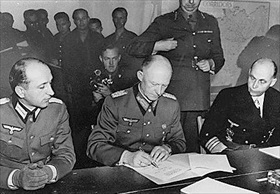
Left: Col. Gen. Alfred Jodl, Chief of the Operations Staff of the Armed Forces High Command, was the sole German signatory to the Instrument of Surrender at Gen. Dwight D. Eisenhower’s Supreme Headquarters in Reims, France, on May 7, 1945. Gen. Ivan Susloparov, the Soviet Military Liaison Mission Commander at Eisenhower’s headquarters, acted as a witness for the Soviet Union. Caught off guard—Susloparov had no instructions from Moscow—Soviet leader Joseph Stalin insisted that the German surrender should have been accepted only by a top military officer of the Soviet Supreme command, that it should have been signed only in the German capital, and that the Reims protocol should be considered preliminary.
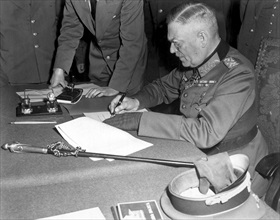
Right: On May 8, 1945, the signing ceremony was repeated at Soviet military headquarters in Karlshorst, Berlin, where the instrument of surrender was signed by Chief of the General Staff of the German Armed Forces Field Marshal Wilhelm Keitel (center in picture), Soviet Marshal Georgy Zhukov, and Air Chief Marshal Arthur Tedder, Gen. Eisenhower’s representative. May 8 is known in the West as Victory in Europe Day (VE Day), whereas in post-Soviet states VE Day is celebrated on May 9 because Keitel signed the surrender document after midnight Moscow time. In Germany, May 8 is known as the “Day of Capitulation” (“Tag der Kapitulation”). Among themselves Germans sometimes refer to the day as “Stunde Null,” a recognition of their country’s clock being set back to “zero hour.”
Contemporary Newsreel Account of German Capitulation in Berlin, May 8, 1945

World War II was the single most devastating and horrific event in the history of the world, causing the death of some 70 million people, reshaping the political map of the twentieth century and ushering in a new era of world history. Every day The Daily Chronicles brings you a new story from the annals of World War II with a vision to preserve the memory of those who suffered in the greatest military conflict the world has ever seen.