World War II was the single most devastating and horrific event in the history of the world, causing the death of some 70 million people, reshaping the political map of the twentieth century and ushering in a new era of world history. Every day The Daily Chronicles brings you a new story from the annals of World War II with a vision to preserve the memory of those who suffered in the greatest military conflict the world has ever seen.
C-47 SKYTRAIN TRANSPORT MAKES MAIDEN FLIGHT
Long Beach, California • December 23, 1941
Of all the workhorse aircraft in World War II, none was more widely and effectively deployed than the Douglas C‑47 military transport. Nicknamed the “Gooney Bird” by American crewmen and passengers, the C‑47 Skytrain was a derivative of the Douglas propeller-driven commercial airliner, the DC‑3. (The British and Australians referred to the C‑47 as the “Dakota.”) Originally designed as a passenger sleeper plane for a U.S. transcontinental airline, the DC‑3 first took flight from Santa Monica Airport near Los Angeles, California, on December 17, 1935.
The U.S. Army Air Corps (U.S. Army Air Forces, or USAAF, in June 1941) selected a modified version of the DC‑3 for its first-of-a-kind military transport aircraft. The transport had more powerful engines (2 1,200 hp Pratt & Whitney R‑1830-90C Twin Wasp air-cooled radial piston engines), strengthened rear fuselage and floor, stronger landing gear, a large 2‑panel portside cargo door, hoist attachment, a roof-mounted astrodome used for nighttime navigation, and at the fuselage’s tail a hook for towing powerless combat gliders. When contracts were awarded in 1940 for the C‑47 Skytrain, Douglas built a new production facility in nearby Long Beach.
The Skytrain made its maiden flight on this date, December 23, 1941. Between Long Beach and Santa Monica in California, and Tulsa and Midwest City in Oklahoma, Douglas Aircraft Company produced 10,174 C‑47s; some commercial DC‑3s were impressed into military service early in the war. A limited number of specialized paratrooper variants of the C‑47, the C‑53 Skytrooper (troop carrier), were built and used in later stages of the war, particularly to tow gliders and drop paratroopers. Nearly 5,000 DC‑3-derived military transport aircraft (Li‑2s) were license-built in the Soviet Union starting in September 1942.
Typically unarmed, the C‑47 had a crew of 4—pilot, co-pilot, navigator, and radio operator—or 3 if co-pilot and navigator duties were combined. As a transport plane, the C‑47 had a load capacity of 12,000 lb./5,443 kg, a range of 1,600 miles/2,600 km, a maximum speed of 224 mph/360 km/h, and a service ceiling of 26,400 ft./8,000 m. The airborne freighter could hold a fully assembled jeep or a 37 mm cannon. As a troop transport, it carried 28 soldiers in full combat gear. As a medical airlift plane, it had room for 18–24 stretcher patients and a 3‑person medical team. Seven basic versions were built, and the aircraft was given at least 22 designations, including the AC‑47D (Spooky) gunship, the EC‑47 electronic reconnaissance aircraft, the aforementioned C‑53 Skytrooper, and the 600 R4Ds in U.S. Navy and Marine Corps service.
Apart from every U.S. military branch, all major Allied services—but primarily the USAAF and Navy and the British and Canadian air forces—flew the C‑47. The aircraft operated from every continent and participated in every major battle. The C‑47 is widely celebrated for flying the treacherous 500‑mile/805‑km “Hump” from as many as 13 bases in India over Asia’s Himalayan Mountains to Kunming, China, delivering nearly 740,000 tons of cargo to America’s Chinese ally during the war; lost were more than 500 transport aircraft and 1,300 pilots and crewmembers.
In Europe the C‑47 played unforgettable roles in the Allied liberation of Europe, first in the invasion of Sicily in July 1943 (Operation Husky), dropping 4,381 Allied paratroopers onto the Italian island. Eleven months later 850 or so U.S. Skytrains and British Dakotas dropped 50,000 paratroopers and glider-borne infantrymen in the first few days of Operation Overlord, the June 1944 D‑Day invasion of Normandy, France. During the 6‑week-long German Ardennes Offensive, better known as the Battle of the Bulge (December 16, 1944, to January 25, 1945), C‑47s air-dropped critical munitions and medical supplies to the veteran 28th Infantry, 10th Armored, and 101st “Screaming Eagles” Airborne Divisions besieged in the Belgian village of Bastogne until the soldiers were relieved by Gen. George S. Patton, Jr’s U.S. Third Army 4th Armored Division on December 26, 1944.
Douglas C-47 Skytrain and Dakota Transport Aircraft During World War II
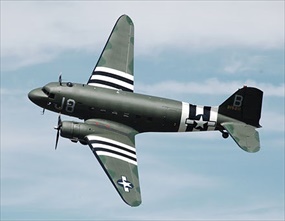 |  |
Left: The Douglas C‑47 transport aircraft played an integral role in the Allied victory in World War II. Fact is, the Douglas C‑47 was the most ubiquitous airplane of the war, performing a variety of airborne services in all theaters of the global war and transporting, among other things, hundreds of thousands of tons of petroleum products in 5‑gallon/19‑liter jerry cans, war materiel and munitions, small vehicles, ration cans, medicine, blood, personnel, clothing and shoes, and logistical aid. Little known is the role of C‑47 crews in evacuating liberated Allied POWs, enslaved civilians, and displaced persons from Nazi prisoner of war, concentration, and death camps. Between April and June 1945 more than a quarter-million repatriates were returned to their homeland or a place of refuge. Gen. Dwight D. Eisenhower, Supreme Commander of Allied Expeditionary Forces in Europe, ranked the C‑47, along with the jeep, bulldozer, 2½‑ton truck, and DUKW amphibious vehicle, as one of the 5 pieces of equipment most vital to Allied successes in defeating the fascist enemy. Pictured here is a USAAF C‑47A Skytrain, which flew from a base in Devon, England, during the D‑Day Normandy invasion. Fresh from an airshow, the plane sports “invasion stripes” on its wings and fuselage.
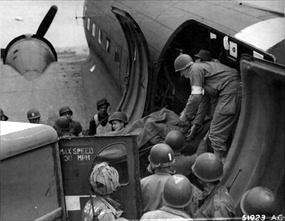
Right: The versatile C‑47 served as military cargo planes, troop transports, and tug planes for powerless, unarmed, canvas-covered U.S. Waco and British Horsa combat gliders throughout the war. A few C‑47s were converted into gliders capable of carrying 40 paratroopers at a top towing speed of 290 mph/467 km/h, which was 90 mph/145 km/h faster than any other transport glider. In this photo, a wounded soldier on a stretcher is being lifted aboard a C‑47 for medical evacuation from France to a hospital in England.
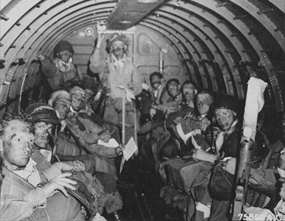 |  |
Left: Fully armed American paratroopers aboard their C‑47 before jumping into German-held Normandy in Northwestern France in June 1944. A C‑47 could carry 28 paratroopers and their gear. More than 13,000 soldiers of the elite American 82nd and 101st Airborne Divisions, as well as several thousand elite paratroopers from the British 6th Airborne Division, were dropped by over 1,200 C‑47 aircraft in the early hours of June 6, 1944, several hours before amphibious troops successfully planted themselves on the 5 Allied invasion beaches.
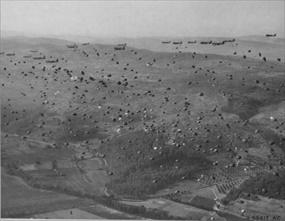
Right: Nine thousand U.S., British, and Canadian paratroopers filled the skies when they jumped from their C‑47s over Southeastern France during Operation Dragoon on August 15, 1944. They were among the 94,000 soldiers and commandos and 11,000 vehicles that landed on the French Mediterranean coast that day and the next.
Battle Stations: Douglas C-47 Troop Carrier and Airborne Freighter

 History buffs, there is good news! The Daily Chronicles of World War II is now available as an ebook for $4.99 on Amazon.com. Containing a year’s worth of dated entries from this website, the ebook brings the story of this tumultuous era to life in a compelling, authoritative, and succinct manner. Featuring inventive navigation aids, the ebook enables readers to instantly move forward or backward by month and date to different dated entries. Simple and elegant! Click