

HIROHITO’S UNCLE PRINCE ASAKA TO COMMAND CHINA TROOPS
Tokyo, Japan • December 5, 1937
On this date in 1937 Prince Yasuhiko Asaka, a lieutenant general in the Imperial Japanese Army and uncle by marriage to Japanese Emperor Hirohito (posthumously referred to as Emperor Shōwa), flew from Tokyo to his new assignment—temporary command of the Japanese Shanghai Expeditionary Force, a unit of Gen. Iwane Matsui’s Japanese Central China Area Army (CCAA). Matsui’s forces besieged 300,000 Nationalist Chinese troops in the vicinity of Nanjing (Nanking), the fortress capital of Chiang Kai-shek’s government. (The Chinese government had vacated its capital days earlier, on December 1, 1937.)
Two days after Asaka’s arrival, the CCAA mounted its final assault on Nanjing’s walls. Asaka, acting for the elderly Matsui who was ill, allegedly issued the order to “kill all captives,” thus sanctioning what became known as the Nanking Massacre, also known as the Rape of Nanking. That the order may have been issued by a known ultra-nationalist staff member of Gen. Matsui’s CCAA without the prince’s knowledge or assent does not absolve Asaka or Matsui from what transpired next because neither officer countermanded it.
Leaving the “kill all captives” order in place may have had much to do with events 4 months earlier, for on August 5, 1937, Hirohito ratified the lifting of Japanese Army constraints on the treatment of Chinese prisoners of war, whether combatant or noncombatant. Indeed, Hirohito’s directive advised staff officers to avoid even using the term “POW.” And so with the appearance on December 13 of the first Japanese troops in Nanking, a 6‑week orgy of bestiality, rape, murder by bayonet or machine gun, theft, arson, and other war crimes commenced.
The postwar International Military Tribunal for the Far East in Tokyo estimated that 20,000 to 80,000 men and women (per a Nationalist Chinese tribunal, more than 300,000), ranging from the elderly to infants (whose bellies were often slit open), were raped, many by gangs of sadistic soldiers going from door-to-door. As temporary commander of Japanese troops in Nanjing in early December 1937, Prince Asaka was implicated in the horrific events through February 1938, when he was recalled to Japan. However, because he was a member of the Imperial family—even representing the family on the Japanese Supreme War Council until the end of the war in August 1945—Prince Asaka, like his uncle the Emperor, escaped indictment and trial as a war criminal.
Two of Emperor Hirohito’s Accomplices in the Nanking Massacre, 1937
 |
 |
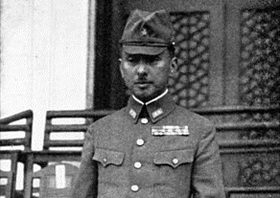
Left: A member of the Japanese Supreme War Council from 1937 to the end of the war in August 1945, Prince Yasuhiko Asaka (1887–1981) wears the uniform of a general in 1940. Asaka was temporary commander of Japanese forces in the final assault on the Chinese capital of Nanking (now Nanjing). His culpability in the issuing the “kill all captives” order and in the subsequent events in Nanjing is fodder for debate. Not open for debate is that the sanction for the Nanking Massacre (sources place the number of dead between 50,000 and 300,000 or more) and the crimes committed during the Second Sino-Japanese war (1937–1945) must ultimately be found in the August 5, 1937, ratification by Emperor Hirohito of the Japanese Army’s proposition to remove the constraints of international law on the treatment of prisoners (combatants and noncombatants) swept up in the Chinese conflict.
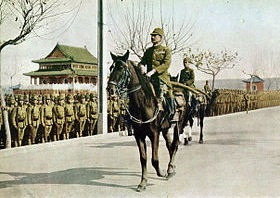
Right: Aging Gen. Iwane Matsui (1878–1948) and 50‑year-old Lt. Gen. Prince Yasuhiko Asaka (in background) on parade, Nanjing, December 17, 1937. Like Asaka, Gen. Matsui held a seat (since 1934) on Japan’s Supreme War Council. Pulled from retirement after a relatively undistinguished military career, Matsui was given command of the expeditionary forces in China from August 1937 to February 1938. Considered a “China expert” owing to his lifelong interest in Chinese civilization and postings to China as far back as the Russo-Japanese War (1904–1905), Matsui remarked to Japanese War Minister Gen. Hajime Sugiyama before leaving for his post in August 1937 that the China problem could only be solved by breaking the power of Nationalist leader Chiang Kai-shek and capturing his capital, Nanjing. On December 23, 1948, the 70‑year-old Matsui was hanged in Tokyo’s Sugamo Prison, having been convicted of war crimes and sentenced to death by the International Military Tribunal for the Far East for responsibility over the Nanking Massacre. (By agreement of the U.S. occupation authorities, Asaka was spared indictment and conviction as a war criminal and thus the hangman’s noose owing to his relationship to the untouchable imperial family.) Matsui was preceded in death by Hajime Sugiyama, who committed suicide by shooting himself 4 times with his service revolver on September 12, 1945, 4 weeks after he and other senior Japanese military officers had affixed their signatures to an agreement to carry out Emperor Hirohito’s order of surrender to the Allies.
Survivor Recounts Nanjing Massacre (Rape of Nanking) Using Contemporary Japanese Footage

World War II was the single most devastating and horrific event in the history of the world, causing the death of some 70 million people, reshaping the political map of the twentieth century and ushering in a new era of world history. Every day The Daily Chronicles brings you a new story from the annals of World War II with a vision to preserve the memory of those who suffered in the greatest military conflict the world has ever seen.