

THIRD B-29 RAID ON TOKYO
Tinian, Mariana Islands · December 3, 1944
On this date in 1944 eighty-six 4-engine B‑29 Superfortresses belonging to XXI Bomber Command, a unit of the U.S. Twentieth Air Force, left the northwestern Pacific Mariana Islands base on Tinian on their third Tokyo bombing mission. Ten days earlier 111 of these heavy bombers had launched the first raid on Japan’s capital since Lt. Col. Jimmy Doolittle’s 16 B‑25 medium bombers inflicted minor damage 31 months earlier. Results of the November 24 raid were discouraging for both sides: only 48 of the 240 bombs dropped on the Nakajima Aircraft Company’s engine plant at Musashino in Tokyo’s arsenal district struck their target, and Japanese suicidal ramming aircraft, lacking guns and armor plate, failed to make a dent on the first B‑29 strike on their capital.
The December 3 target, today’s target, was again Tokyo’s Musashino aircraft factory. Though 85 percent of the Superfortresses attempted to hit their primary target, just 2.5 percent did. A late-December raid on the same complex produced worse results: only 6 bombs landed within 1,000 ft/305 m of the target. Not until January 19, 1945, when 38‑year-old Maj. Gen. Curtis LeMay, a veteran of both the German and China-Burma-India theaters, assumed operational command did the bombing program begin producing dramatic results—this the result of changing tactics from high-level (20,000‑plus ft/6,096‑plus m), high-explosive daytime bombing runs over industrial targets to low-level (5,000–6,000 ft/1,524–1,829 m) nighttime incendiary runs over urban-industrial areas. In just two of these nighttime raids on Tokyo, on February 24/25 and March 9/10, 1945, hundreds of B‑29s laid waste to more 300,000 buildings and homes over a 17‑sq.‑mile/44‑sq.‑kilometer area.
It was not all smooth flying, even when the first P‑51 Mustangs from the newly acquired airfields on Iwo Jima began escorting B‑29s (April 7, 1945). As part of the first of two days of saturation bombing on Japanese cities in mid-May, 472 B‑29s dropped 16,000 tons of napalm and oil bombs on Nagoya, the center of Japan’s aircraft industry; 77 failed to return, or one out of six Superfortresses.
On August 1, 1945, in the biggest air raid yet over Japan, 820 Superfortresses dropped 6,632 tons of high-explosive and incendiary bombs on four cities, bringing the total number of Japanese cities incinerated to 56. The last B‑29 raid on Japan—this on Tokyo now more than 50 percent rubble and ruin—took place on August 10, 1945, one day after a single bomb from a single B‑29 had incinerated Nagasaki.
Bombing of Tokyo, 1944–1945
 |
 |
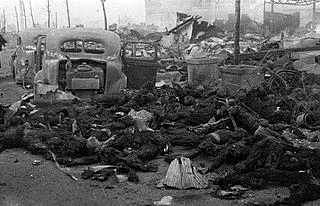
Left: Charred remains of Japanese civilians after the March 9–10, 1945, firebombing of Tokyo (Operation Meetinghouse). Around 1,700 tons of bombs were dropped by 279 B 29s and roughly 16 sq. miles of the city were destroyed. The U.S. Strategic Bombing Survey estimated that nearly 88,000 people died in this one air raid and resulting Dante-esque firestorm, 41,000 were injured, and over a million residents lost their homes. Another estimate is that the Japanese capital suffered more immediate deaths than either Hiroshima (70,000–80,000) or Nagasaki (40,000–75,000), which were targets of atomic bombings on August 6 and 9, 1945, respectively.
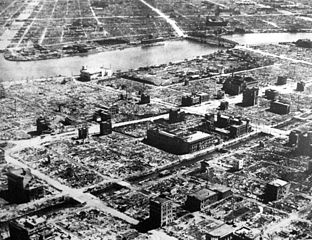
Right: A virtually destroyed Tokyo residential section. Because over 50 percent of Tokyo’s industry was spread out among residential and commercial neighborhoods, the Tokyo firebombings cut the city’s industrial output in half.
 |
 |
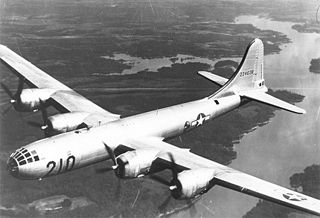
Left: Boeing built 3,970 of these propeller-driven B 29 behemoths between 1943 and 1946. The sleek fuselage, large bomb capacity, impressive performance, four turbo-supercharged engines, and long-range capability of the “Superforts” epitomized American air power in World War II. Two specially configured B 29s, one named Enola Gay and the other Bockscar, carried out the atomic bombings that destroyed Hiroshima and Nagasaki, respectively.
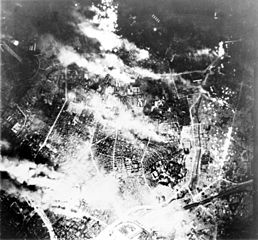
Right: Tokyo burns under a B-29 firebomb assault, May 26, 1945. B 29 raids on Tokyo began on November 24, 1944, 10 1/2 weeks after the first B 29 arrived on Saipan Island in the Marianas, and they lasted until August 10, 1945, five days before Japan capitulated. Twin-engine bombers and fighter-bombers carried out additional attacks on Tokyo. An August 15 raid that targeted airfields in the Tokyo area was conducted by aircraft from Vice Adm. John McCain’s fast carrier squadron, which had not heard the announcement of the cessation of hostilities.
B-29 Strategic Bombing of Japanese Cities, 1944–1945

World War II was the single most devastating and horrific event in the history of the world, causing the death of some 70 million people, reshaping the political map of the twentieth century and ushering in a new era of world history. Every day The Daily Chronicles brings you a new story from the annals of World War II with a vision to preserve the memory of those who suffered in the greatest military conflict the world has ever seen.