

ROOSEVELT’S “VICTORY PLAN” LEAKED
Chicago, Illinois · December 4, 1941
Early in July 1941, four months after the U.S. Congress had enacted the Lend-Lease Program that began assisting Great Britain and China in their defense against the aggressor states of Nazi Germany, Fascist Italy, and Imperial Japan, President Franklin D. Roosevelt asked his Secretaries of War and the Navy to prepare a comprehensive war program. The program was to address specific assumptions regarding materiel needs and potential U.S. adversaries and allies. The collapse of the Soviet Union, which Germany had assaulted the previous June with 3.9 million men, 3,350 tanks, and 4,389 aircraft in Operation Barbarossa, was one of the assumptions that was reflected in the “Victory Plan” submitted to the president on September 1.
On this date in 1941 the Chicago Tribune, no friend of the president, used a source from the War Plans Division to publish details of America’s “Victory Plan”—including the assertion that the U.S. would not be able to field forces in strength against Germany until mid-1943. The article went into highly specific details on how the Victory Plan was to be implemented. Secretary of War Henry Stimson called the source of the leak “wanting in loyalty and patriotism.” The German embassy in Washington was only too happy to cable summaries of the article to Berlin, where Nazi military planners reexamined their own policies in light of the “incontrovertible intelligence” the article provided. All the more reason, Germany’s leader Adolf Hitler believed, to quickly finish off the Soviet Union (at war with Germany since June 22, 1941) and Great Britain (at war with Germany since September 3, 1939) before America could enter the European conflict.
Alas, Japan sprang a nasty surprise on both Germany and the United States when it attacked the U.S. Pacific Fleet at anchor at Pearl Harbor, Hawaii, on December 7, 1941, just 3 days after McCormick & Co. had dropped their own bombshell. Hitler professed to his Foreign Minister, Joachim von Ribbentrop, that he had no alternative but to support his Tripartite treaty partner in the Far East. (In December 1941, the major players in the 9‑member Tripartite, or Axis, Pact were Germany, Italy, and Japan.) And so on December 11, 1941, Germany, followed by servile Italy, declared war on the United States. Upon the citizens of all 3 Axis countries and beyond, the global war would heap misery, poverty, death, and devastation on an unprecedented scale.
America’s Victory Plan Meant Becoming the “Arsenal of Democracy”
 |
 |
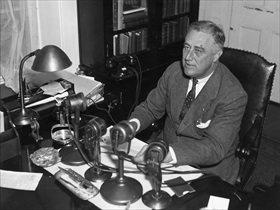
Left: In a radio broadcast (a so-called “fireside chat”) delivered on December 29, 1940, Roosevelt promised to help the government of hard-pressed Great Britain fight Nazi Germany by giving it military supplies while permitting the U.S. to avoid actual combat with Britain’s enemy. Europe does “not ask us to do their fighting,” the president assured his listeners. “They ask us for the implements of war, the planes, the tanks, the guns, the freighters which will enable them to fight for their liberty and for our security.” As “the great arsenal of democracy,” the memorable phrase FDR used in his address, “we must get these weapons to them, get them to them in sufficient volume and quickly enough, so that we and our children will be saved the agony and suffering of war which others have had to endure.” Roosevelt pursued this topic in his annual State of the Union address to the U.S. Congress on January 6, 1941, initiating a debate on what was to become the U.S. Lend-Lease Program.
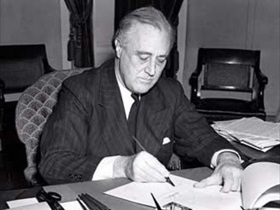
Right: The Lend-Lease Program became law on March 11, 1941, with the president’s signature. The program effectively ended the U.S. pretense of neutrality vis-à-vis Germany, Italy, and Japan. Lend-Lease provided for the procurement, manufacture, and transfer (by loan, lease, or sale) of defense items (for example, aircraft, tanks, ships, trucks, munitions, and fuel) as well as food and services to countries whose defense was deemed crucial to the U.S. The Office of Lend-Lease Administration disbursed a total of $50.1 billion (equivalent to $901.85 billion in today’s dollars) in assistance. The money represented 17 percent of the total war expenditures of the U.S. In all, $31.4 billion went to Britain, $11.3 billion to the Soviet Union, $3.2 billion to France, $1.6 billion to China, and smaller sums to other Allies. The terms of the agreement provided that any equipment was to be used until time for its return or destruction. In practice very little was returned. Canada operated a similar program called Mutual Aid that provided $1 billion in loans and $3.4 billion in supplies and services to Britain and other Allies.
U.S. War Department Film from 1942: “War Comes to America”

World War II was the single most devastating and horrific event in the history of the world, causing the death of some 70 million people, reshaping the political map of the twentieth century and ushering in a new era of world history. Every day The Daily Chronicles brings you a new story from the annals of World War II with a vision to preserve the memory of those who suffered in the greatest military conflict the world has ever seen.