World War II was the single most devastating and horrific event in the history of the world, causing the death of some 70 million people, reshaping the political map of the twentieth century and ushering in a new era of world history. Every day The Daily Chronicles brings you a new story from the annals of World War II with a vision to preserve the memory of those who suffered in the greatest military conflict the world has ever seen.
JAPAN LAUNCHES TWO-WEEK ASSAULT ON RABAUL
Rabaul, Island of New Britain • January 4, 1942
The Battle of Rabaul was fought from January 23 to late February 1942 on the island of New Britain, part of Australia’s League of Nations-mandated Territory of New Guinea (1921 to 1941) lying roughly 660 miles/1,062 km northnorthwest of Australia. More forward observation post than anything else, the 1,400‑strong garrison had recently completed work on fortifying and defending Simpson Harbor, Rabaul’s deep-water port, and 2 nearby airfields. A 130‑man commando unit took up residence on nearby New Ireland (see map below). The Australians soon settled into routine garrison duties. Japanese military expansionists, however, had their own plans for Rabaul, seeing it as a main staging base and strategic springboard for, say, the planned conquest of Port Moresby, territorial capital of Australia’s Papua mandate in southeast New Guinea; for the subsequent occupation of New Caledonia, New Hebrides (Vanuatu), Fiji, Samoa, and other Southwest Pacific islands; and for attacks along the north coast of Australia—at Darwin Harbor in the Northern Territory, for example.
Starting on this date, January 4, 1942, Rabaul came under strong aerial attack by Japanese land-based twin-engine bombers and 4‑engine flying boats based at Truk (Chuuk), site of a major Imperial Japanese Navy base in the Caroline Islands 700 miles/1,127 km or so to the north of New Britain. Ten days later a Japanese invasion force assembled at Truk began steaming toward Rabaul. The force was part of a naval task force that consisted of 4 aircraft carriers—the Akagi, Kaga, Shokaku, and Zuikaku—that had participated in the devastating December 7, 1941, attack on the U.S. Pacific Fleet at Pearl Harbor, Hawaii. Also in the naval task force were 7 cruisers, 14 destroyers, several submarines, and numerous smaller vessels.
On January 20, 1942, more than 109 Japanese warplanes attacked Rabaul’s wharves, shipping vessels, airfields, and gun emplacements in multiple waves. Antiaircraft fire downed 1 enemy bomber and damaged many others, causing 2 to crash. As a result of these intense air attacks, Australian coastal artillery was destroyed and the Australian infantry withdrew from the capital. Two days later between 3,000 and 4,000 enemy troops invaded New Ireland, and the day after that, before sunrise on January 23, an additional 5,000 Japanese soldiers and 600 marines made an amphibious landing in Rabaul’s Simpson Harbor and captured the settlement in a matter of hours. By late February much of New Britain and New Ireland was firmly in the invaders’ hands, including 1,000 Australian soldiers and 200 civilians. Of these prisoners of war, about 160 were bayoneted or shot during the first week of February 1942. Most of the remainder lost their lives on July 1 when a Japanese prison transport vessel, the Montevideo Maru, steaming from Rabaul to the South Chinese island of Hainan, was torpedoed by the USS Sturgeon.
Rabaul soon became the biggest Japanese base in New Guinea, critical to their defenses in the region. Beginning in March 1942 and continuing into 1943 the Japanese conducted operations on the New Guinea mainland—at Lae and Salamaua, along the Kokoda Track leading to Port Moresby, and around Buna-Gona. By mid‑1943, however, U.S. and Australian forces had turned back the tide of Japanese victories. Rabaul itself was on the ropes after U.S. carrier-borne aircraft had twice inflicted heavy losses on airstrips and anchored warships in Simpson Harbor in November 1943. Allied amphibious landings the next month at Cape Gloucester (also known as Tuluvu) on the western tip of New Britain, part of Operation Cartwheel, gradually confined enemy forces to the Rabaul area. Gen. Douglas MacArthur’s Pacific island-hopping strategy “neutralized” the huge Japanese garrison and bases at Rabaul and other enemy strongpoints as the Allies’ 1945 air and sea mining operations against the Japanese Home Islands forced the enemy to agree to unconditional surrender, which their leadership did in Tokyo Bay on September 2, 1945.
Rabaul and New Britain in Japan’s Grand Southern Offensive
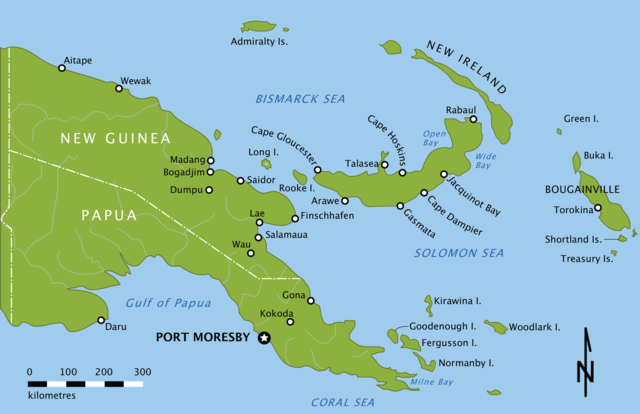 |
Above: Map depicting what is now Papua New Guinea and the large island of New Britain to the east, with Rabaul identified on New Britain’s northeastern tip. The size of Taiwan, New Britain and the islands to its west, north, and east form the Bismarck Archipelago in the Southwest Pacific. Rabaul and other settlements on the islands suffered heavy damage when Allied troops recaptured the area from the Japanese over a 6‑week period in 1944. The Bismarck Archipelago was subsequently made part of the U.N. Trust Territory of New Guinea, administered again by Australia. When Papua New Guinea attained independence in 1975, the archipelago group became part of that country with its capital at Port Moresby halfway down the tip of the Papuan Peninsula.
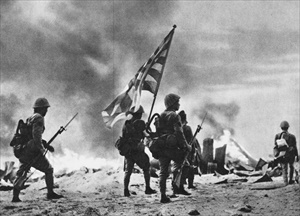 |  |
Left: By the summer of 1941 the Japanese military high command had identified Rabaul as a specific objective of what they called their Southern Offensive. The reason for selecting Rabaul for conquest hinged on Rabaul’s spectacular Simpson Harbor, a flooded caldera that can shelter an entire fleet of warships. Additionally, Rabaul was the perfect location for controlling a large part of the Southwest Pacific, known by the Japanese as the Southeast Pacific. New Britain and neighboring New Ireland, together with Eastern New Guinea, Guam, Bougainville, Guadalcanal in the Solomons, Fiji, and other South Pacific islands, plus strongpoints on the Australian continent, would give the Japanese an outer defense barrier against an Allied counteroffensive. With this eminently favorable strategic situation and control of the region’s raw materials which they required, the Japanese felt they would be well positioned to prosecute the Pacific War to a successful conclusion and to realize their supersize ambition to dominate the Far East.

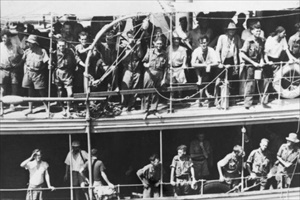
Right: One hundred and fifty New Britain evacuees, mainly Rabaul garrison personnel and a few civilians such as government officials, planters, and businessmen, crowd the rails of HMAS Laurabada at Port Moresby, capital and largest settlement of the Australian mandate of Papua on the eastern half of New Guinea (see map above). Fewer than 400 of the besieged Australians made good their escape in 2 breakouts after evading the Japanese enemy for months and suffering from malaria, dengue fever, and starvation.
Victory at Sea’s “Rings Around Rabaul,” 1944. Japanese and American Footage from 1943–1944 Recounts Allied Encirclement
 History buffs, there is good news! The Daily Chronicles of World War II is now available as an ebook for $4.99 on Amazon.com. Containing a year’s worth of dated entries from this website, the ebook brings the story of this tumultuous era to life in a compelling, authoritative, and succinct manner. Featuring inventive navigation aids, the ebook enables readers to instantly move forward or backward by month and date to different dated entries. Simple and elegant! Click