World War II was the single most devastating and horrific event in the history of the world, causing the death of some 70 million people, reshaping the political map of the twentieth century and ushering in a new era of world history. Every day The Daily Chronicles brings you a new story from the annals of World War II with a vision to preserve the memory of those who suffered in the greatest military conflict the world has ever seen.
RUDOLF HOESS HEADS UP AUSCHWITZ CONCENTRATION CAMP
Auschwitz (Oświęcim), German-Occupied Poland • November 1, 1940
On this date in 1940 SS Hauptsturmfuehrer (Captain) Rudolf Hoess (also Höß or Hoeß; pronounced “hearse”) (1901–1947) reported for duty as commandant of Auschwitz concentration camp in the newly annexed province of Upper Silesia in former Poland. During Hoess’s tenure at Auschwitz, the 20,000‑acre/8,094‑hectare complex of 3 separate camps and 40 subcamps became the most potent symbol of dehumanization, genocide, and especially of the Jewish Holocaust (Hebrew, Shoah)—otherwise known to German Nazis as the “Final Solution” to the Jewish question (Endloesung der Judenfrage). The Final Solution was the cover name for the annihilation (Sonderbehandlung, special handling) of all Jews and mixed-race Jews within the Nazis’ reach and the reach of Nazi Germany’s collaborationist countries and dependent territories. During the Holocaust 90 percent of the Jews in occupied Poland and two-thirds of the Jews in Europe were systematically murdered. Auschwitz, the largest Nazi extermination camp (Vernichtungslager) in Europe, accounted for more than a million of the 6 million Jews who perished during World War II.
The supreme overseer of this unprecedented industrialized program of mass murder was Reichsfuehrer-SS Heinrich Himmler (1900–1945), after Adolf Hitler the most powerful man in Nazi Germany. Hoess became an important spear-chucker for Himmler and his criminal henchmen. Auschwitz was not yet an extermination camp when Hoess assumed command of the camp. In its earliest phase Auschwitz was a poorly resourced detention and quarantine camp for Polish prisoners and, after June 22, 1941, Soviet POWs. Hoess, whose former staff position with Himmler’s SS (the paramilitary arm of Hitler’s Nazi Party) was in the Inspectorate of Concentration Camps, was determined to turn Auschwitz into a more efficient and deadly camp than the likes of Dachau and Sachsenhausen, where he had previous served.
Hoess’s decision proceeded the January 1942 rollout of the Final Solution, and Himmler’s acolyte Hoess was ready and eager to slaughter Jews in addition to other Auschwitz “undesirables” such as Soviet POWs, Poles, Gypsies (Roma), homosexuals, Jehovah’s Witnesses, “asocials,” and political prisoners. Construction began in October 1941 on Auschwitz II, better known as Birkenau (Polish, Brzezinka), next to Auschwitz I (Polish, Oświęcim), the main camp (Stammlager). The goal of the new camp was to accommodate 200,000 prisoners in wooden huts intended to house 500 inmates but which instead housed 800 to 1000 people who were forced to sleep 10 to 12 on wooden planks in 3‑story bunk beds. The accommodations were insufferable, unsanitary, and deadly for many.
Shortly after construction had begun at Birkenau, the decision was made to turn the new camp into a death factory. In the fall of 1941 Hoess and camp authorities conducted experiments killing inmates by gassing them using a pellet-type pesticide called Zyklon‑B, which turned to lethal cyanide gas when exposed to air. The experiments were carried out in makeshift “bunkers” in a remote corner of Birkenau. Delighted with their success, the SS built 4 permanent killing and cremation installations for the specific purpose of gassing people and burning their remains in ovens. The Birkenau installations started operating at the end of March 1943. The pace of extermination reached a peak in the spring and summer of 1944 with the deportation of some 430,000 Hungarian Jews to Auschwitz and the subsequent murder of the majority of the deportees (see photo essays below).
Hoess was a tireless and pitiless genius in scaling up mass murder in German extermination camps. In the serendipitous discovery of the lethal effects of the pesticide Zyklon‑B on humans, Hoess emerged as the biggest cheerleader of using the poison compound to murder approximately 1.1 million inmates in Nazi death camps. As such Hoess embodied the unspeakable and unparalleled wickedness at which Nazis excelled.
Auschwitz, 1940–1945: Primary Killing Site of Jews in Europe
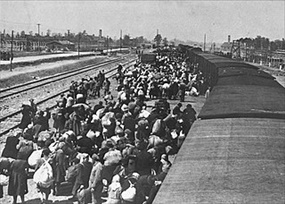 |  |
Left: Jews from Carpathian Ruthenia on the ramp at Birkenau in close proximity to the scene of their murder, May or June 1944. (Former Carpathian Ruthenia straddled southeastern Czechoslovakia and parts of Ukraine and Poland.) Difficult as they are to identify in this photo, the 2 chimneys on the horizon belong to Birkenau crematoria II and III to the left and right of the 3‑track spur line, respectively. The crematoria structures housed multiple subterranean undressing rooms and enormous custom-built poison-gas chambers designed to look like shower rooms, which could hold hundreds of people and be used several times a day. Electric lifts carried the bodies to the upstairs crematoria. The vital statistics of Jewish victims arriving directly at Birkenau, as pictured here, were hardly ever registered in camp record books. Most Birkenau arrivals were asphyxiated using the virulent pesticide Zyklon‑B, their corpses incinerated, just hours after exiting the sealed transport trains. Other victims were killed by a lethal injection of phenol to the heart at all 3 camp hospitals. A sizeable number were shot or hanged at the camps.

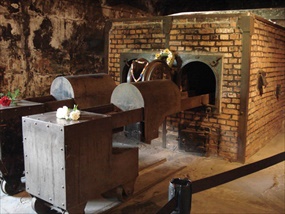
Right: Small memorial wreathes decorate incinerators in Auschwitz-Birkenau, the epicenter of the Final Solution. Depending on the crematoria, furnaces burned from March 31, 1943, to January 26, 1945, the latter date 1 day before Red Army soldiers liberated the camp complex. Birkenau crematoria II and III could incinerate between 4,000 (per Hoess) and 5,000 corpses, respectively, in a single workday that, by Hoess’s account, was often 24 hours long. Crematoria IV and V, also in Birkenau but of a different construction, could incinerate upward of 2,500 and 1,500 victims, respectively, per day. A small crematorium at Auschwitz I’s large mortuary saw service from August 1940 to July 1943. As seen in this photo, the gray metal “drawers” on rollers, known as retorts, typically held 2 corpses each, though that number was often exceeded by crematoria stokers, Sonderkommando (special squad) prisoners who loaded the retorts. The design capacity of the retorts was the same at all 5 crematoria. A retort load of 3 corpses took 15 to 30 minutes from incineration start to finish. The victims’ thicker bones were then removed from the retorts, and Sonderkommandos later used pestles to reduce them to powder. A significant number of cremations at Birkenau took place on open-air wooden pyres and in gigantic fire pits attached to crematoria V, especially at crunch times; e.g., in 1944 when Jews deported from Hungary and Łódź in Poland were being exterminated around the clock. Wooden pyres and fire pits were used successfully in other killing centers in German-occupied Poland at Treblinka, Bełżec, Sobibór, and Chełmno (Kulmhof), where the corpses of some 2 million people were burned without the use of crematoria.
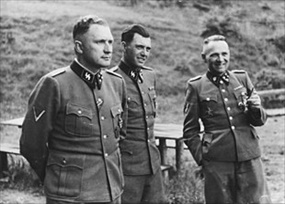 | 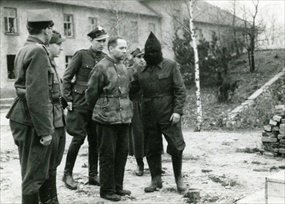 |
Left: Ex-Auschwitz I commandant Rudolf Hoess (right); camp physician Dr. Josef Mengele, nicknamed “Angel of Death” for his grizzly experiments on prisoners at Auschwitz II-Birkenau (middle); and Richard Baer (left), fourth and last commandant of Auschwitz I, whose tenure was from May 1944 to the liberation of Auschwitz in January 1945. The photo may have been taken between May 8 and July 29, 1944, when Hoess was appointed the local Schutzstaffel (SS) garrison commander (Standortaeltester) to oversee the arrival of Hungary’s Jews (Aktion Hoess). The 3 SS officers were at Solahuette, the SS retreat for SS Totenkopf (death’s head) camp guards, administrators, and auxiliary personnel at Auschwitz I, the main camp; at Auschwitz II, the extermination camp at Birkenau; and at Auschwitz III-Monowitz (Polish, Monowice), the slave labor camp servicing German war-related industries that flocked to Monowitz for its cheap labor. Solahuette lay 18 miles/29 kilometers) from Auschwitz.
Right: At 10 a.m. on April 16, 1947, the 47-year-old former commandant of Auschwitz concentration camp and recipient of Nazi Germany’s War Merit Cross (First and Second Class) Rudolf Hoess walked under armed escort to a small wooden gallows. The gallows had been specifically erected for Hoess inside the Auschwitz I compound next to a crematorium where the bodies of tens of thousands of murdered Jews had been reduced to ashes and bone dust. In reality, Hoess had expected to be hanged the year before when he was captured on March 2, 1946, and nearly beaten to death by Jewish soldiers in the arresting party. A year later he stood before the Supreme National Tribunal, a war-crime tribunal in Poland’s capital Warsaw. In a trial that lasted from March 11 to March 29, 1947, the judges and jury convicted Hoess of crimes against humanity and sentenced him to death by hanging.
Architecture of Murder: The Auschwitz-Birkenau Blueprints

 History buffs, there is good news! The Daily Chronicles of World War II is now available as an ebook for $4.99 on Amazon.com. Containing a year’s worth of dated entries from this website, the ebook brings the story of this tumultuous era to life in a compelling, authoritative, and succinct manner. Featuring inventive navigation aids, the ebook enables readers to instantly move forward or backward by month and date to different dated entries. Simple and elegant! Click