World War II was the single most devastating and horrific event in the history of the world, causing the death of some 70 million people, reshaping the political map of the twentieth century and ushering in a new era of world history. Every day The Daily Chronicles brings you a new story from the annals of World War II with a vision to preserve the memory of those who suffered in the greatest military conflict the world has ever seen.
NAZIS BACK VLASOV’S RUSSIAN LIBERATION ARMY AND COMMITTEE
Prague, Occupied Czechoslovakia • November 14, 1944
On this date in German-occupied Czechoslovakia Lt. Gen. Andrei (Andrey) Andreievich Vlasov read aloud the Prague Manifesto to members of the newly created Committee for the Liberation of the Peoples of Russia. Among its 14 principles, the Prague Manifesto guaranteed freedom of speech, press, religion, and assembly, as well as a right to self-determination of any ethnic group living in territories belonging to the Soviet Union. Known by its 4‑letter Russian abbreviation KOHP (English, KONR), the committee was chaired by Vlasov (1901–1946), a former Soviet general who commanded the Russian Liberation Army, itself abbreviated as ROA (POA in Russian). KONR tended to be viewed as the political arm of Vlasov’s ROA. KONR was populated by military and civilian Nazi collaborators who had joined with German invaders to free their homeland from Soviet tyranny.
Sixty days after Adolf Hitler launched Operation Barbarossa, Germany’s June 22, 1941, invasion of the Soviet Union, the first major defection of Soviet soldiers, a Cossack regiment, to the German side occurred. More important was the defection of the very able, recently captured (July 1942) Soviet general Andrei Vlasov. With help from the Wehrmacht (German military) officer corps, Vlasov organized the Committee for the Liberation of the Peoples of Russia and the Russian Liberation Army with support from Reichsfuehrer-SS Heinrich Himmler. ROA soldiers, sometimes referred to as Vlasovtsy, were deserters from the Red Army, Soviet soldiers sprung from German POW camps, Russian volunteers, and anti-Communist civilians. By the start of 1943, 427,000 turncoat Soviets were embedded in German fighting units on the Eastern Front. Late in the war Vlasovtsy numbered a million men. One German commander said that 50 percent of his troops were of Russian or Eastern European origin. An estimated one-quarter of Gen. Friedrich Paulus’ German Sixth Army at the Battle of Stalingrad (August 23, 1942, to February 2, 1943) was Soviet born.
By late January 1945—4‑months before the end of the World War II in Europe—Gen. Vlasov had cobbled together 3 divisions in his Russian Liberation Army. That same month the divisions were detached from the Wehrmacht and placed under the command of the Committee for the Liberation of the Peoples of Russia, or KONR. Only 1 division reached operational readiness by mid-February 1945 and did not see combat against the Red Army until April 11–14 as Germany’s once mighty military collapsed under withering blows on every front.
Vlasov’s Russian Liberation Army, by a quirk of fate, took to the field against German Waffen-SS units in the Prague uprising of May 5–8, 1945. Armed with heavy weapons, ROA’s first division, the 20,000-man 600th Panzergrenadier Division, assisted Czech insurgents in saving most of their beautiful city from wanton destruction. Vlasov hoped unrealistically that advancing U.S. forces would take the Czech capital and allow the ROA to capitulate on “favorable” terms before the Red Army arrived, which happened on May 9. Some 17,000 Vlasovtsy, including Vlosov, ended up as Soviet POWs. They were forcibly repatriated to the Soviet Union, where they were executed as traitors or worked to death in prison camps. Vlasov’s execution in the Soviet capital Moscow on August 2, 1946, was 1 of 2 million deaths inflicted by Soviet Premier Joseph Stalin and his henchmen in their effort to revenge themselves on every soul who was absent from the Motherland during the Great Patriotic War (1941–1945). The forced repatriation of Soviet exiles in Europe between 1944 and 1947 has been referred to as the “two-million-person holocaust.”
Gen. Andrei Andreievich Vlasov and the Russian Liberation Army (ROA)
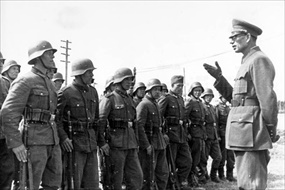 |  |
Left: Gen. Vlasov addresses soldiers of his anti-Communist Russian Liberation Army at the end of their field exercises, probably August 1944. Never before in the annals of warfare had so many soldiers defected to fight for the enemy. Known to the Germans as the Russische Befreiungsarmee and to the Soviets as the Russkaya osvoboditel’naya armiya (Latin script, ROA; Cyrillic script, POA), the Russian Liberation Army was at the time still part of the German Army. Not till the last few weeks of the war did the Russian Liberation Army take the field as a single unit. This photo may have been taken at Dabendorf barracks (Lager Dabendorf) south of Berlin in the German state of Brandenburg.

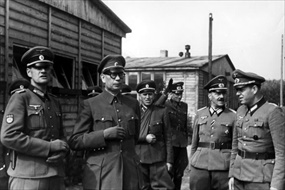
Right: Gen. Vlasov (second person on left) at Dabendorf barracks, probably August 1944. The officer wearing the POA (Russian Liberation Army) patch on his upper right sleeve is identified by the photographer as Gen. Trochin. The men to either side of Vlasov are in German uniforms except for their POA insignia. The 2 men on the right side of the photo appear to be servicemembers in the German Army.
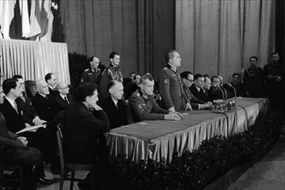 |  |
Left: This photo, taken in Berlin in November 1944, shows the presidium of the Committee for the Liberation of the Peoples of Russia (KONR). Committee chairman Gen. Vlasov is seated to the left of the speaker. The mission of the committee, founded in Prague on November 14, 1944, along with that of its military arm, the Russian Liberation Army, was to topple the Soviet Communist regime of Joseph Stalin. Alas, time was running out for the Third Reich and its friends. After the surrender of Nazi Germany to the Allies in May 1945, KONR ceased to operate. In the immediate postwar period, several new organizations sprang up, started by KONR veterans and Vlasov’s ROA who had managed to escape forced repatriation to the Soviet Union. The intention of the new organizations was to continue KONR’s goal of fighting communism. In the United States in the late 1940s/early 1950s the new Central Intelligence Agency funded 2 Munich-based broadcasters, Radio Free Europe and Radio Liberty. RFE targeted listeners in Soviet satellites in Eastern Europe and RL targeted listeners in the Soviet Union. In 1995 RFE/RL moved its headquarters from Germany to Prague in the Czech Republic (Czechia).
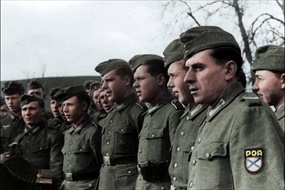
Right: Captions on this photo read ROA soldiers in Belgium or France, October–November 1943. In a strange turn of events, by early 1944 the majority of ROA soldiers in the East were serving on the Western Front, where in mid-1944 they would encounter Allied soldiers engaged in liberating Western Europe from Nazi tyranny. Variously referred to as Osttruppen or Osteinheiten (Eastern units), Hiwis (short for Hilfswilliger, volunteers), or landeseigene Verbaende (provincial formations), East European “volunteers” in German companies and battalions acquired a reputation on diverse German fronts for being unreliable (unzuverlaessig), poorly motivated, and prone to mutiny, desertion, and seizing any opportunity to surrender to the enemy. Seventy-one “Eastern” battalions served on the Eastern Front, and 42 battalions (Cossack, North Caucasian, Georgian, Armenian, Turkoman, Volga-Tatar, Volga-Finn, Azerbaijanian, and other Eastern Europe battalions) served in Finland, Belgium, France, and Italy.
Walter Cronkite CBS Documentary on the Russian Liberation Army

 History buffs, there is good news! The Daily Chronicles of World War II is now available as an ebook for $4.99 on Amazon.com. Containing a year’s worth of dated entries from this website, the ebook brings the story of this tumultuous era to life in a compelling, authoritative, and succinct manner. Featuring inventive navigation aids, the ebook enables readers to instantly move forward or backward by month and date to different dated entries. Simple and elegant! Click