World War II was the single most devastating and horrific event in the history of the world, causing the death of some 70 million people, reshaping the political map of the twentieth century and ushering in a new era of world history. Every day The Daily Chronicles brings you a new story from the annals of World War II with a vision to preserve the memory of those who suffered in the greatest military conflict the world has ever seen.
JAPAN’S KAITEN—HUMAN-PILOTED TORPEDOES—CLAIM FIRST U.S. VICTIM
Ulithi Atoll, Caroline Islands, Western Pacific • November 20, 1944
On this date in November 1944, an hour before daybreak, 3 Japanese Kaitens—human-piloted torpedoes—wakelessly and silently motored eastward through an opening in the coral reef that surrounded the 212‑sq. mile/596‑sq. km Ulithi lagoon in the Caroline Islands. Up until early 1945 Ulithi Atoll was the U.S. Navy’s largest forward supply, replenishment, and repair base in World War II. The naval base had been captured from the enemy the previous September and now serviced U.S. Merchant Navy (civilian) ships and every type of U.S. warship, from small destroyer escorts to the nation’s mightiest aircraft carriers. In Japan’s first successful attack by a Kaiten pilot, 1 single‑man suicide submarine sought out the U.S. fleet oiler Mississinewa among the hundreds of anchored ships in the lagoon and sank it.
Toward the end of 1943, the Japanese high command in Tokyo recognized the unfavorable progress of the war that shrank the nation’s watery outer defense perimeter closer and closer to the 4 Home Islands as the Allies seized one Pacific island after another. Seemingly overnight Allied airfields and supply bases appeared where none had existed before. One famously desperate reaction by the enemy was to recruit volunteer one-way pilots between the ages of 17 and 28 for aircraft (Kamikaze), piloted bombs (Ohka), suicide boats (Shinyo), and mini-submarines (Kaiten, often translated “Turn the Heaven” or “Turn of Heaven’s Will”). (The enemy also trained 1,200 kamikaze frogmen [Fukuryu] to attach 33 lb./15 kg explosives to hulls of Allied ships passing overhead.)
The very first Kaiten, a Type 1, was not much more than a Type 93 (“Long Lance”) torpedo warhead and engine compartment attached to a cylinder that would become the pilot’s compartment and afterbody (see photo essay). Types 2–6 and 10 were prototypes and never used in combat. Types 2–5 prototypes were 2‑man or even 4‑man mini-subs. The Type 6 variant was simply a Type 1 with a modified forward air tank. Based on the submarine-launched Type 92 electric torpedo, the land-launched Type 10 Kaiten was tiny in comparison to a Type 1 and carried a warhead one‑fifth the size of a Type 1.
Type 1 vessels weighed in at 8.3 long (Imperial) tons/8.4 metric tons, had a length of 48 ft. 5 in./14.75 m, and a diameter of 3 ft. 3 in./1 m. Type 1s carried a 3,420 lb./1,550 kg warhead. Kaitens were launched from decks of submarines (21), destroyers (14), and 1 light cruiser. Submarines I‑47 and 1‑36 launched 8 Type 1 Kaitens on November 20, 1944, outside Ulithi’s large lagoon. One of the Kaitens inside the lagoon dispatched the fleet oiler USS Mississinewa and 63 men to a watery grave. All 8 pilots and Kaitens were lost in this initial deployment of Japan’s newest kamikaze weapon.
The Kaiten Human Torpedo—Japan’s Newest Kamikaze Weapon
 |
Above: Of the 7 Kaiten type classes, only the Type 1 was used operationally. Approximately 330 Type 1s were built, of which more than 100 were sent on one-way missions. The pilot entered his compartment through a lower hatch mated to the mother warship. The person operated the periscope and, in the event the attack failed, detonated the weapon. He set course, operating depth (maximum 260 ft./80 m) and speed (minimum 5.1 kn/9.5 km/h at any depth, maximum 30 kn/56 km/h). The Type 1 had a maximum range of 42 nautical miles/78 km. Powered by kerosene and oxygen its 550‑hp motor spun 2 contra-rotating propellers.
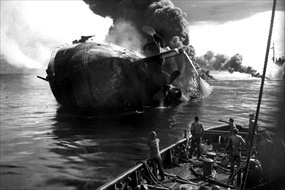 |  |
Left: The U.S. auxiliary fleet oiler Mississinewa, at anchor in the Ulithi lagoon, was sunk on the morning of November 20, 1944, by a Kaiten launched from I‑47 just outside the lagoon. Ulithi coral reef lagoon in the Western Pacific Caroline archipelago could accommodate over 700 ships with plenty of room for refueling, repair, maintenance, and storage operations. The Kaiten attack was the first successful attack by Japan’s kamikaze mini-subs. The Mississinewa’s cargo tanks were filled nearly to the brim with 404,000 U.S. gallons of aviation gas, 9,000 barrels of diesel fuel, and 90,000 barrels of fuel oil. The explosion of the Kaiten’s warhead in the front starboard bow area rocked the oiler. A second explosion occurred when an aviation gas cargo tank ignited. Fires reached the after magazine and caused yet another explosion. Flames towered 100 ft./30 m over the wounded ship. A little over 4 hours later the oiler slowly rolled over on its port side and disappeared beneath the oily surface, taking with it 63 hands out of 299 officers and enlisted men.

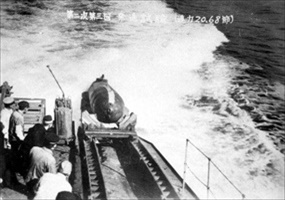
Right: Most of the Type 1 Kaitens were sent into combat by 21 submarines. A smaller number of launch vessels (14) were destroyers and a single light cruiser. Destroyers and the light cruiser Kitakami could accommodate 8 Kaitens, 4 on the port side and 4 on the starboard. Submarines accommodated 4 Kaitens. The Kaitens were tested at Kure Naval Arsenal near Hiroshima. The naval arsenal lay on the Seto Inland Sea as did the Sasebo Naval Arsenal. A series of emergency repairs owing to a British torpedo attack in late January 1944 forced the Kitakami to Sasebo Naval Arsenal later in August for repairs and modification into a human torpedo carrier. The refit was completed 5 months later, after which the cruiser was assigned directly to the Imperial Navy Combined Fleet, home port Kure, to train Kaiten pilots in the Seto Inland Sea as shown in this photograph. This late in the war fuel shortages limited the cruiser’s training sorties.
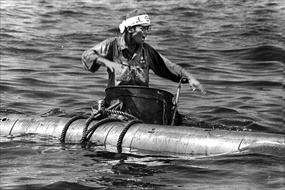 |  |
Left: A volunteer Kaiten pilot in training maneuvers wears a white silk hachimaki around his head. The great majority of Kaitens were Type 1 Kaitens and were based on Japan’s successful Type 93 “Long Lance” torpedo, which burned ethanol or methanol. The photograph above may depict this samurai warrior wrestling with a Type 10 Kaiten, which was built around a Type 92 electric torpedo. Only 1 prototype and 2 or 6 were ever produced. The Type 10 Kaiten was tiny compared to Type 1 Kaitens. Entered through an upper, not lower, hatch, the Type 10 Kaiten at 2.3 ft./0.7 m in diameter—impossibly cramped, stifling, and uncomfortable for the pilot and plagued by seawater leaks into the battery compartments and pilot’s compartment—carried a warhead just a fifth the size of a Type 1 Kaiten. Nevertheless, the Japanese Naval command ordered construction of more than 500 Type 10s.
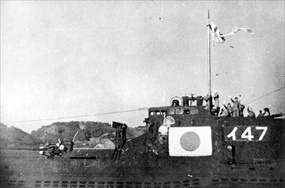
Right: Commissioned in July 1944, I‑47 operated as a Kaiten human-piloted torpedo carrier during the final year of the Pacific War. I‑47 was 1 of 2 mother submarines that composed two-thirds of the Kikusui-tai Kaiten (“Floating Chrysanthemum”) trio assigned to mount the first Kaiten operation of the war—in the case of I‑47 and I‑36 on the U.S. anchorage at Ulithi Atoll in the Caroline Islands. I‑37, the third member of the Kaiten operation, came to grief off the Philippine island of Leyte, its objective, on November 19, 1944. Three days earlier, on November 16, Japanese reconnaissance aircraft had made a high-altitude flight over Ulithi Atoll and sighted 4 fleet aircraft carriers and 3 battleships as well as many cruisers and destroyers in the north-central part of the lagoon and transports, oilers, and other ships in the south-central part. In fact over 200 ships were at anchor in the lagoon that week. On November 20, 1944, between 3:28 and 3:42 a.m., I‑47 launched its Type 1 Kaitens. I‑36 managed to launch a single Kaiten, which a U.S. warship sank. At 5:47 a.m. one of I‑47’s Kaitens rammed the hull of U.S. Navy fleet oiler Mississinewa, which caught fire, capsized, and sank at 9:28. After examining after-action reports and post-attack reconnaissance photographs, the Japanese mistakenly credited the Ulithi attack with sinking 3 aircraft carriers and 2 battleships when only a fleet oiler was sunk. Radio Tokyo declared the Ulithi attack a rip-roaring success.
Kaiten: Japan’s Crewed Attack Torpedo and Suicide Craft, 1944–1945

 History buffs, there is good news! The Daily Chronicles of World War II is now available as an ebook for $4.99 on Amazon.com. Containing a year’s worth of dated entries from this website, the ebook brings the story of this tumultuous era to life in a compelling, authoritative, and succinct manner. Featuring inventive navigation aids, the ebook enables readers to instantly move forward or backward by month and date to different dated entries. Simple and elegant! Click