World War II was the single most devastating and horrific event in the history of the world, causing the death of some 70 million people, reshaping the political map of the twentieth century and ushering in a new era of world history. Every day The Daily Chronicles brings you a new story from the annals of World War II with a vision to preserve the memory of those who suffered in the greatest military conflict the world has ever seen.
U.S. CAPITALISM UNDERPINS “ARSENAL OF DEMOCRACY”
Washington, D.C. • December 8, 1941
“His genius was problem-solving,” it was said of Andrew Jackson Higgins (1886–1952). “Higgins applied it to everything in life: politics, dealing with [trade] unions, acquiring workers, producing fantastical things or huge amounts of things.” Among the “fantastical things” he produced in quantity were the very amphibious landing boats linked to his name. Constructed mainly from wood, Higgins landing boats came in all shapes and sizes, most famously the 36‑ft./11‑m, 36‑man LCVP, short for Landing Craft, Vehicle, Personnel. On this date, December 8, 1941, the day after Japan’s surprise attack on Pearl Harbor, Hawaii, the 55‑year-old entrepreneur and wealthy boat builder filed a U.S. patent for his namesake boat, the legendary Higgins boat. Gen. Dwight D. Eisenhower, whom U.S. President Franklin D. Roosevelt selected to liberate Western Europe from Nazi tyranny, paid tribute to Higgins’ creations, which had so dramatic an impact on the outcome of the 1944 Normandy landings (Operation Overlord). “Andrew Higgins is the man who won the war for us,” he said in a 1964 interview. “If Higgins had not designed and built those LCVPs, we never could have landed over an open beach. The whole strategy of the war would have been different.” Certainly without Higgins, Gen. Douglas MacArthur’s classic Pacific island-hopping campaigns would not have been possible.
Many factors worked in Higgins’ favor, as well as in the favor of two other exceptional Americans who played oversized roles in this nation besting its enemies—William S. Knudsen (1879–1948) and Henry J. Kaiser (1882–1967). It was a combination of American patriotism and capitalism operating in a country of abundant natural resources, wealth, and paid manpower. All came together to produce an “arsenal of democracy.” By the end of the war America’s factories were producing two-thirds of all Allied military equipment: tanks (86,000), warplanes (286,000), naval vessels (8,800), merchant ships (5,600), and trucks (2.5 million), to list 5 key constituents. As Knudsen said, “We won [the war] because we smothered the enemy in an avalanche of production, the like of which he had never seen nor dreamed possible.
Roosevelt appointed Knudsen to head the 4‑member Office of Production Management, or OPM. First at Ford and then at General Motors, the Danish immigrant enjoyed a long automotive career, distinguished as a skilled manager of resources and a leading expert in mass production, championing the critical role of interchangeable parts, continuous workflow and a moving assembly line for enhanced efficiency and productivity, and simplified design. For a dollar a year Knudsen applied his skills to U.S. war production.
Henry J. Kaiser was a brilliant industrialist and capitalist who became known as the father of modern American shipbuilding. He owned 7 major shipbuilding yards in California (4), Oregon (2), and Washington (1) states. “Problems are only opportunities in work clothes,” he was fond of saying. Putting into practice innovative methods of shipbuilding, his yards outproduced similar facilities, building 27 percent of U.S. maritime construction in World War II. On average his Liberty and larger Victory cargo ships were famously completed in two-thirds the time and at one‑quarter the cost of his competitors.
Like hundreds of thousands of other American employers, Higgins and Kaiser recruited laborers in a relatively free market economy from across the country of 132 million people (1940), paid them justly, and expanded hiring to women, minorities, the elderly, and the handicapped. Conversely, in Nazi Germany, America’s chief wartime opponent (population 65 million), over 20 million foreign civilian workers, concentration camp prisoners, and prisoners of war from German-occupied countries were required to perform forced labor in Germany during the war. In the face of nearly all German males serving in the Wehrmacht (armed forces), foreign labor constituted over a quarter and in some factories up to 60 percent of the workforce. Repression, discrimination, deprivation, humiliation, and for Jews, Sinti, and Roma extermination through labor (Vernichtung durch Arbeit) were notable underpinnings of Nazi Germany’s wartime economy.
Three Examples of American Entrepreneurial Spirit and Capitalism Deployed to Defeat the Axis Enemy
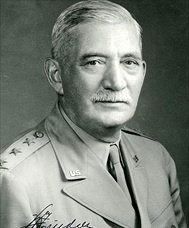 | 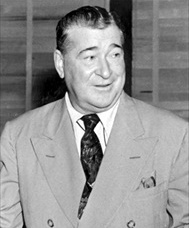 |  |
Left: Accepting Roosevelt’s 1940 invitation to come to Washington, D.C., to lead America’s war materiel production efforts, “Big” Bill Knudsen drafted a plan that harnessed the principles of American capitalism and a powerful free market economy, in the process turning the nation into the global supplier of war materiel needed to defeat Nazi Germany and its principal allies, Italy and Japan. His plan mobilized retooled factories, business and Wall St. capital, and free labor at top speed so that by 1943 and 1944 America’s. economy was operating at peak production. At Roosevelt’s suggestion the U.S. Army commissioned Knudsen in January 1942 as a lieutenant general, the only civilian ever to enter the army at such high rank. In 1944 and again in 1945 the U.S. Army awarded Knudsen the Distinguished Service Medal.

Middle: World War II was a 2-ocean fight: The Atlantic and Mediterranean and the Pacific. None of the theaters of war could have taken delivery of the humongous number of needed troops, vehicles, equipment, and supplies but for Andrew Higgins’ flat-bottomed, transport ship-to-shore boats. By 1943 New Orleans-based Higgins Industries employed over 20,000 workers of both sexes (some right off the farm) and every shade of color (up from 75 people working in a small workshop in 1938), all paid equal wages according to their job. The workforce, eventually numbering over 85,000 across 7 plants, responded by producing 20,094 vessels—12,500 of them LCVPs—for the Allied war effort. Vessels included the iconic armored steel ramp-bowed Higgins landing boats with their innovative V‑shaped keel as well as PT (patrol torpedo) boats—prototypes the pioneering entrepreneur financed out of his own pocket. “There was no task Higgins couldn’t do,” said an admirer. “He would find a way to do something, then find a way to do it better.” (Higgins held roughly 30 patents pertinent to amphibious landing craft and vehicles.) Like West Coast shipbuilder Henry J. Kaiser (below), Higgins applied Henry Ford’s assembly-line techniques to boat-building. By the end of the war, Higgins Industries had built a whopping majority of U.S. naval ships.
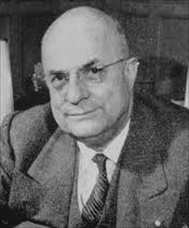
Right: Burly, bald “Hurry Up Henry” J. Kaiser was a self-made industrial tycoon who constructed the great Boulder (Hoover), Bonneville, and Grand Coulee Dams in the West. Around 1939 he established his West Coast shipbuilding company to help meet construction goals set by the United States Maritime Commission for merchant shipping. Another man ahead of his time, Kaiser was a production genius. For instance, to hasten the pace of shipbuilding, Kaiser turned his attention to welding, not riveting, steel. Welding was advantageous because it took less strength to do and it was easier to teach to thousands of new employees, who were mostly unskilled laborers and many women. Kaiser also adopted the use of subassemblies in ship construction. When the U.S. actively entered World War II, Kaiser Shipyards was awarded major contracts for construction of the Liberty ships, freighters that could be built rapidly at low cost. His shipyards had an average construction time of 45 days per ship compared to the national average of 65 days per ship. His ships were also delivered for less than half the cost of his competitors. As the war progressed, his shipyards built many of the Casablanca and successor class escort carriers (CVEs) and the larger, speedier Victory-class cargo ships. Construction records established by Kaiser Shipyards continue to stand.
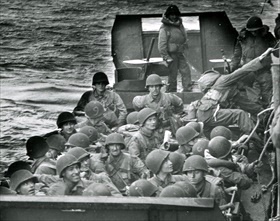 |  |
Left: A transport ship offloads upwards of 36 fully-armed U.S. soldiers into a Higgins boat on D‑Day, June 6, 1944. Standing at the rear is the coxswain, typically a U.S. Coast Guardsman, who steered the landing craft to 1 of 5 Normandy invasion beaches. Builder of all sorts of rugged amphibious landing craft (the “LC” in LCVP, LCPL, LCM, LCT), Higgins developed a reputation for being able to do the impossible. The U.S. Navy practically dared Higgins to come up with plans for a new boat design in 3 days. “Hell,” he replied, “I can build the boat in 3 days,” which is exactly what he did—build over 20,000 purpose-built vessels by war’s conclusion.
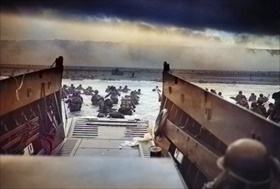
Right: “Into the Jaws of Death” is the description of this colorized image taken by Chief Photographer’s Mate Robert Sargent of the United States Coast Guard. Taken at 7:40 on the morning of June 6, it is one of the most widely reproduced photographs of the D‑Day landings. It depicts heavily laden troops of Company E, 16th Infantry Regiment, 1st Infantry Division—the Big Red One—departing their LCVP and wading through waist-deep water and under no cover toward the heavily fortified “Easy Red” sector of Omaha Beach. Two-thirds of Company E were among D‑Day’s casualties as they advanced up Omaha Beach through minefields into 4 batteries of artillery, 18 antitank guns, 6 mortar pits, 35 rocket launcher sites, 8 concrete bunkers, 35 pillboxes, and 85 machine-gun nests.
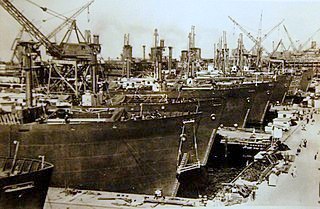 |  |
Left: Machinery and cargo-handling equipment being installed in a group of Liberty ships at the fitting-out dock of a Kaiser shipyard in this photo released in March 1942 by the U.S. Office of War Information. Kaiser hit on the breakthrough notion that shipyards could prefabricate large components as big as deckhouses and then use cranes to place them on top of nearly completed ships. Kaiser’s commercial ship hulls also became America’s smaller, more numerous (over 100) 498‑ft./152‑m, 6,730‑ton “escort carriers” (CVEs), nicknamed “baby flattops,” “jeep carriers,” and “Kaiser carriers,” employed in both the Pacific and the Atlantic theaters. The concepts Kaiser developed for the mass production of World War II merchant and naval vessels are still in use at shipyards around the world.
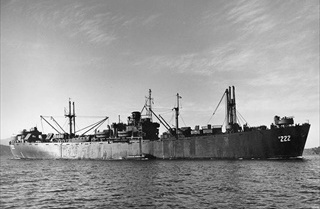
Right: USS Livingston (AK-222) in California’s San Francisco Bay. Of 7 Kaiser shipyards, 4 were in San Francisco’s East Bay region at Richmond. The Richmond yards built 747 Liberty and Victory ships for the war effort, more than any other site in the U.S. The Richmond yards broke many shipbuilding records and even built a Liberty ship, the SS Robert E. Peary, in a record 4 days, 15½ hours in a competition with rival shipyards. On average Kaiser’s yards could produce a vessel in 30 days. All together Kaiser’s yards built 1,490 ships, or 27 percent of total U.S. Maritime Commission construction. Kaiser ranked 20th among U.S. corporations in the value of wartime production contracts.
Higgins Boats Documentary. The Boats that Won World War II

 History buffs, there is good news! The Daily Chronicles of World War II is now available as an ebook for $4.99 on Amazon.com. Containing a year’s worth of dated entries from this website, the ebook brings the story of this tumultuous era to life in a compelling, authoritative, and succinct manner. Featuring inventive navigation aids, the ebook enables readers to instantly move forward or backward by month and date to different dated entries. Simple and elegant! Click