

FREE FRENCH VANGUARD LIBERATES PARIS
Paris, France • August 25, 1944
On this date Nazi Germany’s Paris garrison surrendered the French capital to elements of French Maj. Gen. Jacques Philippe Leclerc’s 2nd Armored Division. A little more than 4 years before, the German Wehrmacht (armed forces) goose-stepped into Paris on June 14, 1940, a month after mounting simultaneous attacks on neighboring Netherlands, Belgium, and Luxembourg. France was the last of the 4 nations to accept defeat, signing a humiliating Franco-German armistice near Compiègne on June 22, 1940. A puppet French state commonly known as Vichy was set up in the south of France under Marshal Philippe Pétain while the Wehrmacht assumed governance of the northern and western parts of metropolitan France.
The opening phase of Paris’s liberation began on August 19, 1944, launched by Parisian members of the paramilitary French Forces of the Interior (Forces françaises de l’Intérieur), or FFI. The buildup to the uprising began 4 days earlier when Paris Métro employees and 2 national law enforcement organizations, the Sûreté nationale (police) and the Gendarmerie, went on strike. French postal workers struck the next day, August 16. On August 18 a citywide strike shut down businesses across the capital. If these strikes were not worrisome enough to Gen. Dietrich von Choltitz, commander of the 20,000-man German garrison, armed French irregulars by the thousands made their street appearance on August 19, as already noted, and engaged their oppressors in daylong firefights. Choltitz reacted by ordering his men to punish the insurgents without hesitation: anyone looking suspicious was shot, tanks shelled buildings, but Choltitz and his men were running out of good options as their situation grew more untenable by the day. Yet the biggest existential threat to Choltitz’s garrison force was Gen. George S. Patton, Jr’s approaching U.S. Third Army, of which Leclerc’s Free French 2nd Armored Division was an integral part.
Choltitz began evacuating the city. Panicky streams of cars and trucks packed with administrative personnel and French collaborators raced for the exits. At the same time Gaullist, non-Gaullist, and communist résistants were hard pressed to embrace a common course of action apart from ambushing German patrols and throwing grenades and firing weapons into fleeing German convoys or shooting German stragglers individually or in groups (see YouTube video below). Paris descended into looting and chaos, whooping, and singing unending strains of “La Marseillaise,” France’s national anthem. Street barricades popped up, trees were felled across streets, and patriots took to planting the French Tricolor on government buildings, the Eiffel Tower, on balconies, in fact everywhere.
Gen. Dwight D. Eisenhower, Supreme Commander of Allied armies in France, advised Leclerc that Allied forces must circumvent the French capital lest they endanger the entire Western Front by attacking Paris head-on and setting off a drawn-out, horribly destructive urban battle. By August 22 Eisenhower had reversed himself and Leclerc ordered all 16,000 of his men to move full speed toward Paris. It was no walk in the park. Hundreds in Leclerc’s advancing column were bushwhacked, wounded, and killed before the first elements entered Paris in the late hours of August 24. Parisians flooded into the streets, climbed lamp poles and passing tanks and jeeps, showering their liberators with flowers and kisses and shouting “Vive la France, Vive de Gaulle, Vivent les alliés.”
Early the next afternoon, August 25, Leclerc’s men burst into Choltitz’s headquarters in the Le Meurice hotel and took the portly, diminutive Wehrmacht general into custody. Gen. Charles de Gaulle arrived in Paris later in the afternoon to assume control of the French capital as head of the Provisional Government of the French Republic. Less than 24 hours later, on the afternoon of August 26, a beaming de Gaulle led a victory parade down Paris’s famed Champs-Élysées boulevard, which was lined by hundreds of thousands of cheering people. Paris was again free and French.
Paris Liberation, August 1944
 |
 |
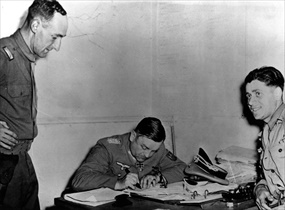
Left: Gen. Dietrich von Choltitz (1894–1966) is seen here officially surrendering his garrison to the French Forces of the Interior following Paris’s liberation by soldiers of Maj. Gen. Jacques Philippe Leclerc’s 2nd Armored Division, or 2eme Division Blindée (2e DB) in French. Choltitz signed the 6‑paragraph document (French, Reddition de la garnison allemande de Paris) at Leclerc’s temporary command post, Paris’s Gare Montparnasse train station. Leclerc, to Choltitz’s right, and a smiling Henri Tanguy (nom de guerre Colonel Rol), communist leader of the regional branch of the FFI, countersigned. After 4 years of zealous service on both the Western and Eastern Fronts, Choltitz arrived in Paris on August 9, 1944, appointed Wehrmacht commander of Greater Paris (Wehrmachtsbefehlshaber von Groß‑Paris) and military prefect (governor) of Paris in a meeting with Hitler 3 days before. With Allied armies just over 2 weeks (as it turned out) short of entering the French capital, Hitler instructed Choltitz to “stamp out without pity” all civilian acts of terrorism and insurrection and, if necessary, leave Paris a burned-out shell should German forces ever find their backsides pressed to the proverbial wall. Choltitz, able destroyer of Netherlands’ Rotterdam and Crimea’s Sevastopol, allegedly used the intervening days to undergo a change of heart and forestall Paris’s scorched-earth destruction. When Free French soldiers burst into Choltitz’s office in his Le Meurice headquarters early in the afternoon of August 25, 1944, and ordered him to surrender himself, Choltitz did so without a quibble.
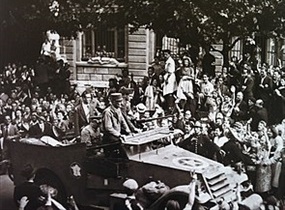
Right: Standing in an open-topped armored M3 Scout Car, Leclerc whisked his booty Choltitz, seated on the car’s rear seat, through Paris streets to cheering crowds shortly after taking the former German garrison commander prisoner on August 25, 1944. On the side of the scout car is the Free France emblem, the Cross of Lorraine, imposed on a map of metropolitan France. Choltitz was one of 12,800 prisoners taken during the Battle of Paris.
 |
 |
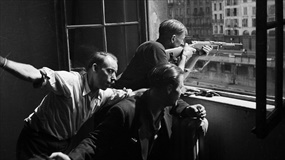
Left: Gaullist or Parisian irregulars line an open window firing their weapons at German targets. On the morning of August 19, Gaullist forces in the hundreds commenced attacking German armed forces and fortifications throughout Paris, thus kicking off the Battle for Paris from inside the city. It wasn’t long before rival leftist insurgents, who numbered roughly 5,000 men and women more than the Wehrmacht’s 20,000, joined the fray, and scores of occupation troops were assailed by Parisians armed with World War I surplus rifles, Molotov cocktails, pistols, shotguns, and a few slow-firing Hotchkiss machine guns. An estimated 800–1,000 résistants were killed during the battle to liberate Paris, and another 1,500 wounded. Civilian casualties were put at 585 killed and 2,012 wounded. German casualties were between 2,800 and 3,200 dead and an indeterminate number wounded. Another 1,000 Germans were killed in the weeklong fighting against insurgents in Paris itself. Leclerc’s 2nd Armored Division suffered 71 killed and 225 wounded. Material losses were heavy: 35 tanks, 6 self-propelled guns, and 111 vehicles.
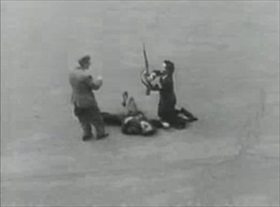
Right: Screenshot from the 30-minute documentary “La Libération de Paris,” which was secretly shot by the French Resistance during the Battle of Paris. This still shows 2 Parisians, possibly members of the French Forces of the Interior, disarming a recently killed German soldier. In the frames before this, the soldier is seen being shot (5:19), as Parisian snipers directly overlooking the landmark Notre Dame Cathedral watch him die. In the next few frames, the woman and the man remove his rifle, a pistol, and other objects (5:33–5:38). (See video below.)
 |
 |
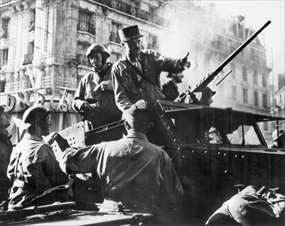
Left: French Maj. Gen. Philippe Leclerc (1902–1947) standing in his M3 Scout Car arrived to an exultant Parisian welcome after a pell-mell 2‑day, 122‑mile/196‑km-drive, having ordered on his own authority the men of his 2nd Armored Division to strike out early on August 21. The dash to Paris actually began at dawn on August 23. It was important to Leclerc, and later his American superiors, that French soldiers be the first Allied troops to enter France’s capital and largest city. That happened just before midnight on August 24. At the behest of Gen. Omar Bradley, head of the Twelfth U.S. Army Group, the veteran 4th U.S. Infantry Division (nicknames “Ivy” and “Iron Horse” division) entered Paris in the early hours of August 25, followed in the early afternoon by British commandos known as 30 Assault Unit. At 3:30 that afternoon Choltitz surrendered his garrison to Leclerc as other French units streamed into the capital.
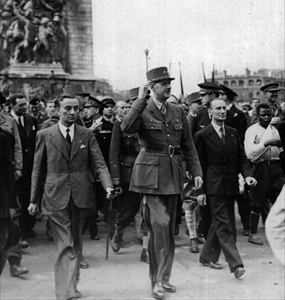
Right: Gen. Charles de Gaulle (1890–1970), towering Free French centerpiece, leads a victory parade on foot from the Arc de Triomphe down the famous Champs-Élysées to Notre Dame Cathedral, where a thanksgiving mass was celebrated, August 26, 1944. Heading the parade were 4 Sherman tanks representing Leclerc’s 2nd Armored Division, the first Allied soldiers to liberate the French capital.
Contemporary American Newsreel of Liberation of Paris, August 1944

World War II was the single most devastating and horrific event in the history of the world, causing the death of some 70 million people, reshaping the political map of the twentieth century and ushering in a new era of world history. Every day The Daily Chronicles brings you a new story from the annals of World War II with a vision to preserve the memory of those who suffered in the greatest military conflict the world has ever seen.