

BLACK MARINES OPEN SEGREGATED RECRUIT DEPOT
Montford Point, North Carolina • August 26, 1942
On this date in 1942, 12 miles/19 km upriver from the new whites-only amphibious training camp at Camp Lejeune, the first set of black Marine Corps recruits set up a segregated recruit depot of their own. The training camp, named Montford Point, was a satellite camp of Camp Lejeune near Jacksonville, North Carolina. The segregated camp was located on an isolated, festering, marshy patch of ground poking into the state’s New River. The first task their white officers gave the Marine recruits was to clear the trees, level the ground, and erect wooden barracks. By October only 600 black recruits had begun basic training, although the call was for 1,000 blacks to fill the ranks of the 51st and, from December 1943 on, the 52nd Composite Defense Battalions every month. Defense battalion enlistees focused on defending advanced naval bases using coastal gun batteries, antiaircraft batteries, machine gun units, and infantry.
Recruitment of black volunteers for the U.S. Marine Corps started on June 1, 1942. Maj. Gen. Thomas Halcomb, Commandant of the Marine Corps, was none too pleased. “If there were a question of having a Marine Corps of 5,000 whites or 250,000 Negroes,” he once told a Washington, D.C., audience, “I would rather have the whites.” But fighting over President Franklin D. Roosevelt’s 1941 Executive Order 8802, which prohibited racial discrimination in government and the defense industry, was not worth the cost of quarreling with his boss.
Small changes were underway nevertheless. By May 1943 all training at Montford Point was done by black sergeants and drill instructors (DIs). Blacks turned out to be harder on their recruits than the former white instructors. It was said that the goal of black instructors was to make their “boot recruits” better than those just down the road (i.e., at Camp Lejuene).
Ironically, the Montford Point 51st and 52nd combat defense battalions, deployed to the Pacific Theater in the last 12 months of the war, saw only a few months of action patrolling the recaptured island of Guam. Conversely, Montford Point’s logistics service units, the depot companies (of which there were 51) and the ammunition companies (of which there were 12), saw savage fighting on the battlefields of Saipan (D‑Day June 5, 1944), Tinian, and Guam in the Marianas, Peleliu in the Palau group, Iwo Jima, and Okinawa, where 2,000 Mondfort Pointers set up supply and ammo dumps. Men from the 2 service companies and the Steward’s Branch (cooks and mess attendants)—men who had received the fewest weeks of basic training back in the States—were often inserted into the front lines as riflemen. These enlistees suffered most of the casualties among black Marines, losing 7 killed in action, 2 who died of wounds, and 78 who survived their wounds. Lt. Gen. Alexander Vandegrift, Holcomb’s replacement as head of the Marine Corps on January 1, 1944, was impressed with the stellar performance of Montford men who had joined Marine assault troops under fire on Saipan. He declared: “The Negro Marines are no longer on trial. They are Marines, period.”
The last Montford Point unit to be deactivated after the Pacific War—the 49th Marine Depot Company—occurred on Guam on September 30, 1947. The Montford Point Marine training facility was closed in 1949 after President Harry S. Truman issued Executive Order 9981, which fully desegregated the U.S. Armed Forces. Until the end of the Korean War the number of black Marines hovered between 1 and 3 percent. In 2022, self-identifying black enlisted servicemembers and officers made up 19.9 percent and 11.3 percent of the Corps, respectively, the lowest percentages of black servicemembers in the 4 service branches. On June 27, 2012, the U.S. Congress honored the Montford Point Marines with the Congressional Gold Medal, the highest civilian award the legislature confers.
Pioneer Montfort Point Marines During World War II
 |
 |
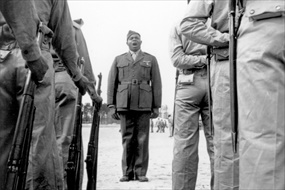
Left: A platoon of “boot recruits” listen to their drill instructor, 37-year-old Sgt. Gilbert “Hashmark” Johnson. (Johnson was known as “Hashmark” because he had more diagonal service stripes—one each for the Army, Navy, and Marine Corps—than rank stripes.) In 1943, Johnson was among the first black men to be trained as Marine drill instructors. More than 1 million African Americans were called up for service, and of these 835,000 went into the U.S. Army. By 1944, 18,000 black Marines had passed through Montford Point. Of those, 12,738 were deployed overseas in the Pacific Theater, mostly in combat support companies. Unlike the Army, the Marine Corps did not allow blacks to become officers during the war. Not until November 1945 did an African American, a veteran of the 51st Defense Battalion, earn a commission in the Marine Corps, which allowed the newly minted second lieutenant to give orders to white enlisted Marines.
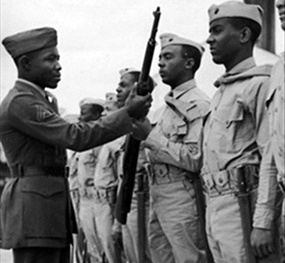
Right: Cpl. Mortimer Cox of Birmingham, Alabama, inspects his platoon of recruits at Montford Point. Immediately following the Japanese attack on Pearl Harbor, Hawaii, on December 7, 1941, the authorized troop strength of the Marine Corps increased from 75,000 to 104,000 Marines. During the last month of peace in November 1941, 1,978 men enlisted in the Corps. In December enlistments jumped to 10,224. That number was smashed by a record of 22,686 enlistments in January 1942. Overall, half a million Marines graduated by the end of the war from 5 Marine Corps recruit depots: San Diego and Camp Pendleton in California, Parris Island in South Carolina, Camp Lejeune, and segregated Montford Point, the latter 2 depots in North Carolina. Training consisted of, among other things, rigorous exercises, close-order drills, hand-to-hand combat, and weapons firing. The pay: $21 a month.
 |
 |
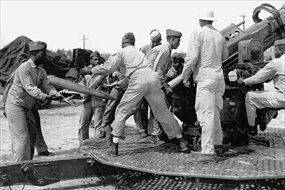
Left: Montford Point Marines participate in a battery drill in this photo. The men of the segregated 51st Composite Defense Battalion distinguished themselves as the finest artillery gunners in the Marine Corps, breaking almost every accuracy record in training. During firing exercises attended by Secretary of the Navy Frank Knox, Commandant of the Marine Corps Gen. Holcomb, and a colonel from the Selective Service System watched an African-American crew open fire with a 90 mm gun at a sleeve target being towed overhead and hit it within 60 seconds. The Commandant’s reaction: “I think they’re ready now.” Unfortunately, discrimination toward African American combat abilities existed during the war period. When shipped to the Western Pacific, the 51st and 52nd Defense Battalions (the qualifier “Composite” had been dropped) were first posted to islands away from the primary action. In July 1944 the 51st was reorganized as an antiaircraft unit. Former drill instructor Sgt. Maj. (since January 1945) Gilbert “Hashmark” Johnson, a member of the 52nd Defense Battalion that helped garrison recaptured Guam, lobbied his commanding officer to assign black Marines to combat patrols, from which they were then exempt. Once approved, Johnson personally led 25 patrols to mop up stragglers or die-hard surviving enemy who found concealment in the island’s dense vegetation.
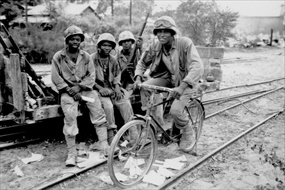
Right: Posing with a Japanese bicycle they had captured on Saipan Island are 4 Montford Pointers in the 3rd Marine Ammunition Company. Their company was a combat service support unit consisting of (typically) 8 commissioned officers and 251 enlisted men. The Marine Corps believed that the fuses and shells handled by ammunition companies required noncommissioned officers with technical know-how and the ability to use this knowledge in enforcing safety regulations. In the midst of war the Corps felt it could not afford 2 months to train inexperienced blacks for these duties; instead, they relied on previously trained white noncommissioned officers down to the level of buck sergeant (3 upward stripes only). Black depot companies, because training was 3 weeks, had black noncommissioned officers from first sergeant (3 upward stripes and 3 rocker stripes) on down to corporal (2 stripes only). Montford Point organized 1 ammunition company and 2 depot companies each month. Both sets of companies were often inserted into the front lines as riflemen. The first depot company shipped out in April 1943, the ammunition companies shortly afterwards.
The Montford Point Marines, 1942–1949

World War II was the single most devastating and horrific event in the history of the world, causing the death of some 70 million people, reshaping the political map of the twentieth century and ushering in a new era of world history. Every day The Daily Chronicles brings you a new story from the annals of World War II with a vision to preserve the memory of those who suffered in the greatest military conflict the world has ever seen.