

ICELAND CUTS TIES TO DENMARK
Reykjavik, Iceland · May 17, 1941
On April 9, 1940, Nazi Germany invaded Denmark and Norway, ostensibly to protect the neutrality of the 2 Scandinavian countries against Franco-British aggression. Adolf Hitler had become convinced in mid-December 1939 that the 2 West European Allies, at war with Germany for 3½ months now, were hell-bent on disrupting the Swedish iron ore supply through Norway’s ice-free port of Narvik. So he ordered his Armed Forces High Command to begin preliminary planning for an invasion of Norway. Planning Denmark’s conquest came later at the insistence of the Luftwaffe, which claimed it needed air bases on the Danish peninsula to support the Norwegian operation.
A month after Denmark fell, a small force of British Marines landed in Iceland, which was a sovereign kingdom in personal union with Denmark through Denmark’s King Christian X. Eventually 25,000 British troops were stationed in Iceland, strategically positioned at the midway point in the convoy lifeline between the German-besieged British Isles and North America.
On this date in 1941 Iceland’s Althing (parliament) broke with the mother country, proclaiming the nation to be separate and neutral. A week later President Franklin D. Roosevelt pledged U.S. aid and support, as necessary, to any country resisting Nazi Germany. Motivated by the British and by its own desire to disabuse Germany of any move it might take to “protect” Iceland’s neutrality, the Althing authorized another neutral, the U.S., to station its armed forces on the island, which occurred between July 7 and 12, 1941. U.S. Marines now relieved Great Britain, deeply embroiled in the Battle of the Atlantic, of the responsibility for defending the world’s newest nation.
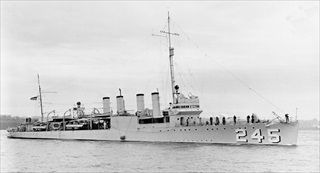
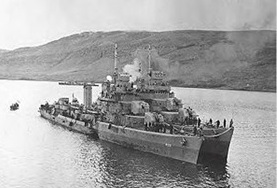
In September and October Roosevelt’s pledge of support to Great Britain against her German adversary led to several prewar confrontations between the U.S. Navy and German U‑boats that were feasting on Allied merchant ships. On October 17, 1941, the USS Kearny, an escort ship in a 50‑ship convoy, was torpedoed off the Icelandic coast at a cost of 11 dead and 24 wounded while assisting a British plane trying to sink a U‑boat, and on October 31 the USS Reuben James, providing convoy escort service west of Iceland, went down with 115 sailors, the first U.S. Navy vessel sunk by Nazi Germany. To the American public Roosevelt portrayed these 2 incidents as part and parcel of unprovoked German aggression (not entirely true), all the while knowing from British intercepts of German Enigma (coded) traffic that Hitler had ordered his U‑boats to avoid to the extent possible confronting America on the high seas.
Hitler’s open declaration of war against the United States on December 11, 1941, appears to be a page torn from the Wehrmacht’s martial handbook, as Germany angled for every advantage in a conflict that spelled doom for the loser. Roosevelt had played his poker hand brilliantly. He knew that only way to ensure the entry of a hesitant and divided America into the European war on the side of Great Britain was to await an unprovoked attack on American interests on a gigantic scale. Hitler’s Tripartite treaty partner, Japan, did that in spades by attacking the U.S. Pacific Fleet at Pearl Harbor, Hawaii, on December 7, 1941.
The U.S. Navy on the Eve of War, 1941
 |
 |
Left: The USS Reuben James—a 4-funnel, post-World War I destroyer—was the second U.S. Navy ship sunk by hostile action in World War II. The river gunboat USS Panay, serving on the Yangtze Patrol in war-torn China, was bombed, strafed, and sunk by Japanese aircraft on December 12, 1937, with a loss of 4 dead; the wounded were 43 sailors and 5 civilian passengers.
Right: USS Kearny at Reykjavík, Iceland, two days after being torpedoed by the U‑568. The USS Monssen is alongside. The torpedo hole is visible in Kearny’s starboard side. The Kearny, assisting three other U.S. destroyers, came to the rescue of a beleaguered convoy whose Canadian escorts were being mauled by a U‑boat wolf pack when it came under attack. Casualties among Kearny’s crew members included over 20 injured and 11 dead. The dead were among the more than 36,000 Allied sailors and navy airmen and 36,000 merchant seamen who lost their lives in the Battle of the Atlantic (1939–1945).
American Singer-Songwriter Woody Guthrie Performing His “Sinking of the Reuben James”

World War II was the single most devastating and horrific event in the history of the world, causing the death of some 70 million people, reshaping the political map of the twentieth century and ushering in a new era of world history. Every day The Daily Chronicles brings you a new story from the annals of World War II with a vision to preserve the memory of those who suffered in the greatest military conflict the world has ever seen.