
SPECIAL U.S.-CANADIAN OPS FORCE ACTIVATED
Fort William Henry Harrison, Helena, Montana · July 9, 1942
On this date in 1942 the First Special Service Force was activated as a joint U.S.-Canadian force. Regarded as parents of the U.S. Green Berets, the United States Special Operations Command, and the Canadian Special Operations Forces Command, these volunteers were the shock troops of the U.S. Army in World War II. Americans and Canadians who had formerly been lumberjacks, hunters, prospectors, explorers, game wardens, and skiers received rigorous training in stealth tactics, hand-to-hand (often unarmed) combat, explosives demolition, rock climbing, parachute jumping, and amphibious, mountain, and ski warfare. An amalgam of two armies, these hand-picked officers and enlisted men—single men between the ages of 21 and 35—trained on the hot, dusty Montana prairie, in the frozen peaks of the Rocky Mountains, and in the chilly waters of Chesapeake Bay.
Much feared for their fighting prowess, the First SSF adopted their German nickname “Black Devils” (Schwarze Teufel) for themselves. With blackened faces, these small agile units often overwhelmed German defenders without firing a shot and then disappeared into the night. The Devil’s Brigade saw action in Alaska, Italy (Anzio, Monte Cassino, Rome in the spearhead of the U.S. Fifth Army), Southern France (Operation Dragoon), and the Rhineland campaign (late 1944). In Italy they used their trademark stickers depicting their unit patch (a red Indian arrowhead) and the slogan “Das dicke Ende kommt noch,” meaning “The worst is yet to come,” placing the stickers on German corpses and fortifications.
In the December 1943 to January 1944 mountain campaign in Italy, the Black Devils suffered 77 percent casualties. In the invasion of Southern France, their commander was wounded nine times. Overall, the 1,800-member First SSF accounted for roughly 12,000 German casualties, took some 7,000 prisoners, and sustained an attrition rate of over 600 percent.
The First SSF was disbanded in December 1944 in Southern France. The Canadian contingent quietly dispersed as combat fillers. American members were sent to the 82nd Airborne Division as replacements, others formed the core of a new infantry regiment for service with Gen. George S. Patton’s U.S. Third Army, and still others were integrated into U.S. Army Ranger battalions.
[fblike]
[amazon_carousel widget_type=”ASINList” width=”600″ height=”200″ title=”Recommended Reading” market_place=”US” shuffle_products=”False” show_border=”False” asin=”1596872187,1551251124,0764311719,0968096913,0764324306,0764320548,1591140048,0891418679,1841769681,1459709640″ /]
Supercommandos: First Special Service Force (1942–1945) and Lineal Descendants
 |
 |
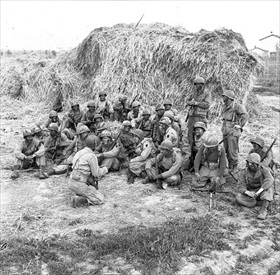
Left: Personnel of the First Special Service Force being briefed before setting out on patrol, Anzio beachhead, Italy, April 20, 1944. An order found on a German POW stated that the Germans in Anzio would be “fighting an elite Canadian-American Force. They are treacherous, unmerciful and clever. You cannot afford to relax. The first soldier or group of soldiers capturing one of these men will be given a 10‑day furlough.” It was at Anzio that the Devil’s Brigade (or Black Devils’ Brigade) adopted their German nickname on account of the black boot polish the men applied to their faces before going on nighttime operations behind enemy lines, appearing out of nowhere, and taking prisoners.
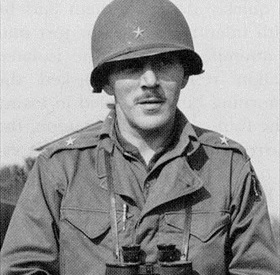
Right: Brig. Gen. Robert T. Frederick commanded the mixed force of Americans and Canadians since its earliest days, working hard to create an integrated “North American” fighting unit. His men greatly admired Frederick for his intelligence, courage, and willingness to fight alongside them in battle, including walking into a German minefield to help retrieve wounded soldiers. After the Italian campaign, British Prime Minister Winston Churchill called Frederick “the greatest fighting general of all time” and “if we had had a dozen more like him we would have smashed Hitler in 1942.” In August 1944 Frederick left on promotion to major general to command the 1st Airborne Task Force.
 |
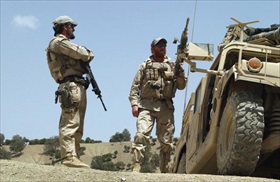 |
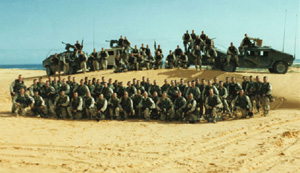
Left: Bravo Company, 3rd Battalion of the 75th Ranger Regiment of the U.S. Army Special Operations Command in Somalia, 1993. The all-volunteer 75th Ranger Regiment is the Army’s premier raid force, specializing in seizing key terrain such as airfields, destroying strategic facilities, and capturing or killing enemies.
Right: U.S. Army Special Forces, also known as Green Berets, on patrol in Afghanistan. Special Forces are tasked with five primary missions: unconventional warfare (the original and most important mission of the force), foreign internal defense, special reconnaissance, direct action, and counterterrorism.
The Devil’s Brigade: U.S.-Canadian First Special Service Force

World War II was the single most devastating and horrific event in the history of the world, causing the death of some 70 million people, reshaping the political map of the twentieth century and ushering in a new era of world history. Every day The Daily Chronicles brings you a new story from the annals of World War II with a vision to preserve the memory of those who suffered in the greatest military conflict the world has ever seen.