

BATTLE OF BRITAIN: RAIN OF TERROR BEGINS
London, England · July 10, 1940
On this date in 1940, less than one month after France’s capitulation to Nazi Germany and just 10 days after the Germans had seized Great Britain’s Channel Islands of Jersey and Guernsey off France’s Brittany coast, Luftwaffe aircraft based in France began a relentless aerial campaign targeting the lone European holdout against the German juggernaut. Adolf Hitler’s aim in the four-month Battle of Britain (July 10 to October 31, 1940) was to destroy the Royal Air Force (RAF) Fighter Command, ravage British radar defenses, and generally prepare the way for Operation Sea Lion (Unternehmen Seeloewe), the Wehrmacht’s invasion of England.
A German invasion force projected at 20 divisions strong was assembling in ports on the continent even as Luftwaffe fighters and bombers began their aerial campaign of destruction—which Air Marshal Hermann Goering assured Hitler would be successful in a matter of weeks. The RAF disabused both men of that notion even as it took a terrible beating: In just over a week, the RAF lost 106 pilots and 208 fighter aircraft, with no hope of replacing the lost planes quickly. Against the RAF’s 570 Spitfires and Hurricanes in Southeast England, the Luftwaffe deployed nearly 3,200 aircraft.
On the night of August 25, 1940, the RAF bombed Berlin, shocking Hitler and his military coterie. (Goering had assured Hitler that an air raid on the Nazi capital was out of the question.) In retaliation Hitler ordered the Luftwaffe to concentrate on bombing English cities. Between the start of the “Blitz” in September 1940 and its end in May 1941, British civilians endured the harsh reality of air raid sirens, sudden death, raging fires, and collapsing business and apartment buildings.
The worst destruction the Luftwaffe inflicted occurred on September 15, 1940, now known as Battle of Britain Day, the day Goering had hoped to eliminate the RAF from English skies. German bombers pounded the British capital day and night, as well as the ports of Bristol, Cardiff, Liverpool, and the manufacturing center of Manchester. The Luftwaffe lost 56 aircraft (bombers and fighters) to the RAF’s 26. By the time the Blitz ended without a German victory in mid-1941, Sea Lion had been replaced by another ambitious and equally futile operation in the planning stages, Operation Barbarossa, the German invasion and occupation of European Russia.
The Blitz, September 7, 1940, to May 21, 1941: Hitler’s Follow-On Campaign to the Failed Battle of Britain
 |
 |
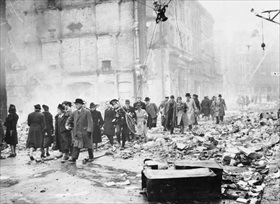
Left: Office workers make their way through a debris field as they go to work after a heavy air raid on London. During the eight-month Blitz, London suffered 71 major air raids—major meaning at least 100 tons of bombs were dropped. Other metropolitan areas experienced at least 56 major air raids. All told, the Blitz cost around 41,000 lives and may have injured another 139,000.
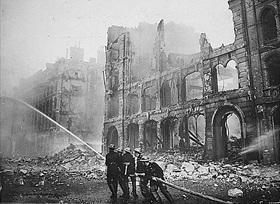
Right: Firefighters put out a blaze in London after a 1941 air raid. The Luftwaffe dropped around 45,000 short tons of bombs during the Blitz, disrupting production and transport, reducing food supplies, and shaking British morale. However, the Germans’ hoped-for effect from their aerial campaign never materialized. Britain was never moved to negotiate an armistice, nor was war production decisively weakened. Material U.S. assistance more than made up for temporary war and food production shortfalls.
 |
 |
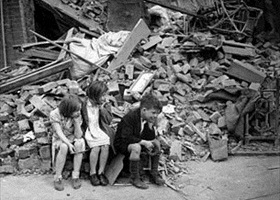
Left: Children of a London suburb, made homeless by the random bombs of Luftwaffe night raiders, wait outside the wreckage of what was their home, September 1940.
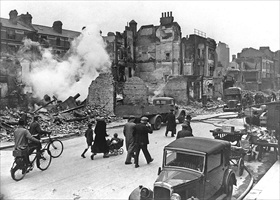
Right: A street of ruined houses in London. Though militarily ineffective, the Blitz caused enormous damage to Britain’s housing stock. Many sites of bombed buildings, when cleared of rubble, were cultivated to grow vegetables to ease wartime food shortages and were known as “victory gardens.”
 |
 |
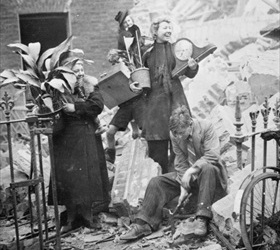
Left: Women salvage prized possessions from their bombed house, including plants and a clock.
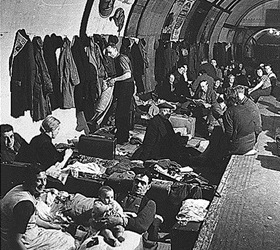
Right: A London Underground station serves as an air raid shelter during the Blitz, an all-to-common scene.
The Battle of Britain, July 10 to October 31, 1940: The RAF’s Finest Hour. Narrated by Charlton Heston

World War II was the single most devastating and horrific event in the history of the world, causing the death of some 70 million people, reshaping the political map of the twentieth century and ushering in a new era of world history. Every day The Daily Chronicles brings you a new story from the annals of World War II with a vision to preserve the memory of those who suffered in the greatest military conflict the world has ever seen.