

SECOND QUEBEC CONFERENCE MAPS VICTORY OVER AXIS
Quebec City, Quebec, Canada • September 16, 1944
On this date in 1944 the 4-day Second Quebec Conference ended with multiple agreements that shaped war-torn and postwar Europe for decades to come. Chief attendees were U.S. President Franklin D. Roosevelt, British Prime Minister Winston Churchill, and their combined military chiefs of staff. Also in attendance was long-time U.S. Treasury Secretary Henry Morgenthau, Jr. Among the significant agreements reached in Quebec concerned continued U.S. Lend-Lease aid to Great Britain, the Allied occupation zones in a vanquished Nazi Germany, and Morgenthau’s proposed plan to disarm and demilitarize Germany after its unconditional surrender.
Sometime between January and September 1944 Morgenthau drafted a memorandum titled “Suggested Post-Surrender Program for Germany” for Roosevelt’s consideration. Initially against Morgenthau’s proposal, Churchill was able to narrow its scope by drafting a new version, which ended up being signed by the 2 statesmen. That signing coincided with their signing a $6.5 billion long-term aid package to Great Britain, which Churchill desperately needed to see his nation through a war that was bankrupting it. To Roosevelt’s Secretary of State Cordell Hull, the 2 signings looked like a quid pro quo.
Morgenthau advocated harsh measures to ensure postwar Germany would be unable provoke a third world war. According to his original plan, Germany was to be demilitarized by completely disarming the German armed forces and people (including the removal or destruction of all war material), the total destruction of the whole German armaments industry, and the reduction or destruction of all civilian heavy industry that might have a military potential. Morgenthau likened these steps to “castrat[ing] the German people . . . so they can’t just go on reproducing people who want to continue the way they have in the past.” Production of aircraft, merchant ships, and locomotives, for instance, was prohibited. What was left of the German economy was to be restructured toward light industry and agriculture in accordance with Germany’s “approved peacetime needs.” Also, Germany was to be partitioned into 2 autonomous, independent states, one in the north and one in the south, after Germany’s eastern neighbor Poland was awarded Germany’s East Prussia and Silesia regions and Germany’s western neighbor France awarded Germany’s Saar and adjacent territories between the Rhine and Moselle rivers. The heavily populated Ruhr region (“the cauldron of wars”) was to be stripped of its industries, its skilled workers and families relocated, and the whole area turned into an international zone to be governed by an agency of the United Nations (see map below).
The Western Allies implemented some portions of the Morgenthau Plan following the Quebec conference. Some of them strongly influenced Joint Chiefs of Staff Directive 1067 signed by President Harry S. Truman on May 10, 1945. JCS 1067 directed U.S. occupation forces in Germany to “take no steps looking toward the economic rehabilitation of Germany [nor steps] designed to maintain or strengthen the German economy.” The new president succeeded in incorporating much of JCS 1067 (and indirectly the Morgenthau Plan) into the Potsdam Agreement, a “communiqué” that the victorious powers hashed out during their meeting in a Berlin suburb from July 17 to August 2, 1945. Following the Agreement’s implementation, German living standards declined and malnutrition and death rates rose above prewar levels.
Beginning in mid‑1946 many observers came to see JCS 1067 as inflicting undue hardship on Germans and limiting the ability of their country to recover from the devastating effects of the past decade. Truman’s new Secretary of State, retired Gen. George C. Marshall, citing U.S. security concerns following a fact-finding visit to Western Europe, was able to convince the president to rescind the punitive occupation directive JCS 1067 in 1947, 14 months after the Morgenthau Plan had been abandoned as official U.S. policy.
Exacting Revenge on Germany: The 1944 Morgenthau Plan
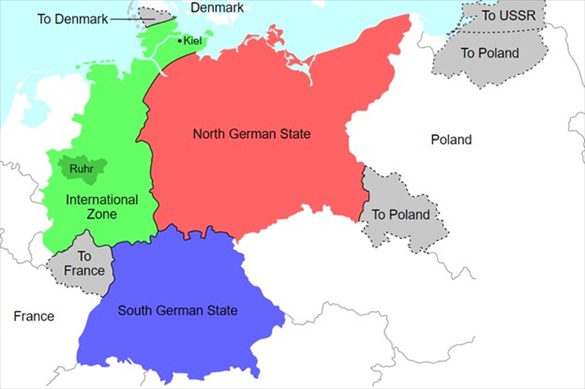 |
Above: Map of the 1944 Morgenthau Plan. The plan envisioned defeated Germany totally demilitarized and divided into three areas: a northern state, a southern state, and a de-industrialized International Zone in the west, administered by “an international security organization to be established by the United Nations.” The International Zone included the Ruhr area (dark green), regarded as Germany’s industrial heartland (coal, steel, armaments, chemicals), and the important Baltic naval port of Kiel. The intention was to prevent Germany from ever again being able to develop military industry or wage war. In addition, the Saar region and surrounding area, another important source of coal and industry for Germany, was to be ceded to France. To Poland would go most of Silesia and southern East Prussia; to the Soviet Union, northern East Prussia; and to Denmark, northern Schleswig. The Morgenthau Plan, in the sense of the plan drafted by Morgenthau or the plan initialed by Roosevelt, was never implemented. In April 1948 a new plan, informally named after President Truman’s Secretary of State George C. Marshall, was in place. The $13 billion, 4‑year Economic Recovery Program helped European economies (apart from those of the Soviet satellites trapped behind the Iron Curtain in Central and Eastern Europe) quickly recover and modernize their industrial and business practices along American lines. Besides instilling a sense of hope and self-reliance in war-weary Europeans, the Marshall Plan also stimulated the political reconstruction and economic integration of Western Europe, which today finds expression in the 27‑member‑state European Union.
 |
 |
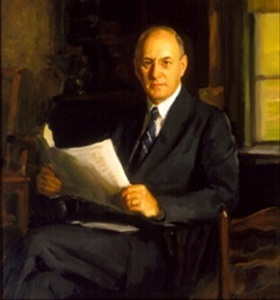
Left: Henry Morgenthau, Jr. (1891–1967) was U.S. Secretary of the Treasury during all but one year of President Franklin D. Roosevelt’s administration. He played a major role in designing and financing Roosevelt’s New Deal, which was a series of welfare programs and financial reforms that helped lift the nation out of a deep depression. His biggest domestic success was the new Social Security program, signed into law in 1935. During the World War II era he was the godfather of the massive public relations campaign to finance U.S. participation in the war through the sales of war bonds. More than 85 million Americans purchased bonds totaling $185.7 billion. As the only Jewish member in Roosevelt’s cabinet, Morgenthau pushed the president to create the U.S. War Refugee Board in January 1944, which helped save as many as 200,000 European Jews from Nazi extermination. On the international stage at the 1944 Bretton Woods Conference, Chairman Morgenthau was present at the creation of the International Monetary Fund and World Bank. And, of course, he was the author of the 1944 Morgenthau Plan, a proposal to prevent Germany from ever again becoming an international military threat.
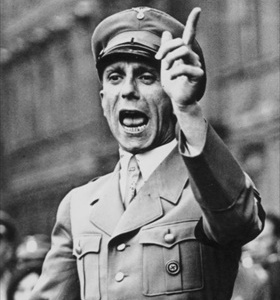
Right: Joseph Goebbels (1897–1945) was German Minister of Propaganda from 1933 to 1945. A virulent anti-Semite, Goebbels was one of Adolf Hitler’s closest and most devoted acolytes, choosing suicide for him and his family hours after Hitler and his wife had ended their lives in the ruins of the Nazi capital, Berlin. Upon learning the details of the Morgenthau Plan, Goebbels was able to use its existence to bolster German resistance on the Western Front, telling his media audience that “the Jew Morgenthau” planned the enslavement of Germany. Screamed a headline in the Voelkischer Beobachter, the official newspaper of the Nazi Party (circulation 1.7 million in 1944): “ROOSEVELT AND CHURCHILL AGREE TO JEWISH [Morgenthau] MURDER PLAN!” The Washington Post urged the Roosevelt administration to stop giving Goebbels ammunition: if the Germans suspect that nothing but complete destruction lies ahead, then they will fight on. Roosevelt’s Republican opponent in the 1944 presidential election complained in his campaign that the Germans had been terrified by the plan into fanatical resistance: “Now they are fighting with the frenzy of despair.” A member of the War Department said the Morgenthau Plan was worth 30 German divisions.
Appraisal of the 1944 Morgenthau Plan

World War II was the single most devastating and horrific event in the history of the world, causing the death of some 70 million people, reshaping the political map of the twentieth century and ushering in a new era of world history. Every day The Daily Chronicles brings you a new story from the annals of World War II with a vision to preserve the memory of those who suffered in the greatest military conflict the world has ever seen.