

HUGE NAVAL BATTLES IN AND AROUND LEYTE GULF
Off the Coast of Leyte Island, the Philippines • October 23, 1944
Allied campaigns from August 1942 to early 1944 had driven Japanese forces from many of their South and Central Pacific island bases, while isolating many of their other bases in the same area. The Allies bypassed a few Japanese bases like Rota in the Marianas as they muscled their way past Japan’s so-called “absolute defense perimeter,” that country’s chain of frontline land, air, and naval bases in the Pacific. They chose instead to capture neighboring Saipan, Guam, and Tinian islands. However, the considerable air power Japan had amassed in the Philippines, a U.S. territory that had fallen to the enemy when the last American garrison was overpowered in May 1942, was thought to be too dangerous to bypass en route to attacking the Japanese homeland. In a series of exchanges between Gen. Douglas MacArthur, Allied Supreme Commander, Southwest Pacific Area, and the Joint Chiefs of Staff in Washington, D.C., in August and September 1944, the Philippines was identified as the next strategic target. It was decided that MacArthur’s triad force, consisting of the U.S. Sixth Army, the U.S. Seventh Fleet, and the U.S. Fifth Air Force, would invade the island of Leyte (see map below) and fulfill the general’s 1942 promise to return to Philippine soil.
On October 20, 1944, an Allied fleet of more than 730 transport, supply, and escort vessels, supported by aircraft carriers and 100 warships, disgorged 160,000 U.S. troops onto Leyte Island. Three days later on this date, October 23, 1944, and over the next several days, air and naval forces of the Imperial Japanese Navy counterattacked in the do-or-die-trying Battle of Leyte Gulf, which actually consisted of 4 separate engagements by 4 Japanese fleets: the Battle of the Sibuyan Sea (October 23–24), the Battle of Surigao Strait and the Battle off Samar (October 25), and the Battle of Cape Engaño (October 25–26). Separated by great distances, these individual battles are counted together by virtue of their all being caused by the IJN’s Operation Sho-Go (Victory). The Battle of Leyte Gulf is notable on multiple counts: it was the largest naval battle of World War II in terms of engagement area and tonnage (342,310) sunk; it was the last naval battle between battleships in history (Battle of Surigao Strait); and it was the first naval battle in which Japanese aircraft successfully carried out organized kamikaze attacks (Battle off Samar).
In three days the Japanese Navy suffered its greatest loss of ships and crew ever—26 out of 60 frontline warships. The Americans had 8 fleet carriers, the same number of light carriers, 18 escort carriers, and 1,500 carrier planes. These were arrayed against 3 Japanese light carriers and a single fleet carrier, the veteran Zuikaku, the only surviving carrier from the 6 that had attacked Pearl Harbor on December 7, 1941. The U.S. lost escort carriers Gambier Bay and St. Lo and the light carrier Princeton. American casualties were about 3,000 dead and wounded to about 12,500 dead Japanese sailors and aviators. Of 9 Japanese battleships, 3 were sunk, with a loss of no American battleship.
The IJN’s failure to dislodge the Allied invaders from their Leyte beachheads presaged the inevitable loss of the Philippines. The loss of the Philippines in turn meant that resource-poor Japan would be all but cut off from the Pacific and Southeast Asian territories still in Japanese hands. Those overseas territories had been using a wide variety of maritime vessels, diminished month by month by Allied submarine attacks, to deliver resources (oil, rubber, tin, bauxite ore, and foodstuffs) vital to Japan’s wartime economy and its overseas garrisons. Losing the Philippines spelled finis for the Empire of Japan.
The Philippines and the Chief Players in the Battle of Leyte Gulf
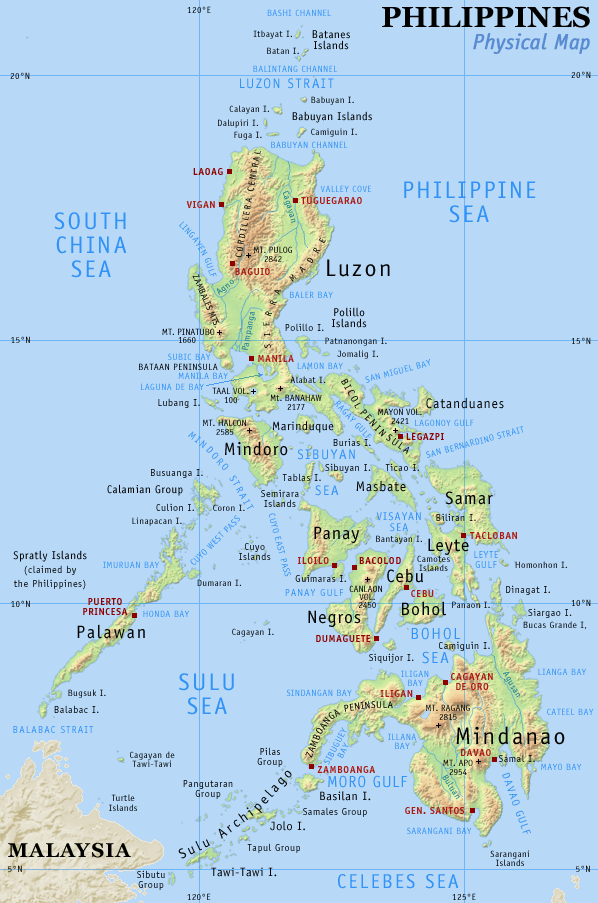
Above: Map of the Philippines showing the location of Leyte Island and Leyte Gulf, which are on the eastern side of the Philippine archipelago and close to its middle. Sharing Leyte Gulf is Samar Island, off which one of 4 naval engagements in the 3‑day Battle of Leyte Gulf took place (on October 25, 1944). The Sibuyan Sea is to the east of Mindoro Island, where a U.S. air attack occurred (October 24). The Surigao Strait is in the very south of Leyte Gulf (October 25) and Cape Engaño is the thumblike peninsula at the northern end of the large island of Luzon (October 25–26). Note the location of the San Bernardino Strait north of Samar Island.
 |
 |
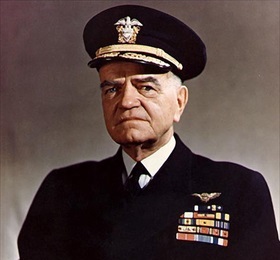
Left: Adm. William F. “Bull” Halsey (1882–1959) commanded the U.S. Third Fleet in June 1944 for the advance on the Japanese-held Philippines. While providing more distant cover and support for the invasion of Leyte Island than Adm. Thomas Kinkaid’s close-in Seventh Fleet, Halsey fell for Japanese Vice Adm. Jisaburō Ozawa’s ruse and led his 64‑ship fleet northward after 17 decoy ships. This left both the eastern end of the San Bernardino Strait unguarded to in-and-out passage (which in fact occurred) and MacArthur’s invasion forces on Leyte’s beaches vulnerable to an attack by other Japanese naval forces approaching from the west. In spite of the clear danger his absence posed to the success of MacArthur’s enterprise, Halsey succeeded in destroying the remnants of Japan’s naval air power by sinking all 4 of Ozawa’s carriers (containing a paltry 100 or so aircraft) in the Philippine Sea before disengaging from battle (Battle of Cape Engaño) and reversing course.
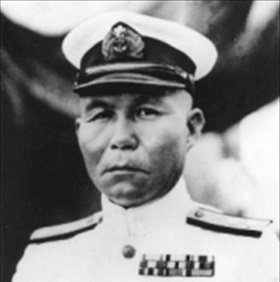
Right: Vice Adm. Jisaburō Ozawa (1886–1966) was responsible for Japanese naval operations in the South China Sea and was the last commander of what little remained of the Combined Fleet, which Halsey’s Third Fleet had earlier decimated in the Battle of the Philippine Sea (aka Great Marianas Turkey Shoot) in June 1944. At the Battle of Cape Engaño (October 25–26, 1944), Ozawa, who commanded the IJN’s Main Force (Northern Force) came the closest of any Japanese commander to inflicting a reverse on the U.S. Pacific Fleet by his diversionary ruse.
History Channel: The Battle of Leyte Gulf (October 23–26, 1944)

World War II was the single most devastating and horrific event in the history of the world, causing the death of some 70 million people, reshaping the political map of the twentieth century and ushering in a new era of world history. Every day The Daily Chronicles brings you a new story from the annals of World War II with a vision to preserve the memory of those who suffered in the greatest military conflict the world has ever seen.