

ROYAL NAVY ENDS THREAT TO ARCTIC CONVOYS
London, England · December 26, 1943
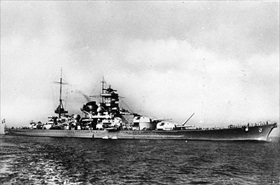
The Scharnhorst was a German capital ship, variously described as a battleship and battlecruiser of the German Kriegsmarine. Launched in 1936 and completed in 1939—her nine‑gun, triple turrets the pride of the Kriegsmarine—the 31,500‑ton ship was sister ship to the Gneisenau. During much of the early part of the war, the Scharnhorst and the Gneisenau operated in tandem, often making sorties into the Atlantic to raid British merchant shipping in a manner reminiscent of the German “pocket battleship” Admiral Graf Spee, which had been scuttled by her captain off the South American port of Montevideo, Uruguay, on December 17, 1939 (Battle of the Atlantic).
Both Scharnhorst and Gneisenau were called upon to assist in the German invasion of Norway in April 1940, and both warships were involved in the action that sank the British aircraft carrier HMS Glorious and its two escorting destroyers later that year, on June 8, 1940, off the Norwegian port of Narvik. In an air raid on the German Baltic port of Kiel on February 26–27, 1942, the RAF heavily damaged the Gneisenau, and the ship was decommissioned in July 1942.
On this date in 1943, in the European Theater’s last classic naval duel between capital ships, the Scharnhorst was sunk in severe weather off Norway’s North Cape while attempting to intercept a convoy of 19 cargo vessels bound for Murmansk, one of two ports in the Soviet Union’s extreme northwest (the other was Archangel) to which the Allies dispatched war materiel, heavy equipment, and food used to fight Axis armies on what was called the Eastern Front. The unescorted Scharnhorst was first hit by four torpedoes launched by British and Royal Norwegian destroyers. Battered and crippled, unable to flee, the Scharnhorst was then subjected to a deluge of radar-assisted fire control shells and more torpedoes (in all 55 torpedoes, 11 of which hit their mark, and 2,195 shells) by the British battleship Duke of York, three cruisers, and six destroyers. Within minutes, the ship capsized and sank stern first, her propellers still spinning, leaving only 36 survivors of the 1,900‑man crew to be plucked from the frigid waters. The Scharnhorst’s destruction in the Battle of North Cape (December 26, 1943) effectively ended German efforts to interdict Russia-bound Arctic convoys.
[fblike]
[amazon_carousel widget_type=”ASINList” width=”600″ height=”200″ title=”Recommended Reading” market_place=”US” shuffle_products=”False” show_border=”False” asin=”159114325X,184884557X,1841763276,159114177X,1591145600,1591146437,1783036389,B0057FIHIA,1591143691,1591146518″ /]
Arctic Convoys, 1941–1945, and Sinking the Scharnhorst
 |
 |
Left: The loss of the German battleship Scharnhorst demonstrated the vital importance of radar in modern naval warfare for locating and destroying enemy warships. While the Scharnhorst should have been able to outgun all of her opponents except the Royal Navy’s battleship Duke of York, the early loss of the Scharnhorst’s radar-assisted fire control, combined with the problem of inclement weather, left her at a distinct disadvantage. In the aftermath of the Battle of North Cape, as the sea encounter was called, Admiral Karl Doenitz of the Kriegsmarine remarked, “Surface ships are no longer able to fight without effective radar equipment.” This led Doenitz to a shift in emphasis from surface raiders to U‑boats. Some heavy German warships were physically dismantled and their weapons used in coastal fortifications.
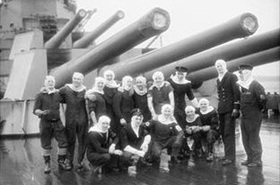
Right: Gun crews of HMS Duke of York under the ship’s 14‑in guns at Scapa Flow, Scotland, January 1, 1944, after sinking the Scharnhorst on December 26, 1943. Crew members are wearing anti-flash gear, a personal protective equipment consisting of a fire-resistant hood and fire-resistant gloves. In October 2000 the heavily damaged wreck of the Scharnhorst was found 66 miles north-northeast of North Cape, upside down some 950 ft below the ocean’s surface.
 |
 |
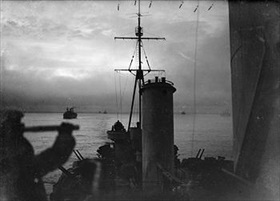
Left: Twilight view from the cruiser HMS Sheffield sailing on convoy duty through the waters of the Arctic Ocean, December 1941. In the background are merchant ships of the convoy. Between August 1941 and May 1945, 78 ocean-going convoys, consisting of roughly 1,400 merchant ships, delivered essential supplies to the Soviet Union under the U.S. Lend-Lease program, escorted by British, Canadian, and U.S. Navy warships.
Right: Monument to the participants of the Arctic convoys to Murmansk. Eighty-five merchant vessels and 16 Royal Navy warships were lost to the Kriegmarine’s surface ships and submarines, as well as to a large number of German aircraft. The convoys demonstrated the Allies’ commitment to helping the Soviet Union during the “Great Patriotic War,” as the Soviets called their war against the Axis. Combating the Allies’ Arctic convoys tied up a substantial part of Germany’s Kriegsmarine and Luftwaffe, not to mention tying up British resources that could have been used to deter the Japanese Navy in the Indian Ocean and the waters off Southeast Asia. Toward the end of the war the military importance of supplies delivered by Arctic convoys was likely symbolic, as fighting on the Eastern Front had reached a turning point in favor of the Soviet Union.
End of the Scharnhorst, December 26, 1943

World War II was the single most devastating and horrific event in the history of the world, causing the death of some 70 million people, reshaping the political map of the twentieth century and ushering in a new era of world history. Every day The Daily Chronicles brings you a new story from the annals of World War II with a vision to preserve the memory of those who suffered in the greatest military conflict the world has ever seen.