

GLUM DAMPENS GERMAN CHRISTMAS SPIRITS
Berlin, Germany • December 25, 1941
On this date in 1941 Japanese citizens celebrated the 15th anniversary of the succession to the Imperial Throne of Emperor Hirohito (posthumously referred to as Emperor Shōwa), according to tradition the 124th direct descendant of Jimmu, the legendary first ruler of the Empire of the Rising Sun. Festive toasts invoked the Imperial reign, 2½ weeks after Japan provoked the United States into war against that country and its Axis partners, Germany and Italy.
Half a world away, people all over Germany celebrated Christmas as best they could. Because the new religion of the Reich was Nazism, Germans were forbidden to send Christmas cards, or even New Year’s greetings, which had become a covert substitute, allegedly because they wasted valuable paper. Adolf Hitler’s minister of information and czar of public communication, Joseph Goebbels, forbade radio stations to play Christmas hymns except for “O Tannenbaum,” whose words made no reference to the Christian holiday. Trees were scarce and candles rationed, so even the 200‑year-old German tradition of placing gifts around a lighted tree on Christmas Eve took a drubbing.
There wasn’t much worth celebrating, it seemed, anyway. To the east, in a white Russian netherworld where temperatures stood at ‑36°F/‑37.7°C, fuel froze, machine guns ceased firing, German soldiers lacking cold-weather gear died from severe frostbite, and only a few replacements for worn-out men and materiel were available. (The same cold weather, typical for the season, hit Soviet troops and equipment, but they were better prepared.) The Nazis’ June 1941 invasion of the Soviet Union, Operation Barbarossa, and their planned October coup de grâce, Operation Typhoon, which aimed to knock the Soviet Union out of the war by capturing its capital and largest city, Moscow, had ended in a single reconnaissance battalion seizing a bridge over the Moscow-Volga Canal and glimpsing through a telescope the fabled spires of the Kremlin 14 miles/22.5 km in the distance—this on December 2, 1941—but that’s as close as any soldier in Hitler’s army ever got to the end goal. Facing a slew of battlefield reversals and limited unsanctioned withdrawals by his army (Heer) generals in the first 3 weeks of December, Hitler assumed complete control of the battered German army 6 days before Christmas in an effort to forbid further shameful episodes
Germany’s Eastern Front, Late 1941
 |
 |
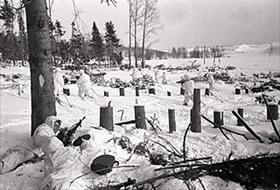
Left: Camouflaged Soviet soldiers on the forest’s edge in the Moscow region, December 1941.
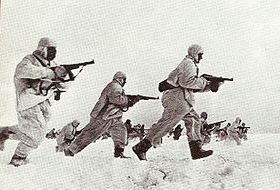
Right: Soviet soldiers during a counterattack on German positions during the Battle of Moscow, December 1941.
 |
 |
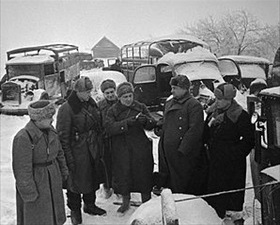
Left: The commander of the Soviet 16th Army, Lt. Gen. Konstantin Rokossovsky (second on left), and his staff examine captured German vehicles, December 10, 1941.
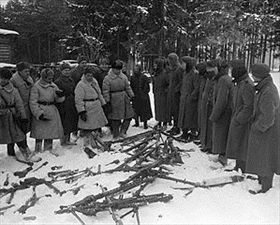
Right: Remains of a defeated Nazi unit after its surrender, December 20, 1941.
 |
 |
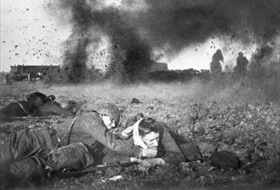
Left: Fighting in the vicinity of Moscow, September 21, 1941.
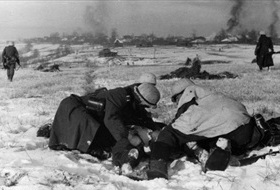
Right: Germans evacuate their wounded in the winter of 1941 against the backdrop of a burning Russian village near Moscow.
 |
 |
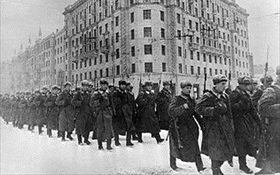
Left: Fresh Soviet troops march through Moscow on their way to the front, December 1, 1941.
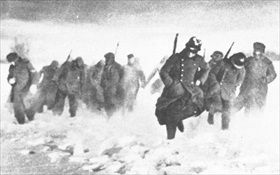
Right: German soldiers during the retreat from Moscow, 1941. The number of casualties on the Soviet and German sides is open to debate, partly because the dates for the Battle of Moscow (as it is known in Russia) or Operation Typhoon (German offensive against Moscow) are variously given and partly owing to the elastic scope of battle. Perhaps the best approach is to say that estimated casualties between September 30, 1941, and January 7, 1942, range from 174,000 to 400,000 for Germany’s Army Group Center and from 650,000 to 1,280,000 for the Soviet Red Army. Regardless of the huge spread between the low and high numbers, the Battle of Moscow must be considered among the most lethal campaigns in World War II.
Hitler’s Strategic Gamble: Operation Barbarossa, 1941

World War II was the single most devastating and horrific event in the history of the world, causing the death of some 70 million people, reshaping the political map of the twentieth century and ushering in a new era of world history. Every day The Daily Chronicles brings you a new story from the annals of World War II with a vision to preserve the memory of those who suffered in the greatest military conflict the world has ever seen.