

PRIME MINISTER HIDEKI TŌJŌ SACKED
Tokyo, Japan • July 18, 1944
On this date in 1944 Prime Minister, War Minister, Home Minister, and Chief of Army General Staff Hideki Tōjō was removed from office with the blessing of Emperor Hirohito (posthumously referred to as Emperor Shōwa). Up until this date the scrawny, owlish Tōjō had enjoyed the confidence of his emperor. Indeed, it was Hirohito who supported Tōjō’s February 1944 proposal to allow the War Minister to assume the country’s highest military office as Chief of the Imperial Army General Staff. The shattering February 17–18, 1944, loss of Japanese naval bases on the Truk (Chuuk) Islands in the Carolines, which were located within Japan’s absolute defense perimeter, called for extraordinary measures in the emperor’s mind.
Concentrating Japanese military, civilian, and now army functions in one man in February 1944 was intended to unite the military and the government to ensure a more robust management of Japan’s war effort against the Western Allies. Japan in 1943 and 1944 had been unable so far to stop or reverse Allied offensives in the South Pacific, and Hirohito felt he had to intervene in the long-standing rivalry between the Japanese Army and Japanese Navy, the latter which had lost the emperor’s trust, to ensure a unity of command under senior Army general Tōjō.
The anti-Tōjō group comprised many naval officers and senior civilian statesmen, including Prince Fumimaro Konoe whom Tōjō had replaced in the prime minister’s slot in the run-up to the Pacific War. The twin defeats of the Japanese Fifteenth Army at Imphal and Kohima on the Burma-India border in June–July 1944 by Lt. Gen. William Slim’s British Fourteen Army and the annihilation of the Japanese 31st Army garrison on Saipan in the same time period helped sway Hirohito into backing the anti-Tōjō coalition and force the removal of his faithful servant from all positions of power on July 18, 1944. The possibility of ending hostilities, which gnawed on Hirohito’s mind for years, seemed closer at hand than any time since December 8, 1941, the day after Pearl Harbor.
Still, a year passed before Hirohito announced the first of 2 seidans (sacred imperial decisions) at a midnight Imperial Conference (Gozen Kaigi) of top government and military officials on August 9/10, 1945, to terminate the war. “The time has come when we must bear the unbearable,” was how the emperor put it to his audience. Though an ever-shrinking minority, Japanese diehard militarists were determined to fight the Allies to the bitter end, which of course was what it had come down to following the atomic destruction of Hiroshima and Nagasaki on August 6 and 9, respectively. The second seidan on August 14 was Hirohito’s acceptance of the Allies’ nonnegotiable surrender terms. With the emperor’s next-day, first-ever radio broadcast to his subjects, his 4‑minute jewel voice capitulation speech (Gyokuon-hōsō), the Pacific War came to an abrupt end. The Allies arrested Tōjō and executed him on December 23, 1948, but spared his chief patron the same fate.
Noriko Kawamura’s Emperor Hirohito and the Pacific War provides a realistic reappraisal of Japan’s Hirohito few Westerners would recognize whenever they are reminded of Pearl Harbor and the Pacific conflict. This owes largely to Kawamura’s drawing on a huge number of primary and secondary Japanese-language sources—some of them only recently available to scholars. Mining them Kawamura draws a portrait of an emperor personally against waging war with the West, all the while officially sanctioning (as required by the Japanese [Meiji] constitution) state decisions that led to the events of December 7, 1941. Once Japan’s leaders launched their nation’s high-risk campaign to seize Western colonial interests, Hirohito assumed the mantle of supreme commander in chief (daigensui) of all Japanese armed forces, again as required under the constitution. Kawamura portrays Hirohito growing ever more skeptical of a favorable military outcome as Japanese victories over the enemy proved more elusive month after month. Terrified by the prospect of “Japan’s annihilation,” as Hirohito himself put it, the emperor at last flexed his moral muscles in a set of imperial prerogatives (seidans), taking on the fire-breathers in the war faction to end the conflict he never wanted. To his dying days in January 1989 the Hirohito of Kawamura’s account privately agonized over his not nipping in the bud the calamity that his pro-war military and their ultranationalist and financial (zaibatsu) supporters were poised to inflict both on his loyal subjects and on tens of millions more who would suffer, be injured or maimed, or lose their lives in the Pacific War.—Norm Haskett
Two Notable Events in Mid-1944 Determining Japan’s Irreversible Fate
 |
 |
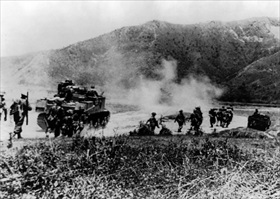
Left: Gurkhas advancing with M3 medium tanks to clear the Japanese from the Imphal-Kohima road in Northeastern British India. The thrashing Lt. Gen. William Slim’s British Fourteenth Army’s gave the Japanese 15th Army at Imphal and Kohima (March 9 to July 3, 1944) was the largest defeat to that date in Japanese history. Japanese casualties at Imphal numbered 55,000, including 13,500 dead. Casualties and losses at Kohima numbered upwards of 7,000. Most of these losses were the result of starvation, malaria, dysentery, and exhaustion. Casualties among British, Gurkha, and Indian soldiers were 17,500 and just over 4,000 at Imphal and Kohima, respectively, almost entirely from battle. In subsequent operations in the Burma Campaign, the Japanese Army continued to suffer massive losses—a total of some 106,000 killed and wounded through August 1945. After the Battle of Meiktila and Mandalay and Operation Dracula (both occurring in January–March 1945) Japanese forces were all but driven from Burma.
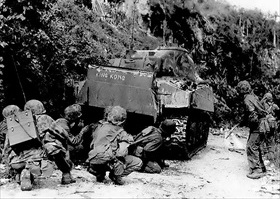
Right: Beginning June 15, 1944, 71,000 U.S. Marines and soldiers under the command of Marine Gen. Holland M. Smith began their successful amphibious assault on Saipan, at 15 miles/24 kilometers long and 8 miles/13 kilometers wide the largest Japanese island-fortress in the Northern Marianas. American airbases there would put the Allies well within the range of an air campaign against Japan’s Home Islands by the U.S. XXI Bomber Command using Boeing’s new B‑29 long-range bombers. In this photo U.S. Marines take cover behind a M4 Sherman tank while clearing the enemy from the northern end of Saipan, July 8, 1944. The loss of 29,000 servicemen and 22,000 civilians during the Battle of Saipan (June 15 to July 9, 1944) was a heavy blow to Tōjō’s military and civilian administration. (American dead were 3,000, wounded 10,000, the highest casualty toll to date in the Pacific.) “Our war was lost with the loss of Saipan” was the sentiment of many senior Japanese leaders, though Tōjō’s cabinet insisted the war was still a draw and argued staying the course. In the face of intense political criticism, however, the unpopular Tōjō submitted his resignation on July 17, 1944. Hirohito accepted it the next day.
History Channel Presentation: U.S. Captures Saipan, June 15, 1944

World War II was the single most devastating and horrific event in the history of the world, causing the death of some 70 million people, reshaping the political map of the twentieth century and ushering in a new era of world history. Every day The Daily Chronicles brings you a new story from the annals of World War II with a vision to preserve the memory of those who suffered in the greatest military conflict the world has ever seen.