

POTSDAM CONFERENCE TO REDRAW EUROPE’S BORDERS
Berlin Suburb of Potsdam, Germany • July 17, 1945
After Nazi Germany’s fuehrer (leader) Adolf Hitler committed suicide on April 30, 1945; and after Hitler’s political successor Reich President Grand Admiral Karl Doenitz agreed to the unconditional surrender of all German armed forces on May 7 and 8, 1945; and after Gen. Dwight D. Eisenhower, Supreme Commander Allied Expeditionary Force, dissolved Doenitz’s government on May 23; and after Allied representatives placed German governance under the authority of the Allied Military Occupation Government on June 5, it was time for the world’s top 3 statesmen and their chief civilian and military advisors to meet face to face to negotiate a just and lasting peace under which a new Europe could emerge.
That meeting, the third between a U.S. President but the first between Harry S. Truman, British Prime Ministers Winston Churchill and his successor Clement Attlee, and Soviet Premier Joseph Stalin, got underway on this date, July 17, 1945, in Berlin’s relatively undamaged, picture-postcard suburbs of Potsdam and Babelsberg, temporarily absent their local citizenry. Among the agenda items pushed by the planners of the Potsdam Conference (codenamed Terminal) was the establishment of a new postwar order that would rectify the defects of the past 3 decades. Since the Big Three’s last meeting in Yalta, Soviet Crimea, 5 months earlier, Stalin’s armies had overrun the 3 Baltic States, Poland, Czechoslovakia (today’s Czech Republic and Slovakia), Hungary, Romania, Bulgaria, and half of prewar Germany (Central [now Eastern] Germany, East and West Prussia, Pomerania, and Upper and Lower Silesia). The Western Allies had helped expel Hitler’s armies from Norway, Denmark, the Netherlands, Belgium, and Italy. (France had been liberated the year before.) The victors had divided Germany and Austria into 4 occupation zones each. Thus Europe was roughly divided longitudinally through Central Europe, with Western democratic regimes planted in the West and Soviet-style satellite regimes in the East.
Early in their discussions in Potsdam the Big Three faced up to a military fait accompli by accepting the bifurcation of Europe into West and East. The issue of establishing new national borders in Central and Eastern Europe based largely on ethnic homogeneity, however, dominated what came next, especially as it affected Poland and neighboring Germany. Nazi Germany’s annexations in the East were reversed, and the country’s eastern border was shifted westwards to the Oder and Neisse Rivers, effectively reducing prewar Germany in size by close to 25 percent (see map below), while over 28,000 sq. miles/72,520 sq. kilometers of Eastern Poland were annexed by the Soviet Union, today forming western Lithuania, Belarus, and Ukraine (not shown in map). German populations in newly configured Poland, Czechoslovakia, Hungary, and the Soviet Union were to be expelled from their ancestral homelands “in an orderly and humane manner.”
The orderly and humane expulsion of alien nationals never happened. The creation by the 3 victorious powers of ethnically homogeneous nation states in Central and Eastern Europe, in which every nation state would supposedly have and live within defensible borders, gave rise to an appalling series of forced population transfers and resettlements (we know them today as “ethnic cleansing”), not just of ethnic Germans, but of Eastern Poles, Hungarians, Romanians, Ukrainians, and others who after the war found themselves outside the borders of their reconfigured home states. The largest single ethnic population upheaval in European history displaced more than 20 million people in total, of which between 12 and 14 million were German citizens and foreign ethnic Germans. During the upheaval over 2 million civilians, mostly women and children, died from hunger, disease, and violence; indeed, 10–30 percent of those affected were killed.
Potsdam Conference Sets Off Large-Scale Population Upheaval and Resettlement. Poland and Czechoslovakia Provide Examples
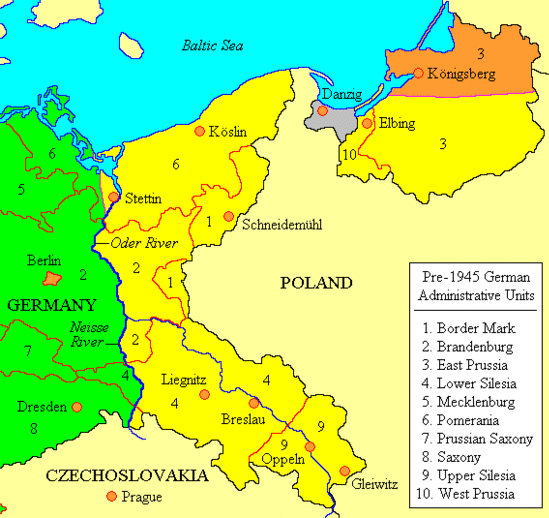
Above: With the stroke of a pen all prewar German territories east of the dark blue north-south Oder-Neisse line—comprising nearly one quarter (23.8 percent) of the country—were severed from those to the west under border changes promulgated at the Potsdam Conference (July 17 to August 2, 1945). The dark yellow region (called the Poland Administrative Area by the Soviets) and the gray region encompassing the port city of Danzig—both regions populated almost exclusively by Germans—became part of postwar Poland. The rust-colored remainder, consisting of northern East Prussia with the large German city and ice-free port of Koenigsberg (now renamed Kaliningrad), was allocated to the Soviet Union as the Kaliningrad Oblast of today’s Russia even though it sat in ethnically Polish and Lithuanian territory. Nearly all ethnic Germans in these reshuffled territories of Central and Eastern Europe—estimated at roughly 12 million as of autumn 1944—fled west on foot or by available transport or were later forcibly expelled, adding another 2 million impoverished and displaced persons (DPs) to this frantic exodus of frightened men, women, and children. On July 21 at Potsdam Stalin told Truman and Churchill: “There are no Germans left [east of the Oder-Neisse].” Truman sought clarification: “Where are the nine million Germans?” Stalin shrugged, “They have fled.” Another 7.8 million DPs in Germany had been involuntary foreign laborers and recently released inmates from prisoner of war and death camps. Over 2 million DPs, mostly women and children, perished from disease or starvation or were killed in revenge-driven ethnic cleansing (10–30 percent) during this mass migration of more than 20 million people, of which 13.5 million were Germans and upwards of 4 million were Poles uprooted from areas that became parts of the Soviet Socialist Republics of Lithuania, Belorussia (Belarus), and Ukraine. Such was the price of peace.
 |
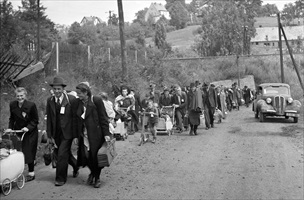 |
Left: A group of expelled Sudeten Germans from Czechoslovakia. During the war the Czechoslovak government-in-exile pursued a 2‑fold policy: (1) restore Czechoslovakia to its pre-1938 (pre-Munich) boundaries and (2) remove or at least reduce, through a combination of minor border rectifications and population transfers, the state’s German and Hungarian minorities in order to restore the territorial integrity of Czechoslovakia, establish greater national homogeneity, and reduce the potential risk of their becoming fifth columnists. Czechoslovak president Eduard Beneš, in a May 19, 1945, decree labeled the 3 million ethnic Germans and Hungarians “unreliable for the state,” meaning traitorous citizens based on wartime Nazi activities, clearing the way for nationwide confiscations and expulsions of people who found themselves on the wrong side of the Czechoslovak border.
Right: Carrying suitcases, pushing baby carriages and improvised handcarts loaded with few remaining belongings, Sudeten Germans make their way to the railway station in Liberec, Czechoslovakia, to be transferred to Germany in this July 1946 photo. The widely expressed urge to create ethnically homogeneous nation states in Central and Eastern Europe was presented as the key reason for the official decisions of the 1945 Potsdam and previous Allied conferences as well as the resulting expulsions of alien residents. President Franklin D. Roosevelt called forced population transfer measures “harsh” but acceptable if they were “the only way to maintain peace” between quarreling ethnicities. Prime Minister Churchill agreed. But the wrinkle was this: With so many national borders shifting or having shifted, to which countries should these refugees and displaced persons be repatriated? Was it ever justified, for example, for non- and anti-communist refugees to be repatriated against their will to countries under Soviet domination perhaps to suffer false arrest, arbitrary imprisonment, or a worse fate? And what about Jewish survivors of the Holocaust? President Truman took a crucial step of ordering that Jews be identified and registered as Jews, not by their prewar nationality. The cold reality was, first, some European states wanted neither the Jews they had nor their Jews to return, and, secondly, European Jews had no state of their own to offer them asylum before the state of Israel was established in May 1948 on termination of the British mandate of Palestine.
 |
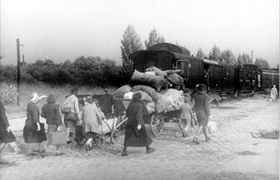 |
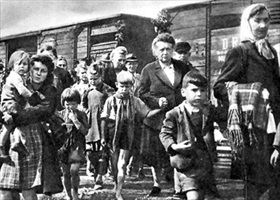
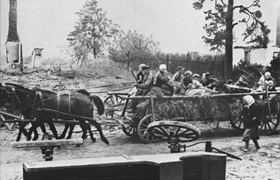
Left: East Prussian “repatriants” from what is today Poland drive past ruins to reach the safety of Germany, 1945. By the end of the war in Europe an estimated 5.6 million ethnic Germans had fled their homes in the East, up from 3.5 million in January 1945, often with nothing but the clothes on their back and what they could carry. Poles believed the expulsion of Germans from postwar Poland would avoid future atrocities like those the Nazis had inflicted on their population during the war. Polish authorities in exile abroad proposed a population transfer of Germans as early as 1941. During the war the Polish government-in-exile and the Czechoslovak government-in-exile, both located in England, worked toward making this happen as soon as Nazi Germany was defeated. The 1923 Treaty of Lausanne had set such a precedent when 1.5 million ethnic Greeks from Turkey and 500,000 Muslims from Greece had been forcibly removed and resettled.
Right: With their modest possessions, refugees from Germany’s “lost Eastern [Polish] territories” make their way to Berlin’s Pankow freight station to secure rail transportation to other parts of Germany. The postwar Polish and Czechoslovak governments characterized the forced exile and confiscation of expellees’ property as “a just punishment for Nazi crimes.”
 |
 |
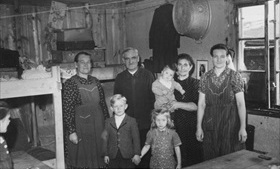
Left: A family, possibly from Czech Sudetenland, takes up new residence in a refugee camp in Bavaria in 1945. The expulsion of ethnic Germans from areas outside the redrawn borders of post-Nazi Germany created major social disruptions in the receiving German states (Laender). The states were hard pressed to provide millions of new residents with decent housing, schooling, employment, and financial assistance. An estimate from the year 2000 suggested that as many as 20 percent of Germany’s 80 million citizens were expellees and their descendants.
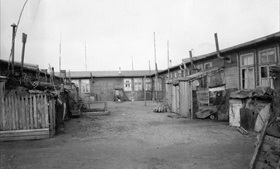
Right: A photo from 1951 of barracks in a refugee camp in Schleswig-Holstein, Northern Germany, shows the poverty into which many refugees, many who were well-to-do and privileged before the war, were forced to settle.
U.S. Army 1945 Newsreel, “Searchlight on Displaced Persons”

World War II was the single most devastating and horrific event in the history of the world, causing the death of some 70 million people, reshaping the political map of the twentieth century and ushering in a new era of world history. Every day The Daily Chronicles brings you a new story from the annals of World War II with a vision to preserve the memory of those who suffered in the greatest military conflict the world has ever seen.