

OPERATION HANNIBAL TO RESCUE TRAPPED SOLDIERS AND CIVILIANS
Gotenhafen, German-Occupied Poland • January 23, 1945
On this date in 1945 German Grand Adm. Karl Doenitz launched Operation Hannibal, a seaborne evacuation or, as Germans called it, a rescue operation (Rettungsaktion) of well over a million people trapped by war in Latvia, East Prussia, and German-occupied Poland. Mounted by naval, merchant marine, and civilian vessels, Operation Hannibal dwarfed the better-known British-coordinated Operation Dynamo (May 26 to June 4, 1940) that evacuated more than 338,000 British, French, and Belgian soldiers trapped by the German Wehrmacht (military) on beaches in Northwestern France. By contrast, the number of German evacuees transported west across the Baltic Sea to relative safety in occupied Poland, Germany, and German-occupied Denmark in 1945 runs from 800,000 to 900,000 civilians and 350,000 combatants or even more. Doenitz placed the total evacuees—he called them “compatriots” (Landsmaenner)—at over 2 million. Sadly, an unknown number of the estimated 200,000 Baltic Germans who attempted to flee overland ahead of the advancing legions of the Red Army were lost to wintery elements and subzero temperatures, enemy artillery and air attacks, starvation, and illness. Adding to these losses were hundreds of Kriegsmarine, passenger, merchant marine, and civilian vessels and their passengers and crews during the 15‑week rescue operation, which officially ended on the date of Germany’s unconditional surrender to the Allies on May 8, 1945, but ran days past. The rescue operation was set in motion by Doenitz alone, not Adolf Hitler, whom Doenitz and the Kriegsmarine kept in the dark, defying the arrogant Fuehrer’s explicit order for Germans in the Baltic to stand fast and fight.
The Red Army’s Operation Bagration (June 22 to August 19, 1944) in Belarus, the Baltic States, and Eastern Poland preceded the Soviets’ East Prussian Offensive by 5 months. The latter offensive (January 13 to April 25, 1945) played a crucial role in the collapse of Germany’s Eastern Front. At the start date of Doenitz’s Operation Hannibal on January 23, 1945, the upper sector of the Eastern Front stretched south from the Courland Peninsula in Latvia, recently captured by the Red Army, along an ever-narrowing sliver of Baltic coast through Koenigsberg, capital of German East Prussia (see map below). From Koenigsberg (today Russia’s Kaliningrad) the front swung westward along the seacoast of East Prussia, West Prussia, and Eastern Pomerania (all 3 territories now Polish) to northern Mecklenburg-Western Pomerania in present-day Germany.
On April 30, 1945, the political and military reins of the crumbling Third Reich were suddenly thrust into Doenitz’s hands by Hitler’s suicide. Months earlier Adm. Doenitz had begun visualizing the apocalyptic end of his country. He started planning ways to limit the awful consequences of its downfall. Ergo, Doenitz’s radio message of January 23, 1945, to his top lieutenants at Gotenhafen (Polish, Gdynia) naval base in occupied Poland, ordering them to execute Operation Hannibal with its 2 objectives: One, evacuate badly injured military casualties, high-ranking officers, and Nazi officials and family to temporary safety to the rear. And, two, do everything humanly possible to remove civilian men, women, and children from harm’s way. The twin humanitarian objectives required finding, crewing, and launching just about every seaworthy vessel of every type within arm’s reach. It proved no small feat. Fuel and ammunition shortages, mechanical problems, and depleted crews made implementing the rescue all the harder.
It is to Doenitz’s personal credit and his brilliant planning of Operation Hannibal and to his senior commanders’ tactical execution, so ably assisted by thousands of major and minor actors, that so many of the Wehrmacht’s sick and wounded and so many desperate, traumatized, and frightened German residents of the Eastern Baltic were rescued. Equally amazing was that so few, comparatively speaking, were lost in the flight to safety.
Operation Hannibal: Flight Over Fight in the Last Days of the Third Reich
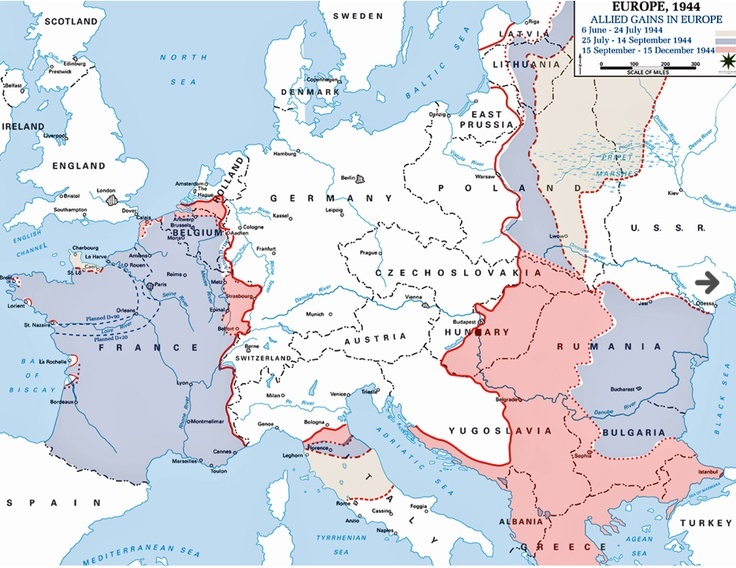 |
Above: War in Europe 1944. The gray-blue area in the right half of the map shows the extent of the Soviets’ Operation Bagration. Between June and August 1944, the Soviet Army drove the German Wehrmacht (armed forces) out of parts of Poland, Latvia, Lithuania, and Belarus while in Western Europe the Allied armies drove the Wehrmacht eastward toward the Franco-German border (Operation Overlord). The coastal area in Northwest Latvia (site of the Courland defensive pocket defined by a diagonal red line on the map) southward to East Prussia and from there westward along the Baltic coast to Denmark was the location of the last great German military operation of World War II, Operation Hannibal.
 |
 |
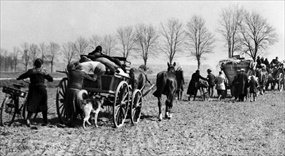
Left: Pushing bicycles, horse-drawn wagons piled high with household items, German civilians flee in an orderly line to a place of hoped-for safety in the west.
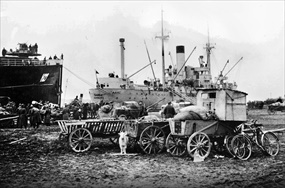
Right: After having driven carts and wagons loaded to the gills with their prized possessions, including a goat tied to a wagon (center of photo), desperate Baltic Germans queue to board evacuation ships at the port of Pillau, a U‑boat training base. Pillau, today’s Baltiysk in Russia’s Kaliningrad Oblast, was linked by road and canal to East Prussia’s capital of Koenigsberg. By mid‑January 1945, days after the start of the Red Army’s East Prussian Offensive, Pillau bulged with 100,000 panicky civilians. East Prussia became a veritable death trap for tens of thousands of civilians and shattered, weapons-poor military units fleeing the onrushing Red Army armed to the teeth. Hitler’s “invincible bastion” of Koenigsberg, completely cut off by the Red Army in October 1944 and under siege in late January 1945, finally fell to the enemy on April 9, followed by Pillau on April 25, bringing the Soviets’ East Prussian Offensive to a close.
 |
 |
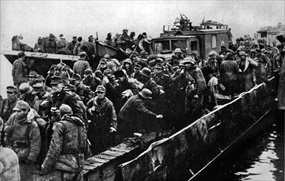
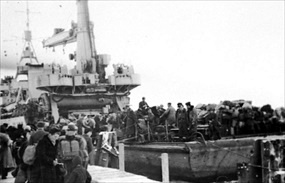
Left: Grand Admiral Doenitz defied Hitler’s “no retreat, no surrender” orders and pulled much of Army Group Courland (shown here piling into overcrowded boats) out of their defensive pocket to be repositioned further south per Operation Hannibal. Some of the rescued soldiers lost their lives when Soviet submarines torpedoed passenger liners and merchant ships that had been inducted into the Baltic rescue operations. On the night of January 30, 1945, as many as 9,500 out of more than 10,000 military and civilian passengers, of which 4,000–5000 were children, went down in the jam-packed Wilhelm Gustloff bound for Kiel, Germany, making history as the largest loss of life in a single-ship sinking, a loss 4 times greater than Titanic’s. Next to the tragic fate of Wilhelm Gustloff’s passengers was the fate of 6,000‑plus soldiers and Baltic evacuees who perished when the liner Goya was torpedoed on April 15, 1945, 3 weeks before hostilities ended; only 183 survived.
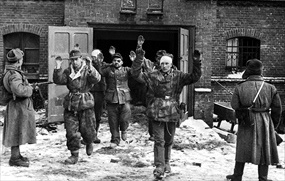
Right: Unlucky German soldiers, including several wounded, surrender to Soviet riflemen in East Prussia. Approximately 3 million German POWs were employed as force labor in the Soviet wartime economy and postwar reconstruction. A total of 2.8 million German POWs were held by the Soviet Union at the end of the war. According to Soviet and German records 356,700 German nationals died in Soviet captivity, and it is plausible that 700,000 German POWs listed as missing in action also died in Soviet custody. It is generally believed by Western historians that the Soviets took 3 million Germans prisoner of which 1 million died. By 1950 almost all surviving German POWs had been released, with the last prisoners—those convicted of war crimes (Kriegsverurteilte)—repatriated in 1956.
 |
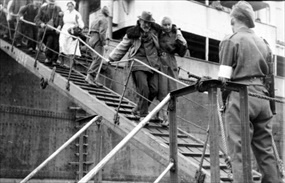 |
Left: German civilians fleeing the besieged city of Koenigsberg in early 1945 pack themselves into the seaplane tender Hans Albrecht Wedel. By April the city was hundreds of miles/kilometers behind enemy lines, surviving solely due to Doenitz’s lifeline. A source says 494 merchant vessels took part in Operation Hannibal out of 790 vessels of all types, from 1 battleship, multiple heavy and light cruisers to landing craft, barges, and small boats.
Right: Evacuees arrive at a German harbor already occupied by British troops. Baltic German evacuees (aka “expellees” or newcomers) swelled the ranks of displaced “homeborn” Germans who had been bombed or burned out of their homes or places of employment, etc. Most villages, towns, and cities on the receiving end were ill-prepared to house or feed the newcomers. In 1950 West Germany (Bundesrepublik) close to 20 percent of the country’s residents (9 million out of 50 million) were expellees from so-called “lost” German territories of East and West Prussia, Pomerania, Silesia, and Sudetenland. In East Germany (German Democratic Republic) expellees approached 30 percent of the population (4 million to 14 million).
The Chaotic Evacuation of German East Prussia, 1944–1945

World War II was the single most devastating and horrific event in the history of the world, causing the death of some 70 million people, reshaping the political map of the twentieth century and ushering in a new era of world history. Every day The Daily Chronicles brings you a new story from the annals of World War II with a vision to preserve the memory of those who suffered in the greatest military conflict the world has ever seen.