

FIRST ALL-BLACK UNIT SEES ACTION ON GUADALCANAL
South West Pacific Area HQ, Brisbane, Australia • January 24, 1944
On this date in 1944 an advance party of the 93rd Infantry Division landed on the Pacific Island of Guadalcanal, the first African American (“colored” was the term used at the time) infantry unit to see action in World War II. Reactivated on May 15, 1942, at Fort Huachuca, Arizona, home of the famed Buffalo Soldiers, the 16,000 all‑Black “Blue Helmets,” a nickname the soldiers had acquired when their division fought in France in the First World War, saw service in the Pacific Theater during World War II: at Bougainville (Solomon Islands), where they were attached to the Americal Division (the only U.S. division in World War II with a name instead of a number); on the Admiralty Islands (Bismarck Archipelago) and Dutch New Guinea; and in the Philippines. The division’s regiments mainly acted as construction units (for example, constructing airfields from which fighter and bomber operations could pummel other Japanese-held islands) and in defensive and security operations.
In the European Theater the counterpart to the 93rd Infantry Division was the all-Black 92nd Infantry Division (known as the “Buffalo Division”), which was part of Gen. Mark Clark’s U.S. Fifth Army in Italy (see photo essay below). The 92nd Infantry Division entered combat in Naples, Italy, on August 24, 1944. (The most-decorated infantry unit in World War II, the Japanese American 442nd Infantry Regiment (Nisei), was attached to the 92nd.) Three months later, in November 1944, men of the all-Black 761st Tank Battalion, the so-called “Black Panthers” attached to Gen. George S. Patton’s U.S. Third Army, made history as the first African American armored unit to enter the war, engaging the German enemy for 183 straight days and spearheading many of Patton’s offensives at the Battle of the Bulge and in 6 European countries. No other tank unit fought so hard (suffering a casualty rate close to 50 percent) and for so long without respite.
All of the segregated divisions, irrespective of their theaters of operation, fought a 2‑front war—against the enemy and against chronic racism and the widely held belief that African American soldiers, sailors, and airmen and airwomen were not up to the task.
In Standing Up Against Hate: How Black Women in the Army Helped Change the Course of WWII award-winning young-readers author Mary Cronk Farrell tells the remarkable, little-known story of how the only all-women, all-black unit of the Women’s Army Corps (WACs) ever deployed overseas brought speed, efficiency, and order to a chronically chaotic mail processing and delivery system in the last 6 months of the war in Europe. Letters and packages from the States were stacked floor to ceiling in 6 aircraft hangers in England. Under the plucky leadership of Major (later Lt. Col.) Charity Adams, a former high school math teacher from South Carolina, the 6888th Central Postal Directory Battalion began the process of sorting and delivering mail to over 7 million GIs, civilians, and Red Cross workers during the remainder of the war, first from Birmingham, England, and later from outposts in Rouen and Paris, France. The motto of the 6888th: “No mail, low morale.” Farrell’s book is a must-read addition to the canon of coming-of-age books that saw the U.S. armed forces transformed from a racially segregated force into a desegregated one where the color of one’s skin slowly but eventually mattered far less than a person’s talent, ability, positive attitude, and hard work.—Norm Haskett
African American Servicemen in World War II in the Pacific and European Theaters
 |
 |
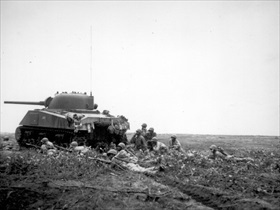
Left: African American troops of the 24th Infantry Division, attached to the Americal Division (less commonly known as the 23rd Infantry Division), wait to advance behind a tank assault on the Japanese near Empress Augusta Bay on the island of Bougainville in Papua New Guinea. Photo likely taken in April 1944.
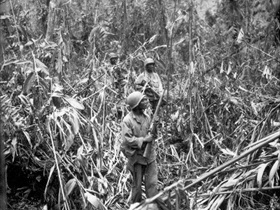
Right: Cautiously advancing through Bougainville’s jungle while on patrol in Japanese territory off the Numa-Numa Trail on May 1, 1944, these members of the 93rd Infantry Division were among the first African American foot soldiers to go into action in the South Pacific Theater.
 |
 |
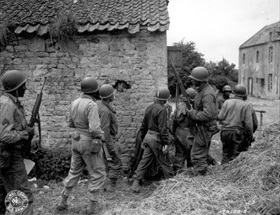
Left: A platoon of African American troops surrounds a farmhouse near Vierville-sur-Mer, France, as it prepares to eliminate a German sniper holding up the U.S. advance from the Omaha beachhead. Normandy, Operation Overlord, June 10, 1944.
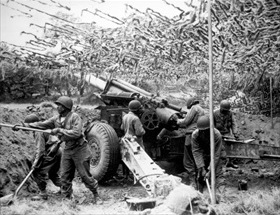
Right: Following the advance of infantry from the Omaha beachhead, these African American members of a field artillery battery set up a new position for their 155 mm howitzer. Normandy, France, June 28, 1944.
 |
 |
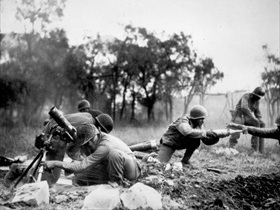
Left: Members of an African American mortar company of the 92nd Infantry (“Buffalo”) Division pass the ammunition and heave it over at the Germans in an almost endless stream near Massa, Tuscany, some 200 miles/322 kilometers north of Rome, the Italian capital, November 1944. The mortar company was credited with liquidating several enemy machine gun nests.
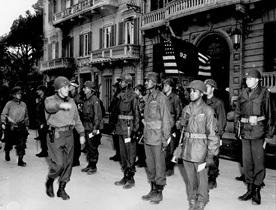
Right: Maj. Gen. Edward M. Almond, Commanding General of the 92nd Infantry Division, inspects his troops during a decoration ceremony in Italy, March 1945. The 92nd Division was strengthened with the addition of the highly decorated Japanese American 442nd Infantry Regiment (Nisei). The 2 units were never very comfortable with each other. But that did not interfere with black soldiers volunteering 17 blood transfusions to save the life of a then 20‑year-old 2nd lieutenant and future U.S. Senator, Daniel Inouye from Hawaii, whose right arm was amputated after a German rifle grenade shattered it.
 |
 |
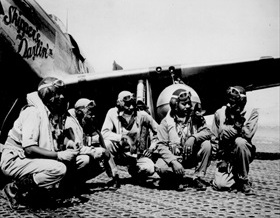
Left: Five members of the 332nd Fighter Group, nicknamed the “Red Tails,” converse in the shadow of one of the P‑51 Mustangs they fly. Italy, August 1944. Seen on the left is Lt. Dempsey W. Morgan, a graduate of the Flight School at Tuskegee, Alabama. On an October 4, 1944, mission over a German airbase in Greece, Morgan and 4 other 332nd Fighter pilots destroyed 9 enemy planes while they were still on the ground. For this mission all 5 were awarded the Distinguished Flying Cross. They joined 91 other Tuskegee Airmen to have won the DFC.
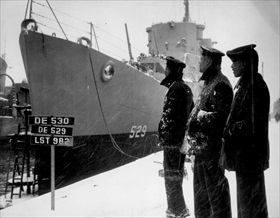
Right: Black crew members of the USS Mason proudly look over the destroyer escort on the day it was commissioned at Boston Navy Yard on March 20, 1944. The Mason was the first U.S. Navy ship to have a predominately African American crew.
Tribute to Buffalo Soldiers in Italy, 1944–1945

World War II was the single most devastating and horrific event in the history of the world, causing the death of some 70 million people, reshaping the political map of the twentieth century and ushering in a new era of world history. Every day The Daily Chronicles brings you a new story from the annals of World War II with a vision to preserve the memory of those who suffered in the greatest military conflict the world has ever seen.