

OPERATION FORTITUDE DECEPTION READY FOR LIVE TESTING
London, England • May 30, 1944
In the run-up to the invasion of mainland Europe (Operation Overlord), the Western Allies concocted an ambitious strategic deception plan to mislead their adversaries as to where and when the actual invasion would take place. Called Operation Fortitude, the plan had 2 polar-opposite components. Fortitude North supposedly threatened German-occupied Norway across the North Sea. Fortitude South appeared to threaten the Pas-de-Calais, a region in Hauts-de-France (upper Northwestern France) occupying the south shore of the Strait of Dover. At 18 nautical miles/33 kilometers, Calais was the closest cross-Channel invasion target from Southeast England. The second-closest cross-Channel invasion target, this from Southwest England, was Normandy, a distance of just under 100 nautical miles/185 kilometers.
German dictator Adolf Hitler had long speculated that Northwestern France would be the Allies’ invasion target (Schwerpunkt), saying so much in Fuehrer Directive 51, dated November 3, 1943. Six months later, on May 10 and 22, 1944, Hitler and his Oberkommando der Wehrmacht (OKW, German Military High Command) had honed in on Normandy followed by the northern part of neighboring Brittany, not Calais in the Hauts-de-France, as the most likely invasion targets. So Fortitude South’s deception planners needed to divert German attention away from the Normandy area—the Allies’ real invasion beachhead—for as long as possible, delaying reinforcements from elsewhere in France by convincing the enemy that the Normandy landings were merely diversionary—a point Allied air forces recently drove home by reconnoitering and bombarding the Pas-de-Calais twice as many times and twice as hard.
A characteristic of Fortitude North was simulating the presence of the bogus British Fourth Army staging in Scotland that posed a threat to 12 German divisions in Norway. Fortitude South had the formidable but equally bogus First U.S. Army Group. The FUSAG comprised 3 armies of real and phantom divisions under the command of George S. Patton, Jr. The flamboyant U.S. lieutenant general was 1 of 2 North African nemeses of legendary Afrika Korps commander Field Marshal Erwin Rommel. Hitler had tapped the Desert Fox to head the German defense of Northwestern Europe. As Befehlshaber of Heeresgruppe B (Army Group B), Rommel commanded 2 armies of 300,000 men almost evenly split between the Seventh, defending Normandy and Brittany, and the Fifteenth, defending Pas-de-Calais. Squaring off against Rommel was his second North African nemesis, Lt. Gen. Bernard Law Montgomery. The hero of El Alamein headed the very real 21st Army Group. On June 6, 1944, D-Day, Monty had 2 armies, the U.S. First Army and the British Second Army. On that day 132,715 Americans, Brits, and Canadians piled onto Normandy’s 5 beaches. Hours earlier 21,500 Anglo-American paratroopers made their appearance in drop zones behind the invasion beaches. In terms of numbers, the adversaries in Normandy appeared evenly matched.
By this date, May 30, 1944, a week before D‑Day, most of the crucial Fortitude deceptions had been implemented: physical deceptions consisting of specious encampments, airfields, aircraft, landing craft, and tanks; controlled leaks through diplomatic channels that found their way to the German High Command; radio traffic spoofing communication with a myriad of military units, some on the move; double agents supplying misinformation to German intelligence services; and the presence of senior military figures and ordinary joes in Southern England sporting unit insignia from the largely fictional FUSAG and dropping disinformation in public places.
The large-scale Normandy invasion surprised the Germans. “When they [the Allies] have established bridgeheads in the Normandy and Brittany peninsulas and have sized up their prospects,” Hitler predicted with assurance to Japanese ambassador Baron Hiroshi Ōshima on May 27, 1944, at his Bavarian residence, “they will then come forward with an all-out second front across the Straits of Dover.” (For his part, Rommel stopped believing in a second Allied front.) For nearly 7 weeks, the Allies’ ruse de guerre led Hitler to delay sending reinforcements from the Pas-de-Calais region to Normandy. On July 1, Hitler’s chief of staff on the OKW, Field Marshal Wilhelm Keitel, telephoned Field Marshal Gerd von Rundstedt, Commander-in-Chief West, frantically seeking advice on what to do next. Rundstedt did not mince words: “The writing [is] on the wall, make peace you fools.” Rundstedt was relieved of his command within the month, his sage advice ignored for nearly a year.
Operation Fortitude: Western Allies’ Strategic Deception Warfare, January–August 1944
 |
 |
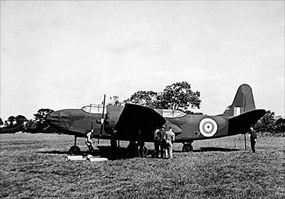
Left: A dummy airplane modeled on the Douglas A‑20 Havoc twin-engine, high-altitude medium bomber, October 1943. Physical deception using plywood and canvas or rubber dummy aircraft look-alikes was one of the “special means” that misled the enemy, along with “ghost” (nonexistent) units, phony military encampments, airstrips marked by lights, military vehicles, ammunition silos, oil storage tanks, and the like. In England an army of unsung war heroes (architects, artists, set builders from Shepperton Studios, actors, and cartoonists) conjured up a literal “theater” of war. Artists “weaponized” their skills to create optical illusions. German reconnaissance planes made notes and photographs of the English countryside, harbors, and shoreline dotted with realistic-looking military equipment mixed with the real McCoy. Real and fake landing exercises were mounted. Genuine British warships and transports began assembling in the Firth of Forth on Scotland’s east coast in April 1944 to pose a threat to occupied Norway. Alarmed by this and bogus diplomatic chatter, Hitler kept 250,000 troops tied down in Norway, 150,000 more than necessary per Col. Gen. Alfred Jodl, Chief of the Operations Staff of the OKW. So successful were these ingenious ruses that the tricks were used in the aftermath of D‑Day to fool, in one example, the Germans into believing that superior forces of up to 30,000 imaginary troops were threatening their lines. Strategic hoaxes, mischievous inducements, and misdirection techniques led the enemy to deploy troops to locations favorable to the Allies.
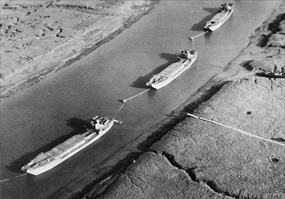
Right: Dummy landing craft used as decoys in the rivers and harbors of Southeast England in the period leading up to D‑Day. Ten miles/18 kilometers west of the port of Dover, in Folkestone Harbor, the Allies built 255 bogus landing craft known as wetbobs or bigbobs by lashing steel tubes to buoyant steel drums and covering them with heavy canvas. It took 30 men over 6 hours to assemble each craft from 1000‑plus pieces. On April 22, 1944, one of the few recon planes the Germans had left in France discovered a convoy of over 2 dozen landing craft and escorts a few miles/kilometers east of Dover; the force appeared to be carrying out landing exercises. Deceivers also built a few fake army encampments throughout Southeast England, the notional staging area of Lt. Gen. George Patton’s First U.S. Army Group, which the Germans referred to as Armeegrupppe Patton. These camps included inflatable dummy M4 Sherman tanks, trucks, and jeeps. Real vehicle tracks were made in the dirt to simulate movement of the dummy vehicles, and the rubber dummies were lifted into place in front of the tracks. Attention to visual detail was a hallmark of Operation Fortitude and proved crucial in the Allies’ triumph in Operation Overlord. Not until after the war did the Germans become aware that an ingenious, complex, and unparalleled deception involving tens of thousands of real and imaginary people and real and hollow props had been practiced on them. Interestingly, Rommel had a deception operation named Landgraf. More modest than Fortitude, it attempted to convince the Allies that German defenses in Northwestern France were stronger than they appeared. Dummy tanks and fictitious divisions were created for this. Landgraf was supported by specially prepared radio broadcasts.
 |
 |
 |
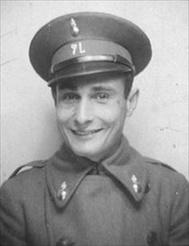
Left: Double agents were arguably the premier strategic deception channel used by the Allied Expeditionary Force in France to mislead the enemy. In Operation Fortitude 3 agents stand out, particularly Juan Pujol García, reputedly the finest double agent of the war. Codenamed Garbo after movie star Greta Garbo by his British handler befitting the “best actor in the world,” Pujol was a brilliant, cunning 30‑year-old Spanish poultry farmer who managed to get recruited by the German Abwehr (military intelligence), then months later by Britain’s Double-Cross (XX) System, a counter-espionage and deception operation of the British Security Service, usually referred to by its cover title MI5. By the time of Fortitude, Pujol had created an international network of 27 nonexistent accomplices passing off as varnished truth false leads and other Allied-approved fabrications. Pujol’s authoritative “sources” hoodwinked the Germans so completely that they kept 2 armored and 19 infantry divisions in the Pas-de-Calais throughout July and August 1944 in anticipation of the “real” invasion or, should the threat level decrease, a secondary invasion. (Nothing like that happened.) Ironically, both the Third Reich and British governments rewarded Pujol for his services as a double agent. Pujol’s wartime service is retold by Stephan Talty in Agent Garbo.
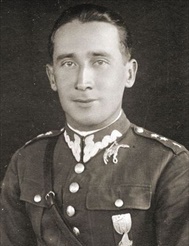
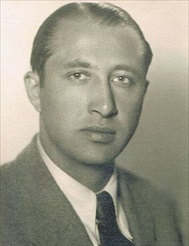
Middle: Thirty-two-year old former Polish Air Force officer, resistance fighter, and double agent Roman Garby-Czerniawski, codenamed Brutus after the Roman senator who betrayed Julius Caesar, once headed a large, clandestine Franco-Polish intelligence circuit, codenamed Interallié. Picked up by Gestapo and Abwehr agents who initially were unsure if they had turned him, Czerniawski gained the trust of his German and MI5 handlers and played a part in Fortitude North. The truth was, though, that Fortitude North’s deceivers did not ultimately convince the Germans that a sizeable assault was to be mounted from Scotland against Norway, so the enemy was never persuaded to reinforce its military outposts there.
Right: Wealthy multilingual Serbian lawyer, businessman, and playboy Dušan “Dusko” Popov was a triple agent (hence the codename, Tricycle), passing off scrubbed information to the Abwehr as part of Britain’s Secret Intelligence Service (SIS), commonly known as MI6, and working also as agent for the Yugoslav government-in-exile in London. During his espionage missions for MI6 and the Abwehr, Popov repeatedly traveled to neutral Portugal, where he met Ian Fleming, who may have used Popov as inspiration for the character of James Bond later in his hugely popular spy novels. Russell Miller recounts Povov’s espionage career in Codename Tricycle. All 3 top agents—Pujol, Czerniawski, and Popov—sought to convince German military planners that the Allied invasion of Europe would take place across from the Southeast English port of Dover, thereby diverting hundreds of thousands of enemy troops away from the field of battle and increasing the likelihood that the Normandy landings would succeed. On D+7 only 1 German division had moved from its defense sector to Normandy. When the German Fifteenth Army in the Pas-de-Calais—the more heavily defended area of the coast—finally sprang into action in the last week of July 1944, it was, as Overlord’s Supreme Commander Gen. Dwight D. Eisenhower testified, too late to have any effect upon the course of victory.
Operation Fortitude: Greatest Deception of World War II

World War II was the single most devastating and horrific event in the history of the world, causing the death of some 70 million people, reshaping the political map of the twentieth century and ushering in a new era of world history. Every day The Daily Chronicles brings you a new story from the annals of World War II with a vision to preserve the memory of those who suffered in the greatest military conflict the world has ever seen.