

FIRST ENEMY STRIKE BY CONSOLIDATED B-32 DOMINATORS
Clark Field, Philippines • May 29, 1945
On this date in 1945 3 test versions of the B‑32 4‑engine Dominators made their first combat appearance in World War II. Leaving Clark Field 60 miles/97 kilometers north of the Philippine capital of Manila, the Dominators targeted a Japanese supply depot less than a flight hour away. Four more B‑32 field operational tests in June targeted structures on enemy-occupied Formosa (today’s Taiwan). Manufactured by Consolidated Aircraft Corporation with production facilities near Fort Worth, Texas, and in San Diego, California, the B‑32 Dominator was the junior but more muscular brother of the aircraft maker’s famed B‑24 Liberator, the most numerous U.S. long-range bomber built during the war. Liberators had flown in the European, Mediterranean, and Pacific theaters since January 1942 and would come to dominate the heavy bombardment role in the Pacific until mid‑1944.
Consolidated Aircraft designed the B‑32 Dominator to be a heavy strategic bomber. Designers intended this aircraft to supplement Boeing’s B‑29 Superfortress and eventually replace Consolidated’s B‑24 Liberators. On September 7, 1942, when Boeing was well on its way to building its first 500 B‑29s, Consolidated’s initial B‑32 prototype (XB‑32‑CO) soared into the skies 6 months behind schedule. Nineteen months later the first B‑32 production versions, designated Model 34, began rolling off the company’s Fort Worth assembly line, with flight testing beginning August 5, 1944. They were intended to be the first of 1,500 B‑32s scheduled for production at the Texas and California sites.
The history of the B‑32 remains inexorably tied to that of its B‑29 counterpart. In January 1940, with Boeing’s B‑17 Flying Fortress just entering service, the U.S. Army Air Corps (after June 20, 1941, the Army Air Forces) issued a request for proposals for a 4‑engine strategic bomber that was to have sufficient operational range to cover the vast stretches of the Pacific Ocean. Four firms submitted design studies and on September 7, 1940, Boeing and Consolidated were awarded development contracts for the XB‑29 and XB‑32, respectively. Consolidated’s Model 33 prototypes (there were 3) morphed over time into the Model 34, the production model. The firm hoped the B‑32 production model would emerge as the U.S. military’s primary strategic bomber in case the Boeing product failed to deliver the contractual goods.
For their new airframe Consolidated’s design engineers decided to duplicate the Liberator’s twin tail and efficient Davis airfoil wing, lengthen the fuselage, and stretch the nose and round its tip. The second prototype was outfitted with a traditional stepped cockpit canopy and, in place of the twin tail, a large rounded, single vertical tail fin. Original Model 33 B‑32 plans called for a pressurized cockpit and remote-controlled retractable dorsal and ventral gun turrets plus a half dozen more conventional gun stations. Unfortunately, the firm’s engineers were tripped up by problems with the remote-controlled armament and pressurization systems among other chronic issues. Manned, power-operated turrets were installed instead, and the pressurization feature was scrapped altogether. The Model 34 B‑32 was now classified a low-to-medium altitude bomber.
Events at home and in the Pacific overtook the B‑32 program. By the time the first production model was delivered to the USAAF on September 19, 1944, Boeing’s Superfortresses had succeeded in striking the southernmost Japanese island of Kyūshū (June 15, 1944) from a Chinese airbase. By that December, when just 5 Dominators had been delivered, 111 Boeing heavy bombers had attacked the Japanese capital Tokyo as well as other targets from new bases in the Mariana Islands (November 24, 1944).
After the shakedown flights of the 3 Philippine-based Dominators were completed on June 17, 1945, it was too little, too late for the B‑32 Dominator to become anything more than a footnote in the Pacific War, which ended 2½ months later.
The Short-Lived Career of Consolidated’s B-32 Dominator
 |
 |
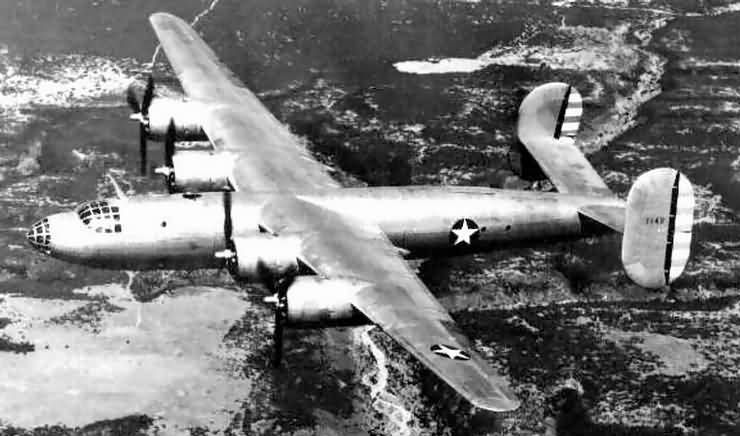
Left: Initial XB‑32 twin-tailed prototype. Second and third prototypes had numerous tail variations installed, including a Boeing B‑29 tail installation. The first flight of the XB‑32 occurred on September 7, 1942. Out of 3,970 Boeing B‑29 Superfortresses built, 24 survive in museums and 1 or 2 even participate in air shows. By contrast, out of the 118 Consolidated B‑32s built and deployed during the last few weeks of war (40 of them unarmed crew trainers), none has survived. After V‑J Day the War Department cancelled 1,099 production-version B‑32‑CFs and 499 B‑32‑COs. The 37 partially assembled B‑32s in Texas and California were scrapped on site by Consolidated and its contractors. Besides the B‑32s damaged or destroyed in accidents, postwar inventories of flyable Dominators were flown directly to storage, then chopped to pieces in Arkansas and Arizona. The last remaining B‑32 was scrapped in the summer of 1949.
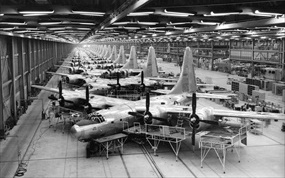
Right: Fort Worth, Texas, assembly line of Consolidated’s Model 34 B‑32 Dominators. The Model 34 “sky giant” bomber was first flown on August 4, 1944. The B‑32 crew numbered 10 or, when delivered as unarmed crew trainer, 8. The plane was 83 ft./25.3 m long, 33.1 ft./10.1 m tall, and had a wingspan of 135.2 ft./41.2 m, a gross weight of 100,800 lb./45,722 kg, and a maximum takeoff weight of 123,250 lb./55,905 kg. With a streamlined fuselage that resembled a scaled-up twin-engine Martin B‑26 Marauder and 4 2,200 hp/1,600 kW Wright R‑3350‑23A Duplex-Cyclone 18‑cylinder air-cooled, supercharged radial piston engines driving 4 large 4‑bladed reversible-pitch (inboard only) propellers, the B‑32 reached speeds of 357 mph/575 km/h, cruised at 290 mph/466 km/h, and had a service range of 3,800 miles/6,100 km. The B‑32 bristled with weapons. In its standard production configuration, of which 75 were produced, were 10 .50 caliber/12.7 mm M2 Browning heavy machine guns variously located in the Sperry-designed electric-hydraulic twin-gunned ball turrets at the nose and belly (these were the problem-plagued retractable turrets), in the Martin electrically operated twin-guns in the forward and rearward dorsal turrets atop the fuselage, in the ventral Sperry ball twin-gunned turret underneath the fuselage, and in the Sperry ball twin-gunned turret at the tail position. Optional armament was upwards of a 20,000 lb./9,100 kg bomb load in twin bomb bays.
 |
 |
Left: Bird’s-eye view of Model 34, Consolidated’s B‑32 Dominator. The Model 34 was initially intended as a backup long-range, heavy bomber should Boeing’s B‑29 program fall significantly behind in its development and build schedule. In the summer of 1944, however, as Boeing began cranking out more and more Superfortresses for the Pacific Theater and full-scale production of the B‑32 was still several months away, the U.S. Army Air Forces began eyeing Consolidated as a potential source to replace fleets of venerable B‑17 Flying Fortresses and B‑24 Liberators in the Mediterranean and European theaters. But Consolidated’s ever-slipping test program prevented the company from delivering a single B‑32 to those 2 combat zones. After the Allies’ victory in Europe in May 1945, Consolidated’s sole combat arena was in the Western Pacific, and that theater shut down abruptly in mid-August 1945. B‑32 production shut down 2 months later.
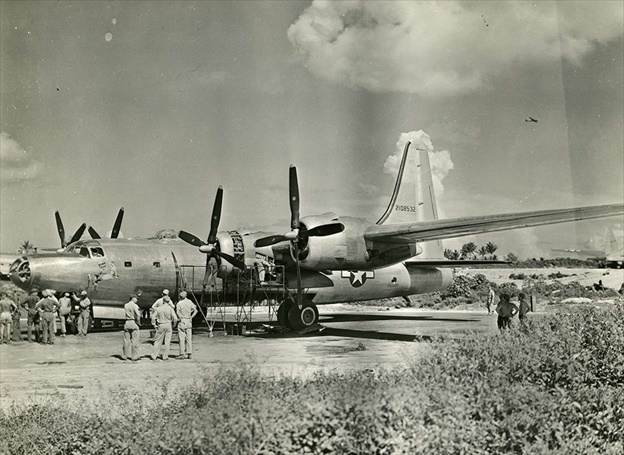
Right: The B‑32 Hobo Queen II undergoing maintenance on the Pacific island of Tinian in the Marianas. Assigned to the United States Army Air Forces’ 386th Bombardment Squadron of the 312th Bombardment Group, the Hobo Queen II flew in the first trio of Dominators sent into combat against Japan—this on May 29, 1945, in the Philippines. It also had the sorrowful distinction of being the last Allied warplane to be engaged in combat after World War II hostilities ended. Following Shōwa Emperor Hirohito’s capitulation broadcast to his subjects on August 15, 1945, the mission of Hobo Queen II changed from bombing Japan to reconnoitering the country as part of U.S. occupation operations; for example, locating and photographing POW camps, monitoring the ceasefire, and keeping an eye out for suspicious activity at Japanese airfields and ports. The Hobo Queen II was doing just that over the Tokyo area on August 18, 1945, in the company of another B‑32 photo-recon aircraft when both were jumped and raked with 20 mm canon fire by 17 Japanese fighter aircraft. Nineteen-year-old U.S. Army photographer’s assistant Sgt. Anthony Marchione was 1 of 3 crewmen hit by incoming fire. He bled to death aboard the Hobo Queen II as the plane managed a beeline for Yontan Airfield, its new Okinawa home base. As for the damaged Hobo Queen II, it was rendered into scrap in September 1945 by an unfortunate series of non-combat mishaps to its airframe.
The B-32 Dominator That Became the Last Casualty of World War II

World War II was the single most devastating and horrific event in the history of the world, causing the death of some 70 million people, reshaping the political map of the twentieth century and ushering in a new era of world history. Every day The Daily Chronicles brings you a new story from the annals of World War II with a vision to preserve the memory of those who suffered in the greatest military conflict the world has ever seen.