

NORMANDY INVASION SET FOR JUNE 6
London, England · June 4, 1944
Tomorrow, June 5, 1944, a Monday, was to have been the big day, the Allied invasion of a 50‑mile stretch of German-occupied beach on the French Normandy coast. The invasion, codenamed Operation Overlord, had been pushed from May, when the weather had been perfect, to June to allow another month’s buildup of landing craft. But gloomy weather reports predicted unsuitable conditions for an amphibious landing in early June: launching landing craft from mother ships in strong winds and high seas would be nigh to impossible. Supporting Allied warships and aircraft would be hampered by low clouds and bad visibility.
Gen. Dwight D. Eisenhower, Supreme Commander Allied Expeditionary Forces, had tentatively selected June 5 as the start date (D‑Day) for the long-rehearsed assault on Festung Europa. But now he ordered Allied troop convoys already at sea to take shelter in bays and inlets on the south coast of England for the night. It seemed entirely possible that the cross-Channel invasion would have to be delayed two weeks, and the shipborne troops, paratroopers, and glider-borne infantrymen ready to embark must return to their embarkation camps.
At a meeting late on this date, June 4, Overlord’s meteorologist, Group Captain James Stagg, cautiously predicted improvement for June 6. British Gen. Bernard Law Montgomery, overall ground commander for the invasion, and Gen. Walter Bedell Smith, Eisenhower’s chief of staff, pressed Eisenhower to proceed. On the strength of Stagg’s forecast, Eisenhower ordered the invasion to proceed one day later, on June 6.
Meanwhile the enemy took comfort from the existing poor weather conditions, which were worse over Northern France than over the English Channel, and believed no Allied invasion was possible for several days. Some German troops stood down and many senior officers were away for the weekend. Field Marshal Erwin Rommel—the man entrusted with defending the French coast between Normandy and the Pas-de-Calais—took a few days’ leave to celebrate his wife’s birthday back in Germany, while dozens of division, regimental, and battalion commanders were away from their posts conducting war games just prior to the invasion. Their absence and that of large armored units close by meant that the 24‑hour period Rommel had given himself to defeat the invaders had no chance of happening.
Carlo D’Este’s Decision in Normandy provides stunning insight into the Allied high command during the 1944 Normandy Campaign. What makes D’Este’s account of British General (later Field Marshal) Bernard Law Montgomery’s leadership so effective is his analysis of the historiography that has muddied the waters of Normandy for historians. D’Este reveals how the political climate of postwar Europe forced Gen. Dwight D. Eisenhower, Supreme Commander Allied Expeditionary Forces, to uphold the myth (in D’Este’s eyes) that Monty, in command of all Allied ground forces, had been the architect of victory in the Normandy Campaign. Harboring presidential ambitions, Ike was unwilling to upset Anglo-American relations in the atmosphere of the Cold War by criticizing Britain’s most beloved general. D’Este therefore demonstrates how the counterargument was suppressed by the very man who had the most cause to criticize Monty. Indeed, after having promised far-reaching results, Operation Goodwood (July 18–20, 1944), a British operation east of Caen and just south of the Normandy beachheads, failed to achieve the breakthrough Montgomery had promised his boss. Eisenhower evidently came close to losing his patience with Montgomery over this, exclaiming that “only seven miles were gained—can we afford to drop a thousand tons of bombs per mile?” Besides his fascinating analysis of the history of Monty’s leadership as well as the problems that plagued him (a shortage of infantry reserves, the inadequacy of British tank design, and the officiousness of Prime Minister Winston Churchill), D’Este proves how in reality the British Army cannot be said to have played the key role in liberating Normandy.—John Merrington
Erwin Rommel: Planning the Defense of Festung Europa, November 1943 to June 1944
 |
 |
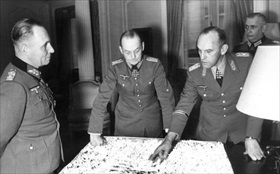
Left: Field Marshal Erwin Rommel (left, age 52), Field Marshal and Commander-in-Chief West (Oberfehlshaber West, OB West) Gerd von Rundstedt (center, nicknamed the “old Prussian”), and Lt. Gen. Bodo Zimmermann, Rundstedt’s operations officer at a staff conference in Paris, January 13, 1944. The 68 year-old von Rundstedt had operational responsibilities for Wehrmacht forces in France, Belgium, and the Netherlands. Hitler sent Rommel to von Rundstedt in early Novem¬ber 1943 to prepare plans and make suggestions for the best ways of strengthening the coastal defenses of the Atlantic Wall. Rommel and many on his staff, over 200 officers and men from Army Group B, consisting of the Seventh and Fifteenth armies, trudged the length the Atlantic Wall from Pas-de-Calais (since 2016 part of Hauts-de-France), immediately opposite the English port city of Dover, to Normandy and Brittany and further south along the coast of the Bay of Biscay in early 1944 right through the end of May.
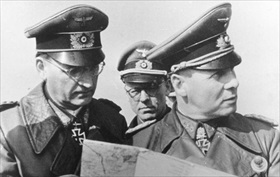
Right: Rommel (right) and Chief of Staff Lt. Gen. Hans Speidel use a map to inspect potential invasion beaches at Pas-de-Calais, April 18, 1944. Almost all German generals believed that the Pas-de-Calais, where the continent was closest to England (just over 20 miles away) and the sea voyage short and air cover simpler, was the most likely site for the anticipated Allied invasion. Intuition led Hitler to think Normandy was where the invasion would come, but he, too, believed that the Pas-de-Calais was the Schwerpunkt, principal target.
 |
 |
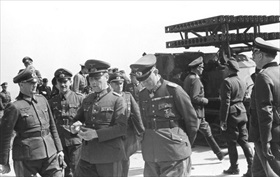
Left: Rommel inspecting troops and a half-track transporter of the newly introduced 80mm multiple rocket launcher (Nebelwerfer) at Riva Bella in Normandy near Caen, May 30, 1944, a week before the cross-Channel invasion.
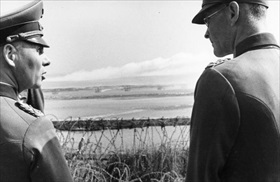
Right: Rommel and an officer observe artillery shells falling into the sea at Riva Bella, about 10 miles north of Caen in the area that would become Sword Beach, the easternmost D‑Day landing site, end of May 1944.
Excellent Documentary: Field Marshal Erwin Rommel Inspected the Atlantic Wall and Realized It Would Never Stop the Allied Invasion

World War II was the single most devastating and horrific event in the history of the world, causing the death of some 70 million people, reshaping the political map of the twentieth century and ushering in a new era of world history. Every day The Daily Chronicles brings you a new story from the annals of World War II with a vision to preserve the memory of those who suffered in the greatest military conflict the world has ever seen.