

GLIDER PHASE OF D-DAY BEGINS
RAF Aldermaston and Ramsbury Airfields, England · June 3, 1944
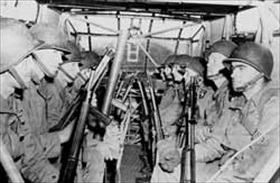
On this date in 1944 in Aldermaston, England, men of the 434th Troop Carrier Group and the 101st Airborne Division began moving 52 CG‑4A gliders and C‑47 Skytrain tow planes onto the airfield to lead the glider phase of Operation Overlord, the invasion of Nazi-occupied France. Taking off five minutes behind the 434th from Ramsbury airfield over 100 miles to the west was the 437th Group towing 52 CG‑4A gliders for the 82nd Airborne Division. Each of these powerless, unarmed gliders carried 13 men and their gear or four men and cargo: a Jeep or a Jeep trailer fully loaded with combat supplies, bulldozers to make landing strips for later glider landings, a 75mm howitzer or 37mm antitank gun, sundry ammunition and/or medical supplies. Gen. Maxwell Taylor, 101st Airborne commander, stretched out on the floor on pillows, catching shut-eye. Most men remained seated, helmet in lap into which some vomited though most vomit ended up on the floor.
Over Guernsey and Jersey, the German-occupied Channel Islands, enemy flak batteries opened fire on the Skytrains and their gliders. Over France, flying at 1,000 ft. or less, the sky armada was within crossfire range of German machine guns and flak guns. Pilots, nicknamed “suicide jockeys,” weaved and twisted, throwing heavily burdened men inside the fuselage this way and that, the bruising and bone-jarring made worse by slipping on the vomit-strewn floor.
Twenty-four hours earlier the Germans had begun studding the fields and pastures in the two intended landing zones with “Rommel’s asparagus” (wooden poles) and were digging and flooding 6‑ft. deep by 10–12‑ft. wide ditches across other fields to hinder glider landings. U.S. casualties in men and equipment were heavy in the nighttime and early morning (4 a.m.) landings behind Utah Beach on June 6, 1944. Gliders came in from every direction, many overshooting the fields and landing in surrounding hedgerow fences or crashing into farmhouses or stone walls, blind in the black night. Some glider troops were impaled by splintering wood or were crushed when equipment broke away. One glider landed on a landmine. Some gliders missed their landing zone and crashed into a swamp 12 miles to the south. Twenty-one of the 850 gliders carrying infantrymen were wrecked in landing.
Over 20,000 parachute and glider infantrymen were delivered to Normandy, the overwhelming majority thrown into combat for the first time. Of the roughly 4,000 sky soldiers who participated in the initial airborne assault phase of Operation Overlord, 10 percent became casualties, either killed or maimed. (More casualties occurred in glider landings than in parachute jumps from transport planes.) But of course Operation Overlord’s success or failure depended on the amphibious landings and the German response.
Waco CG-4A Combat Gliders in the Airborne Invasion of Normandy, 1944
 |
 |
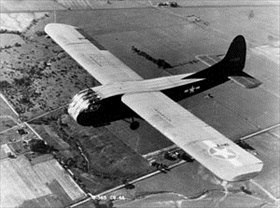
Left: Forerunners of today’s helicopter-delivered airmobile troops, military gliders came of age in World War II when they were made capable of getting a whole squad or more of infantry with heavy weapons onto the ground quickly, with equipment that paratroopers simply could not carry. The Waco CG‑4A glider (C for cargo, G for glider) was the most widely used U.S. troop and cargo military glider of World War II. Derisively called “flak bait” or “flying coffins,” 13,909 of these stealth aircraft were manufactured by 16 companies during the period 1942–1945—more than the number of B‑17, B‑25 or B‑26 bombers; P‑38, P‑39, or P‑40 fighters; or any of the C‑46, C‑47, or C‑54 transport planes manufactured during that same time period.
Right: At 3,750 lb. the CG-4A high-wing monoplane could carry more than its own weight in payload, and frequently did. Its maximum speed was 150 mph at 7,500 lb. or 128 mph at 9,000 lb. As a troop carrier it carried 2 crew members and 13 passengers (“glidermen”). As a cargo carrier with 2 crew members it carried 4 passengers and 1 jeep or 3 passengers, one 75 mm howitzer, and 25 rounds of ammunition.
 |
 |
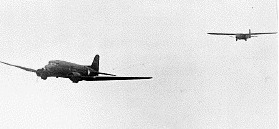
Left: Unarmed and unarmored, canvas-covered gliders were towed behind Douglas C‑47 tug planes on 300 ft./91 m by 1 in./2.5 cm nylon ropes. Communication between the early gliders and their tugs was via a telephone wire wrapped around the tow-rope. These wires often shorted out while being dragged along concrete runways during takeoffs. Two-way radios eventually replaced this system.
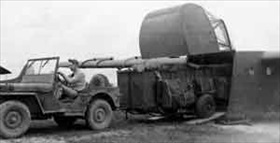
Right: The combat glider had a length of 48 ft. 8 in/14.8 m and a wingspan of 83 ft. 8 in./25 m. It had a height of 15 ft. 4 in./4.6 m. The entire nose section (including the pilot’s compartment) of the CG‑4A swung upward, creating a 70 in./1.8 m by 60 in/1.5 m opening into its cargo compartment. This made it possible to quickly load and, after a successful belly-flop landing, unload the glider.
 |
 |
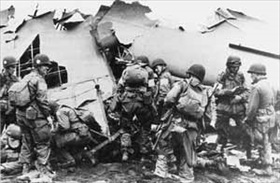
Left: A normal three-point landing required a landing run of 600–800 ft. Gliders at the far end of gross weight need 2,000–3,000 ft. In this photo U.S. troops examine a crashed glider. Almost all the gliders used in Normandy were lost. Few undamaged craft were ever retrieved.
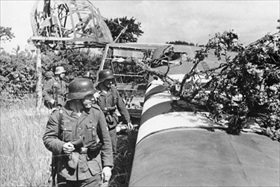
Right: Germans examine this glider that landed in their midst, having crashed into a hedgerow. Several of the occupants were killed and the rest were overpowered and taken prisoner. The 101st Airborne Division lost 30 men in glider crashes, the 82nd nearly 300.
Airborne Invasion of Normandy, France, June 1944

World War II was the single most devastating and horrific event in the history of the world, causing the death of some 70 million people, reshaping the political map of the twentieth century and ushering in a new era of world history. Every day The Daily Chronicles brings you a new story from the annals of World War II with a vision to preserve the memory of those who suffered in the greatest military conflict the world has ever seen.