

NAZIS MOVE TO STRENGTHEN LAWS AGAINST SEX OFFENDERS
Berlin, Germany • June 28, 1935
On this date in 1935, Nazi Germany amended Paragraph 175 of the German penal code that had been in place since 1871 during the chancellorship of Prince Otto von Bismarck, the Iron Chancellor in Kaiser Wilhelm I’s Second Reich. Paragraph 175 outlawed acts of “unnatural indecency” only between men. Six years later the German Supreme Court narrowed the provisions of the paragraph to “intercourse-like acts” with males and beasts (bestiality). The change made arrests and convictions of homosexuals more difficult. Nevertheless, since 1900 during the reign of Wilhelm II, German criminal police (Kripo) had been compiling “pink lists” (dossiers) of suspected homosexual men from across the Reich. In a population of 67 million (1933 census), an estimated (1928) 1.2 million were gay. The Kripo made little or no use of the pink lists until the rise of Adolf Hitler’s Nazi Party in the post-World War I Weimar Republic.
In those heady, hedonistic days of the Golden Twenties, a grassroots campaign and liberal lawmakers in the Reichstag failed to repeal Paragraph 175. Meanwhile, the Nazi Party espoused a platform of traditional values replete with 19th-century sexism, law and order, and a virulent policy of persecuting unwanted (in their mind) socially degenerate and, more famously, “racial” groups like German Jews, who incidentally were less than half the size of the homosexual population. (In 1933 Jews numbered 505,000, or 0.75 percent of the total population.) In 1932, the year before Hitler was named German chancellor by Field Marshal and President Paul von Hindenburg, municipal leaders in “Gay Berlin” began enforcing public morality laws to close bars, cafés, nightclubs, and other meeting places catering to homosexual and bisexual patrons. Soon after taking office on January 30, 1933, Hitler dissolved all gay (Schwule) and lesbian (Lesben) organizations.
The amended version of Paragraph 175 took effect on September 1, 1935. Crimes against provisions in the amended Paragraph 175 were reclassified as felonies (Verbrechen) rather than less serious misdemeanors (Vergehen). Maximum penalties for homosexual acts among adults or youths under 18 rose from 6 months’ to 5 years’ imprisonment. Mutual physical contact was no longer necessary. Simply being lewd (unzuechtig) enough to excite sexual desire in another person qualified one for potential prosecution and incarceration in Hitler’s Third Reich. Nazi movers and shakers said the stronger provisions and penalties were necessary because “according to experience” homosexuality exerts “a ruinous influence” on the moral health of the Volksgemeinschaft (national community).
On October 10, 1936, Reichsfuerhrer-SS Heinrich Himmler, after Hitler the most powerful person in Nazi Germany, opened the Reich Central Office for Combating Homosexuality and Abortion (Reichszentrale zur Bekaempfung der Homosexualitaet und der Abtreibung). The primary task of the Reichszentrale was collecting data about and registering homosexuals. By 1940 the section had accumulated data on some 41,000 suspected and convicted homosexuals. Small wonder then that the number of convictions for sexual offenses under the new, broadened Paragraph 175 increased exponentially, from 1,069 in 1934, of which youth under 18 made up 13 percent, to 4,200 in 1940, of which youths made up 11 percent. About half the prosecutions resulted from police (Kripo) work. Forty percent resulted from private accusations (Strafanzeige) by non-participating observers, and the remainder were from denunciations by employers and institutions. Known widely by its acronym, Himmler’s Gestapo (Nazi Secret State Police) was authorized to pick up and place gays and lesbians in protective custody (Schutzhaft) of arbitrary duration without an accusation (or even after judicial acquittal). This was often the fate of “chronic homosexuals” (repeat offenders) who, after serving their prison sentence, were placed in concentration camps like Dachau and Buchenwald for additional “re-education” (Umerziehung) or liquidation.
Institutionalized Homophobia: Nazi Persecution of German and Austrian Homosexuals, 1935–1945
 |
 |
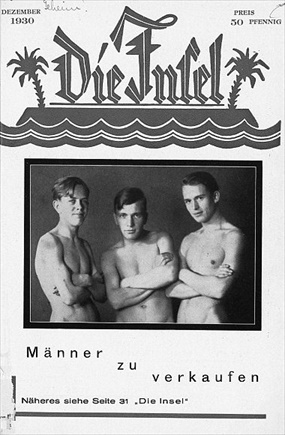
Left: “Men for Sale” is the featured article of this December 1930 issue of Die Insel (The Island), one of many gay-oriented publications in Berlin. The gay rights Institute of Sexual Science (Institut fuer Sexualwissenschaft) in Berlin’s Tiergarten district, founded in 1919 by Jewish physician and sexologist Dr. Magnus Hirschfeld (1868–1935), taught that same-sex love was a natural, inborn characteristic of humans, not merely the perversion of a “normal” sexual tendency. Nazis were convinced that Jews were intent on undermining “public morality.” Hirschfeld’s premises were vandalized shortly after rowdies from the German Student Union (Deutsche Studentenschaft), which was dominated by young Nazis, paraded in front of the Institute on May 6, 1933. Four days later the Institute’s library and archives were hauled out and burned in the streets. Around 20,000 homophile books and journals, and 5,000 images, were destroyed. Nazi thugs forced Hirschfeld into exile in France, where he died 2 years later.
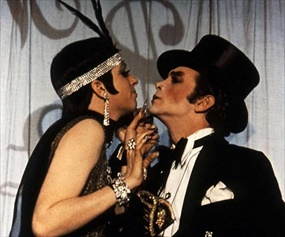
Right: Male prostitution, bars, nightclubs, and cabarets populated by gays, bisexuals, lesbians, and transgenders flourished in a wild, incomparable sexual subculture that was portrayed in the 1972 American film version of Cabaret, starring Liza Minnelli and Joel Grey. The German Weimar Republic emerged out of the wreckage of the First World War. The Kaiser was gone, the 1919 Versailles Treaty saw the abolition of German colonial possessions in Africa, mainland Asia, and the Pacific, and the loss of significant amounts of European territory. It was a troubled and tortured time, but oddly enough Berlin, the old imperial capital, became the most liberal city in Germany. High living, a vibrant urban life, and relaxed social attitudes, along with the influx of American dollars, defined the Golden Twenties, the most creative period in German history up to that time. Writers, poets, artists from London, France, and the United States arrived in Berlin to witness and experience the city’s wild erotic sexual freedom along with curiosity seekers, voyeurs, homosexuals, and gay rights activists. Pervasive prostitution (male, female, heterosexual), public cross-dressing, and easy access to pubs, other meeting places, and media that catered to every sort of interest were a few of the features that supported Berlin’s sex industry.
 |
 |
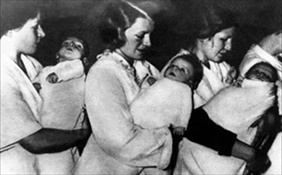
Left: In a symposium on February 18, 1937, Reichsfuehrer-SS Himmler addressed his higher Schutzstaffel (SS) and police leaders on the subject of homosexuality: “With a static number of women, we have two million men too few on account of those who fell in the [first world] war (1914–1918). . . You can well imagine how this imbalance of two million homosexuals and two million war dead, or in other words a lack of about four million men capable of having sex, has upset the sexual balance sheet of Germany.” A unique way out of this “catastrophe” was promoted by the fanatically homophobic Reichsfuehrer himself. His Lebensborn Program established home and maternity hospitals where pregnant married or unmarried women could give birth to their babies and receive the best medical care to boot. The homes—10 in Germany, where about 8,000 children were born, 9 in Norway, where over 6,000 were born, 2 in Austria, and 1 each in Belgium, France, and Luxembourg—acted as a kind of state-sponsored brothel that encouraged sex between single and married SS men and suitable Aryan (Nordic-looking) women. (In 1939 3,500 SS leaders represented a little over 40 percent of the Lebensborn membership.) Members bedded multiple partners during weeklong visits. Ideal genes to pass on to offspring were those that produced tall, fair-skinned, blue-eyed, and blond-haired children. Women renounced all claims to their newborn children, who, at 2 weeks, would be placed by the state in special houses and settlements or given to qualifying families to be raised.
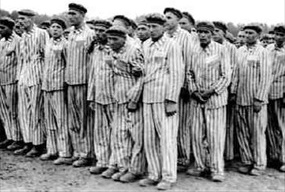
Right: Despite male homosexuality being considered a greater danger to “national survival,” lesbianism—deemed gender nonconformity—was likewise viewed as unacceptable though generally licit, and a number of individual reports on lesbians can be found in Gestapo files. Between 1933 and 1935, some 4,000 men were arrested; between 1936 and 1939, another 30,000 men were convicted. According to Gestapo case files, the majority of those arrested for homosexuality were males between 18 and 25 years of age. In some cases “175ers” were institutionalized in psychiatric clinics; others were forced to choose between “voluntary” castration (second offenders) and imprisonment. Most of the men taken into custody served time in regular prisons, while from 5,000 to 15,000 more were held in concentration camps. Camp prisoners wore a large black dot on their uniforms, later a pink triangular patch, and “175” drawn on the back of their jackets. Most gay prisoners were honorable people, often highly intelligent and accomplished professionals who held high positions in civil and social life: lawyers, professors, teachers, engineers, artisans, actors, trade unionists and craftsmen, health care and social workers. In their campaign against the Catholic Church, the Nazis arrested many Catholic clergymen on false charges of homosexuality and acts of perversion. The targets were really those who voiced opposition to the regime or held views the Nazis disliked. After serving a prison sentence for “immorality,” these Catholic “enemies of the state” were sent to concentration camps. The camp at Dachau had a special “priest block.” This photo shows a group of homosexual convicts at Buchenwald, which incarcerated more gay men and women proportionally than any other camp. Other camps holding pink-triangle prisoners were Sachsenhausen, Mauthausen in Austria, and the women’s camp at Ravensbrueck, to name three more. Many “criminal deviants” were subjected to forced castration in medical experiments in camp hospitals or had surgical insertion of a capsule that released the male hormone testosterone in an effort to “convert” them to heterosexuals. The death rate for homosexuals (60 percent) was 3 to 4 times higher than for other non-Jewish categories of prisoners (after a year, 1 in 2 perished). Perhaps 60,000 incarcerated gays died in Nazi Germany, including gays from Nazi-occupied countries starting in 1939.
Documenting Nazi Persecution of Gays: Collection in the United States Holocaust Memorial Museum

World War II was the single most devastating and horrific event in the history of the world, causing the death of some 70 million people, reshaping the political map of the twentieth century and ushering in a new era of world history. Every day The Daily Chronicles brings you a new story from the annals of World War II with a vision to preserve the memory of those who suffered in the greatest military conflict the world has ever seen.