

GERMAN AIR FORCE, NAVY DECIMATE ALLIED ARCTIC CONVOY PQ-17
Norwegian and Arctic Seas • June 27, 1942
In March 1941, 9 months before Pearl Harbor plunged the neutral nation into World War II, the United States inaugurated the “Lend-Lease” program. That program gave Great Britain, the Soviet Union, China, and other Allied nations resisting Axis aggressors, mainly Germany and Japan, vast amounts of war matériel to defend themselves. American factories and farms churned out tanks, planes, bullets, bombs, shells, artillery pieces, plant and animal foodstuffs, and other items so desperately needed by Adolf Hitler’s and Shōwa Emperor Hirohito’s hard-pressed foes. Supplying these goods free of charge was one thing; getting them to overseas battlefront nations was quite another. Aside from airplanes, insufficient to carry heavy loads for long distances, the alternative was a 2,500‑mile/4,000‑km-long watery highway between North America’s East Coast and the British Isles, even farther to the 2 northwestern Arctic ports of the Soviet Union.
The watery highway had to be kept clear of enemy dangers overhead, on the ocean’s surface, and beneath the waves. Escorted by Allied warships and aircraft, convoys of armed cargomen laden with critical goods trafficked across the North Atlantic Ocean infested by U‑boat wolf packs and surface raiders. From the British Isles eastward through the Norwegian and Arctic Seas to the Soviet ports of Murmansk and Archangel (Arkhangelsk) was the shortest but most risky route for delivering tanks, trucks, aircraft, ammunition, and other vital supplies destined for the hard-pressed Red Army fighting on the Axis’ Eastern Front.
On this date, June 27, 1942, the 34‑ship Convoy PQ‑17, the largest and most valuable Arctic merchant ship convoy to date, departed Hvalfjord (Hvalfjörður), Iceland, for the Soviet Union. Escorted by 6 destroyers, 4 corvettes, 3 minesweepers, 4 trawlers, 2 anti-aircraft ships, 2 submarines, 3 rescue ships, and an oiler, PQ‑17 began its Arctic run to Archangel. The Germans were determined that PQ‑17 would not pass through their ranks unscathed. They instituted Operation Knight’s Move (Unternehmen Roesselsprung) that would add capital ships—the Tirpitz (the late Bismarck’s mighty twin) and heavy cruisers Admiral Scheer and Admiral Hipper—to the intercepting force of hundreds of Luftwaffe aircraft and Kriegsmarine U‑boats, which staged from naval and air bases in German-occupied Norway.
On the morning of July 4 a German torpedo bomber struck a Liberty-built merchant ship that was eventually sunk by a German sub that evening. During the same evening 25 torpedo bombers managed to damage a second Liberty ship that was sent to the bottom by shellfire from another U‑boat. Unhappily for PQ‑17 the Arctic convoy had been nabbed and bloodied. The British Admiralty was beside itself over the possibility that a heavy-duty battle group that included the Tirpitz and other German surface ships would add exponentially to the mayhem inflicted by enemy aircraft and submarines. (Operation Knight’s Move did not leave port until the following day and was subsequently ordered to return to port.) At 9:23 p.m., July 4, after a third ship went down, a divided Admiralty directed the convoy to “disperse and proceed to Russian ports.” Thirteen minutes later the message was changed from “disperse” to “scatter.” Utter disarray ensued. Most of the escorts beat a hasty retreat to Scapa Flow, Scotland; by July 9 the rest had disappeared. One catastrophe after another followed in a free-for-all flight of cargo ships devoid of naval protection steaming independently and willy-nilly eastward.
A half-month elapsed before the fate of Convoy PQ‑17 was fully known. Of the 34 cargo ships that left Iceland on June 27, 1942, with 180,000 metric tons of freight on board, German warplanes and submarines sank 23 ships carrying 116,000 metric tons and killed 153 seamen. Reaching Archangel were just 1 Panamanian, 2 Soviet, 2 British, and 4 American freighters; 2 American freighters reached Murmansk, the Soviet Union’s other Arctic port.
Convoy PQ-17: Unprecedented Arctic Disaster
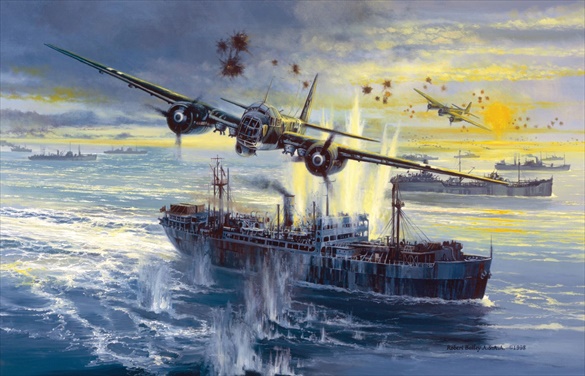
Above: In this painting by English-born combat artist Robert Bailey, Luftwaffe Junkers Ju‑88 bombers press home their attacks against freighters and tankers in Convoy PQ‑17, destined for the northwestern Soviet port of Archangel in July 1942. Convoy PQ‑17 was decimated by U‑boats of the famed Eisteufel (Ice Devil) squadron and Norway-based Luftflotte 5’s Ju‑88 bombers, Heinkel He‑111 torpedo bombers and He‑115 torpedo float planes, and Junkers Ju‑87 Stuka dive-bombers during a series of catastrophic enemy daylight attacks that lasted from July 4 to 10, 1942. Carrying sorely needed war matériel for the Soviet Front, the Anglo-American convoy, under British command, lost 24 of its 34 freighters and tankers after a controversial communique from the British Admiralty late on July 4, 1942, ordered the Soviet-bound convoy escort to “scatter.” The order doomed Convoy PQ‑17. Without the mutual protection provided by sailing in an escorted convoy, lone and armed merchantmen became easy prey to enemy aircraft and U‑boats that beset them. Less than a third of PQ‑17’s merchant ships were successful in running the gauntlet of U‑boats and German bombers.
 |
 |
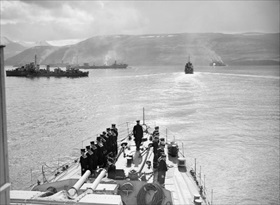
Left: British and American escorts and Allied merchant ships assemble at the Icelandic naval base used by Allied military and commercial vessels at Hvalfjord (Hvalfjörður) before the June 27, 1942, departure of Convoy PQ‑17. The sea voyage to the northwestern Soviet ports of Murmansk and Archangel was the shortest route for sending Allied supplies to the Soviet Union. But it was also the most dangerous owing to the large concentration of enemy forces in neighboring German-occupied Norway.
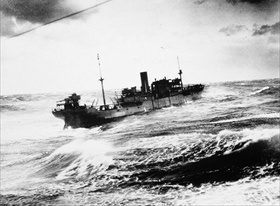
Right: Making the dangerous passage across the North Atlantic and through the Norwegian and Barents Seas to the Soviet port of Murmansk, the armed British merchant ship SS Coulmore weathers heavy seas, May 20, 1943. Just over 10 weeks earlier, on March 10, 1943, on a voyage from Philadelphia to London with general cargo, Coulmore was torpedoed and damaged by U‑229 south of Iceland. There were 7 survivors. The ship was towed, recovered, and back in service when this photograph was taken by the U.S. Coast Guard.
 |
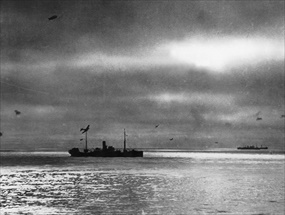 |
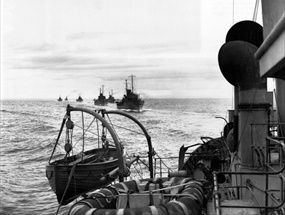
Left: Steaming eastward in a tight convoy, Canadian merchantmen and escorting warships remain on high alert. Attacks from German U‑boats, surface vessels, or aircraft were a constant threat. The successful destruction of PQ‑17 was the result of German signals intelligence and cryptologic analysis. Wartime British Prime Minister Winston Churchill recalled the PQ‑17 disaster as “one of the most melancholy naval episodes of the whole of the war.”
Right: Difficult as it is to see, a swarm of German aircraft sweeps down from a cloudy sky to attack an Allied convoy en route to Murmansk.
 |
 |
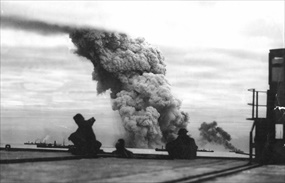
Left: Victims of a German air attack, two Allied ships in PQ‑18 billow smoke while sailors aboard the escort carrier HMS Avenger look on, September 1942. Hit by an aerial torpedo, the U.S. ammunition ship SS Mary Luckenbach (foreground) was basically vaporized along with the entire crew. Escorted by ships of the Royal Navy, Royal Canadian Navy, and the U.S. Navy, about 1,400 merchant ships delivered essential wartime aid to the Soviet Union under the U.S. Lend-Lease program and the Anglo-Soviet Agreement between August 1941 and May 1945. Eighty-five merchant vessels (roughly 6 percent of those involved in this mercantile traffic) were lost during the period. In spite of fearful losses, Arctic convoys demonstrated, first, the Western Allies’ commitment to helping the Soviet Union defend itself against a common enemy prior to the West opening up a second front in Normandy, France, in June 1944 (Operation Overlord). Secondly, Arctic convoys tied up a substantial part of Germany’s naval and air forces, militating against their deployment to Western Europe.
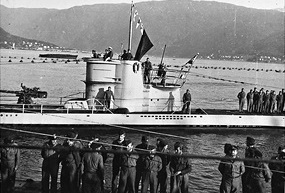
Right: One of approximately 8 Eisteufel U‑boats that decimated Convoy PQ‑17, U‑255 enters its home port of Narvik, occupied Norway, on June 20, 1942, flying 4 victory pennants—one for each kill—in addition to one trophy flag taken from the stricken Dutch merchantman Paulus Potter. Besides administrating a coup de grâce to the Dutch freighter on July 13, 1942, U‑255 skipper Kapitaenleutnant Reinhart Reche dispatched 3 American merchant ships and hundreds of civilian seaman and U.S. Navy Armed Guards to an ice-cold watery graveyard by torpedo and artillery fire: SS John Witherspoon, SS Alcona Ranger, and SS Olopana on July 6, 7, 8, 1942, respectively. Reche reckoned the gross registered tons of the 4 sunken vessels to be over 25.5 million tons.
The Near-Destruction of Convoy PQ-17, July 4–10, 1942

World War II was the single most devastating and horrific event in the history of the world, causing the death of some 70 million people, reshaping the political map of the twentieth century and ushering in a new era of world history. Every day The Daily Chronicles brings you a new story from the annals of World War II with a vision to preserve the memory of those who suffered in the greatest military conflict the world has ever seen.