JAPANESE ON U.S. WEST COAST TO BE FORCIBLY RELOCATED
Washington, D.C. • February 19, 1942
Eighty-four years ago on this date in 1942, celebrated today as the Day of Remembrance, President Franklin D. Roosevelt signed Executive Order 9066. It authorized the War Department to designate “military areas” in the U.S. and admit, exclude, or remove from these areas anyone whom the department felt to be a danger to the security of the nation. The next month Roosevelt signed an Act of Congress that made any violation of mandates issued under his executive order (e.g., public proclamations issued by senior military authorities) a federal crime. Although the unprecedented order appeared carefully neutral, Executive Order 9066 ultimately led to the tragic exile and incarceration of over 120,000 persons of Japanese ancestry, citizens and noncitizens alike, living along the U.S. West Coast and Alaska.
Approximately 80,000 of those sequestered under FDR’s executive order were second- and third-generation American citizens born in the United States (Nisei and Sansei, respectively), not-so-cleverly reclassified by the government as “non-aliens” in a ham-fisted suspension of their birthright under the 14th Amendment to the U.S. Constitution. Almost half of those incarcerated were children born in the U.S. (In Canada, 22,000 Japanese nationals and Canadian-born Japanese [the latter population representing 62 percent of the total] suffered similar or worse treatment: the Canadian government confiscated and sold their property to help defray the cost of relocating and detaining them. South of the border almost 5,000 Japanese were evicted from Mexico’s Pacific Coast and plunked down in Mexico City and Guadalajara.) Suddenly uprooted from their homes, workplaces, places of worship and learning, and deprived of or forced to sell off practically everything they had acquired over a lifetime (Japanese nationals had their bank accounts frozen), native-born Japanese Americans and Japanese nationals residing in the U.S. (known as Issei; with a single exception, first-generation Japanese were prevented by law from acquiring U.S. citizenship) were taken first to 1 of 15 assembly centers, or temporary detention camps. California’s San Joaquin County Fairgrounds and the Santa Anita and Tanforan racetrack stables, still reeking of their former 4‑legged occupants, were 3 sites converted into temporary detention camps. Then they were shipped to any of 10 permanent inland relocation centers where they were held without due process of law “for the duration” inside barbed wire enclosures, watched over by armed military police (see map below).
Notwithstanding that America was at war with both Japan and Nazi Germany, Hawaiians of Japanese ancestry and German Americans and German U.S. residents were not incarcerated en masse and therefore escaped disenfranchisement, measureless separation, precious lost years, miserable deprivation, monotonous camp routine, enforced idleness, and dependence on the U.S. government for their food, shelter, and health care. Under the U.S. Justice Department’s Enemy Alien Control Program, the government detained and incarcerated just over 11,000 German enemy aliens, as well as a small number of German American citizens, either naturalized or native born. The population of German citizens in the United States—not to mention American citizens of German birth—was far too large for a general policy of disenfranchisement and mass confinement comparable to that used against people of Japanese ancestry (Nikkei). Instead, German citizens were detained and removed from coastal areas on an individual basis. The evictions amounted to only several hundred. In addition, over 4,500 ethnic Germans were brought to the U.S. from Central and South America and the Caribbean island of Cuba and similarly detained based on a list covertly drawn up by the Federal Bureau of Investigation with the encouragement of President Roosevelt. The FBI suspected these Germans of subversive activities abroad and demanded the eviction of these “dangerous Axis agents” to this country for detention in camps operated by the U.S. Immigration and Naturalization Service and the Justice Department or else their repatriation to Germany. Many Germans had been residents of Latin America for years, some for decades. Nine Latin American countries and Canada set up their own Axis confinement camps. Only pro-Fascist Argentina refused to play along.
Executive Order 9066 Cleared the Way for the Forced Exile and Relocation of West Coast Enemy Aliens and Japanese Americans to a New Existence in Confinement Centers Far from Their Homes
 |
Above: Map showing (a) the massive World War II exclusion area (Military Areas 1 and 2) and (b) sites of confinement in the continental U.S. for over 120,000 Japanese nationals (“alien enemies”) and Japanese American citizens (labeled “non-alien enemies”) who resided in 4 Western states as well as for over 31,000 suspected enemy nationals and their families interned under the Enemy Alien Control Program. The 10 hastily built confinement sites, euphemistically called “relocation centers,” are identified by black triangles. The sites were located in 7 states all west of the Mississippi River and cost the government $40 million annually to operate. All relocation centers were built in out-of-the-way places, many in desolate high deserts or swamp land. Identified by stars are facilities administered by the U.S. Department of Justice and the U.S. Army. It was to these often former Civilian Conservation Corps camps that several thousand Japanese detained in December 1941 and early 1942—that is, before Executive Order 9066 was in place—were interrogated and locked up indefinitely. Indeed, the full extent of wartime incarceration includes thousands of German and Italian nationals living in the U.S. or deported from Central and South America, plus relocated Alaskan natives, Japanese Latin Americans, and some Japanese Hawaiians incarcerated in more than 75 government facilities in the United States. In the map legend WCCA = Wartime Civil Control Administration, WRA = War Relocation Authority.
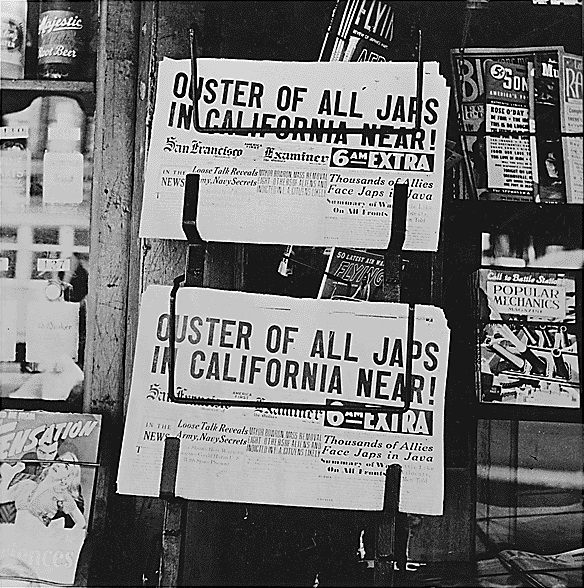 |  |
Left: “OUSTER OF ALL JAPS IN CALIFORNIA NEAR!” San Francisco Examiner headlines of Japanese relocation, February 27, 1942. On May 21, 1942, the rival San Francisco Chronicle told its readers: “S.F. Clear of All But 6 Sick Japs. . . . The last group, 274 of them, were moved yesterday.” Photo by Dorothea Lange. Lange was 1 of 3 photographers the WRA hired in 1942–1943. The other 2 were Clem Albers and Francis Stewart. A civilian, Ansel Adams made multiple trips on his own to Manzanar between 1943 and 1944, documenting camp life. In 1944 Manzanar resident Toyo Miyatake was permitted by Manzanar’s project director to continue taking photographs inside the camp enclosure (he had taken photos surreptitiously) and set up a portrait studio.

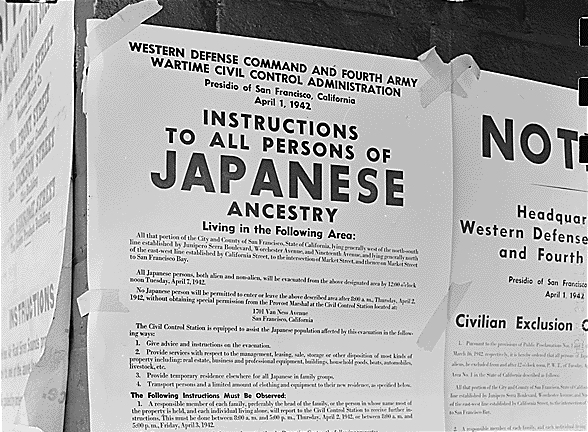
Right: Official notice of exclusion and removal, dated April 1, 1942. Photograph by Dorothea Lange, April 11, 1942. The exclusion order posted at First and Front streets in San Francisco directed the removal of persons of Japanese ancestry from the first San Francisco section to be affected by the evacuation. Years before the December 7, 1941, Japanese bombing of Pearl Harbor, Hawaii, the U.S. government had drafted plans to intern some Japanese Americans and immigrant aliens and had already placed some West Coast communities under surveillance. This in spite of years’ worth of FBI and naval intelligence data that attested to residents of Japanese descent posing no national security threat. The exclusion order also swept up Japanese American soldiers who had taken an oath of allegiance to their country of birth.
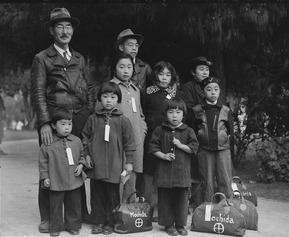 | 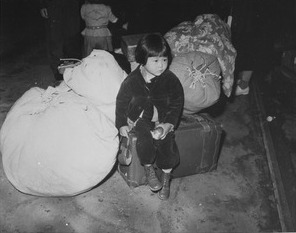 |
Left: With luggage tags affixed to their clothing—an aid in keeping family units intact during all phases of their forced removal—members of the Moriji Mochida family await an evacuation bus in Hayward, Alameda County (San Francisco Bay area), California, May 8, 1942. On the luggage tags was written the family’s designated identification number. Mochida’s youngest child was 3. The Mochidas had operated a 2‑acre/0.8‑hectare nursery and 5 greenhouses in San Leandro, Alameda County, before their incarceration. Photograph by Dorothea Lange.
Right: The forced exodus of Japanese in Los Angeles started at the end of March 1942. Staring into uncertainty 2‑year-old Yuki Okinaga Hayakawa, clutching a tiny purse and an apple with a few bites gone, waits with the family’s allotment of baggage before leaving a chaotic scene at Los Angeles’s Union Station. The child and her single mother, Mikiko, eventually arrived, like most Japanese Angeleno evacuees, at Manzanar War Relocation Center, more than 200 miles/322 kilometers north of LA in California’s Owens Valley, which would be their home for the next 3½ years. Each displaced family member was permitted to take bedding and linens (no mattresses), toilet articles, extra clothing, and “essential personal effects,” nothing more; in other words, only what could be carried by an individual. Photograph by Clem Albers.
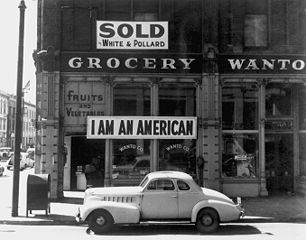 | 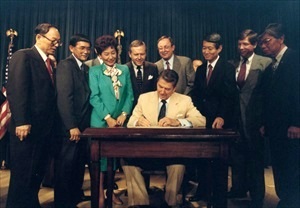 |
Left: The Matsuda family closed its grocery and Japanese goods store in Oakland, California, during March 1942. Son Tatsuro, a Nisei graduate of the University of California, Berkeley, commissioned the large sign “I AM AN AMERICAN” and had it installed shortly after December 7, 1941. Photograph by Dorothea Lange. Declarations like young Matsuda’s were insufficient to overcome the suspicion and contempt directed at people who looked like the enemy and who, it was widely assumed at the time, remained loyal to Japan and its emperor Hirohito (posthumously referred to as Emperor Shōwa).
Right: In 1944 the U.S. Supreme Court upheld the constitutionality of the exclusion orders, described by many Americans as the worst official civil rights violation of modern U.S. history. After years of lawsuits and negotiations, on August 10, 1988, President Ronald Reagan signed the Civil Liberties Act of 1988, which formally acknowledged that the wartime exclusion, evacuation, and confinement of Japanese Americans had been unreasonable. The act granted $20,000 in reparations to each surviving Japanese American (about 82,000 people), costing the U.S. Treasury $1.6 billion. (A month later the Canadian prime minister signed a similar settlement and apology.) It took a decade to locate all eligible U.S. recipients and deliver them their checks and formal apology. In 1991 survivors of the more than 2,200 Latin Americans of Japanese descent who were evicted by their governments and incarcerated in U.S. camps were compensated with a pitifully small $5,000 check. A late 20th-century study concluded that the internal government decisions that led to Roosevelt issuing Executive Order 9066 were based on racial prejudice, wartime hysteria, and failed political leadership.
Injustice Camouflaged as Military Necessity: Japanese American Incarceration During World War II
 History buffs, there is good news! The Daily Chronicles of World War II is now available as an ebook for $4.99 on Amazon.com. Containing a year’s worth of dated entries from this website, the ebook brings the story of this tumultuous era to life in a compelling, authoritative, and succinct manner. Featuring inventive navigation aids, the ebook enables readers to instantly move forward or backward by month and date to different dated entries. Simple and elegant! Click