

GERMAN PARATROOPERS SEIZE CRETE
Crete, Eastern Mediterranean · May 20, 1941
With the start of marathon German operations against the Soviet Union, codenamed Operation Barbarossa, a month away, Adolf Hitler needed to ensure that his Romanian oil supplies in and around Ploiești would not come under bomber attack from stationary bases in the Eastern Mediterranean. The most likely source of those attacks was the island of Crete, lying several hundred miles south of Greece (see map). Just three weeks before, 50,000 out of nearly 60,000 British and Commonwealth soldiers and airmen had escaped German capture in Greece for the safety of British-held Crete and Egypt in a Dunkirk-like evacuation. On this date in 1941 the first of 23,000 German paratroopers descended from a cloudless sky onto Crete, garrisoned now by 45,000 Allied men (which included 9,000 Greek troops). Operation Merkur (Mercury) was the last phase in the Axis Balkans campaign (Yugoslavia, Greece, and Crete) and also the first time in history that an entire invasion force was deployed from the air. German Fallschirmjaeger captured Maleme Airfield in bitter fighting on May 20–21, 1941, which allowed German supplies and reinforcements to be flown into Crete, though not without losing scores of planes and landing craft to Allied and partisan resistance. Maleme was the turning point in the battle for Crete. Even so, German airborne losses were massive enough—one in four killed or missing (Crete was dubbed the Fallschirmjaegers’ graveyard)—that Hitler forbade any further large-scale parachute operations in the future, telling the operations commander, Maj. Gen. Kurt Student, that the surprise factor had now been exhausted and the day of mass jumps was over. Narrowly viewed, Crete’s seizure gave the Axis an advantageous position in the Eastern Mediterranean for the next four years. From the perspective of the big picture, the Axis Balkans adventure had set back Hitler’s Barbarossa timetable by weeks. Hitler told more than one confident that if his Italian partner, Benito Mussolini, hadn’t invaded Greece and needed German aid to undo the fiasco, the entire war, at least on the Eastern Front, would have turned out differently. “We could have anticipated the Russian cold by weeks and conquered Leningrad and Moscow. There would have been no Stalingrad,” he lamented.
[fblike]
[amazon_carousel widget_type=”ASINList” width=”600″ height=”200″ title=”Recommended Reading” market_place=”US” shuffle_products=”False” show_border=”False” asin=”1841768448,0330490591,1844157709,0811735060,0143126423,1864711310,0917653491,071103446X,0711027587,1781592489″ /]
Battle of Greece and Crete, April–May 1941
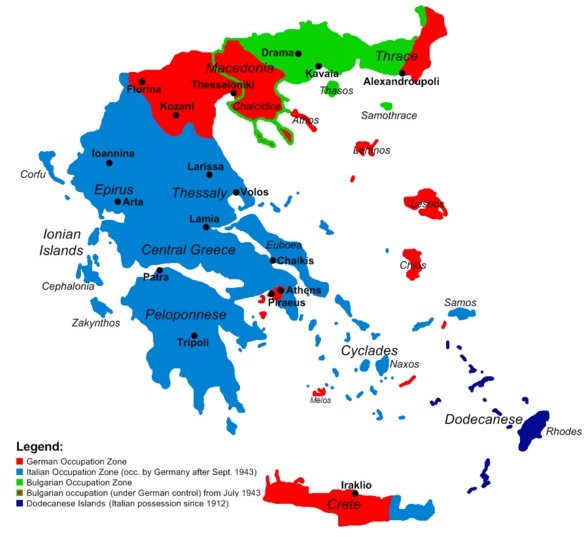 |
Above: Greece and Crete during Axis occupation, 1941–1944. Map depicts the German, Italian, and Bulgarian occupation zones.
 |
 |
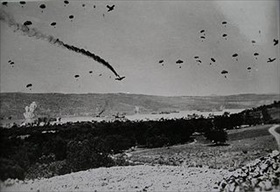
Left: Taken by a British combat photographer on May 20, 1941, this photo was edited for propaganda purposes to show a black smoke trail from a damaged German Junkers Ju 52 transport. German paratroopers suffered heavy casualties within the first hours of the invasion. Some 400 of the III Battalion’s 600 men were killed before the end of the first day. Germans suffered an estimated 6,000–7,000 casualties during the Battle of Crete, which lasted from May 20 to June 1, 1941.
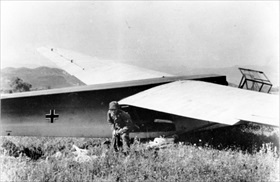
Right: A Fallschirmjaeger and a 10-man DFS 230 transport glider in Crete. The British Navy based at Alexandria, Egypt, retained control of the waters around Crete, so Hitler was forced into an airborne invasion if he wanted to snatch Crete for the Axis. The Luftwaffe lost heavily in the fight for Crete: 220 aircraft were destroyed outright and another 64 were written off due to damage, for a total of 284 aircraft lost, with several hundred more damaged to varying degrees. These losses were later to impact negatively on German attempts to defend Stalingrad.
 |
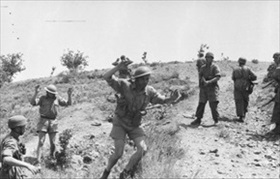 |
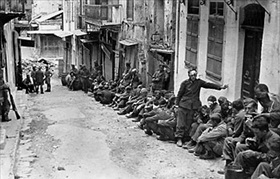
Left: Captured German troops on Crete, late May 1941. Many German troops in the Crete invasion were not trained in airborne assaults and suffered as a consequence. The British and Americans, however, were impressed enough by the potential of airborne assault forces that they began to build and train their own airborne divisions, which they used spectacularly in their invasions of France and Germany in 1944–1945.
Right: British soldiers surrender to German paratroopers. From a disastrous start, the Germans recovered dramatically. By June 1 all but 500 of Crete’s defenders had surrendered. Crete proved a Pyrrhic victory bought at the price of future German airborne operations. The British Mediterranean island fortress of Malta, at just 117 sq. miles, would have been a magnet for a German airborne invasion, but Hitler would not countenance such a thing after talking high casualties on Crete.
1944 Office of Strategic Services Documentary: Battle of Crete, May to June 1941

World War II was the single most devastating and horrific event in the history of the world, causing the death of some 70 million people, reshaping the political map of the twentieth century and ushering in a new era of world history. Every day The Daily Chronicles brings you a new story from the annals of World War II with a vision to preserve the memory of those who suffered in the greatest military conflict the world has ever seen.