

BISMARCK’S BREAKOUT WORRIES ROYAL NAVY
London, England · May 21, 1941
On this date in 1941 the German heavy cruiser Prinz Eugen and the battleship Bismarck set out from occupied Norway into the main Atlantic shipping lanes, there to act as long-distance commerce raiders. It was the maiden voyage of Germany’s monstrous battleship, the most lethal weapon in any navy’s arsenal. Germany’s major surface warships, combined with its fleets of submarines and armed merchant raiders, had caused extensive damage and disruption to Britain’s vital supply routes to and from North America almost since the outbreak of hostilities in September 1939 (click Battle of the Atlantic). As well as sinking merchant ships belonging to belligerent and neutral nations alike, the German Navy forced British-bound convoys carrying food and war materials to be diverted or halted, thereby imperiling the very survival of the island nation. The Royal Navy, continuously seeking out and destroying convoy-prowling German U‑boats, now set out to destroy the 42,000-ton pride of the Kriegsmarine. On May 27, 1941, off the southwest coast of Ireland, the HMS King George V and the HMS Rodney pulverized the Bismarck with their 14- and 16‑inch guns, finishing off the job the Prince of Wales and carrier aircraft from the Ark Royal had begun hours earlier. More than 2,100 officers and men (including the entire German fleet staff) perished. Much further south, this off the coast of Brazil and also on this date, German U‑boat U‑69 torpedoed and sank the unarmed American cargo ship SS Robin Moor. Though passengers and crew were permitted to disembark, President Franklin D. Roosevelt declared an unlimited state of national emergency a week later in response to the U.S. quasi-war with German U‑boats. FDR vowed that the so-called “Neutrality Patrol” operating up and down the American east coast, begun on September 6, 1939, with the aim of discouraging German warships from threatening shipping inside U.S. and Canadian waters, would be extended deeper into the Atlantic. On July 1, 1941, Adm. Ernest J. King, Commander-in-Chief of the U.S. Atlantic Fleet, established task forces to escort convoys between U.S. and Canadian waters and the North Atlantic island nation of Iceland, a job made easier when that country permitted U.S. forces to be stationed on the island seven days later.
[fblike]
[amazon_carousel widget_type=”ASINList” width=”600″ height=”200″ title=”Recommended Reading” market_place=”US” shuffle_products=”False” show_border=”False” asin=”1557504369,1585673978,159114325X,1612000754,1848842503,1862271739,8362878592,1781550395,1849083835,1612001238″ /]
Sink the Bismarck: The Royal Navy’s Operations Between May 21 and May 27, 1941, that Destroyed the Pride of the Kriegsmarine
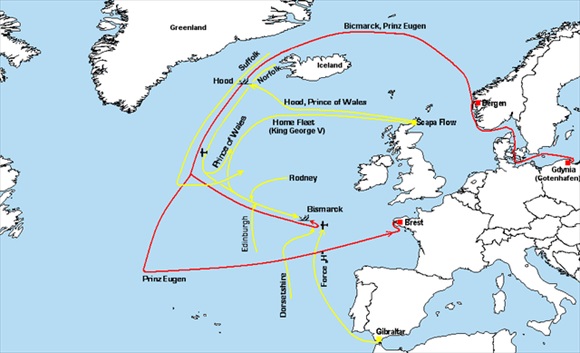 |
Above: Map of the Royal Navy’s operations against the battleship Bismarck and the heavy cruiser Prinz Eugen, with approximate movements of ship groups (red German, yellow British), places of aerial attacks on the two German warships, and the Bismarck’s final resting place. The wrecked battleship was discovered about 400 miles west of Brest, France, on June 8, 1989, by Robert Ballard, the oceanographer responsible for finding the RMS Titanic.
 |
 |
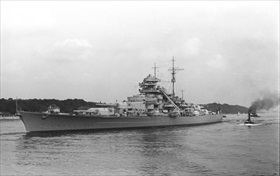
Left: The Bismarck on the River Elbe in Blankenese near the North German city of Hamburg. The mammoth battleship was sunk nine days into her maiden voyage, a voyage that began auspiciously enough with the Bismarck quickly and neatly destroying the battlecruiser HMS Hood, with a loss of 1,500 Royal Navy sailors, and severely damaging the newly commissioned battleship, the Prince of Wales, in the Battle of the Denmark Strait, May 24, 1941 (see map above). In all, six battleships and battlecruisers, two aircraft carriers, thirteen cruisers, and twenty-one destroyers were committed to the search-and-destroy chase.
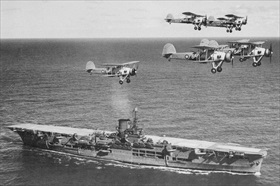
Right: British aircraft carrier Ark Royal with a flight of Fairey Swordfish biplane torpedo bombers overhead, circa 1939. One of these obsolete planes scored a hit that rendered the Bismarck’s steering gear inoperable, making the battleship’s destruction the next morning all but inevitable.
 |
 |
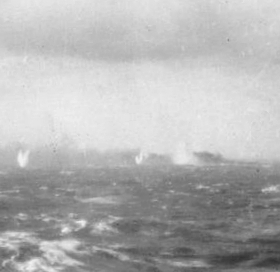
Left: Surrounded by shell splashes, the Bismarck burns on the horizon. Four British warships fired more than 2,800 shells at the Bismarck, scoring more than 400 hits. The photo was taken on May 27, 1941, from one of the Royal Navy’s warships chasing her.
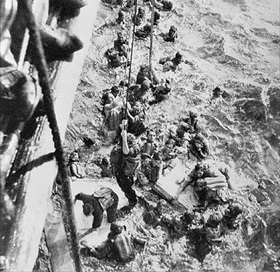
Right: Two British warships attempted to rescue the Bismarck’s survivors after the HMS Dorsetshire (shown here) managed to inflict a coup de grâce by firing two torpedoes into the badly listing battleship. A U‑boat alarm, however, caused the ships to leave the scene after having rescued only 110 out of some 400 sailors in the water. Later a German U‑boat and a German trawler picked up five survivors.
Hunting the Bismarck: The Last Hours of the HMS Hood and the Bismarck

World War II was the single most devastating and horrific event in the history of the world, causing the death of some 70 million people, reshaping the political map of the twentieth century and ushering in a new era of world history. Every day The Daily Chronicles brings you a new story from the annals of World War II with a vision to preserve the memory of those who suffered in the greatest military conflict the world has ever seen.