

FRENCH PARTISANS TARGET GERMAN OCCUPIERS
Paris, Occupied France • August 21, 1941
On this date in 1941 in Paris, well over a year after the hardstepping German Wehrmacht (armed forces) and Gestapo (Germany’s sinister secret police) had entered the French capital and settled in, a 22‑year-old Communist member of the French Resistance named Pierre Georges (noms de guerre, Frédo and Colonel Fabien) fired 2 bullets into the back and head of Alfons Moser, a young German naval ensign, in the Barbès-Rochechouart Métro station, not far from the Gare du Nord in the 10th arrondissement (district). Very public and very bold, these were the opening shots of the partisan warfare that would soon paralyze German occupation forces all over France. Adolf Hitler demanded the immediate execution of 100 hostages. The number was reduced to 10. Maréchal (Marshal) Philippe Pétain, the doddering 85‑year-old titular head of the French government (by this time, almost certainly senile), proposed that his collaborationist Vichy regime carry out the executions by guillotine (a favorite of French police) in public; however, German military authorities, fearing repercussions from the French public, insisted that the executions be done in private.
Beginning on August 28 and over the next several days, French judges sent 11 innocent Frenchmen to their deaths. Between August and the end of 1941, there were 68 serious, mostly hit-and-run attacks on Germans in and around Paris alone. The brutality with which these attacks was met; the mass executions of hostages (500 within several months of Moser’s assassination); the absence of over a million young and middle-aged men who were in prison, concentration or POW camps, in hiding, or in exile; the constant ID checks on the street and in Métro stations; the repression, roundups, and deportation of French-born and nationalized immigrant Jews; and the growing wartime shortages of rationed consumer goods (for example, food, tobacco, clothing, and shoes—leather stocks had been requisitioned by the German military) that gave rise to a vigorous black market—all these things were at last combining to turn average French citizens against the German occupiers and Vichy French servants. Marshal Pétain himself remarked that “from various parts of France, I begin to feel an unpleasant wind getting up.”
Young Moser’s brazen murder marked a turning point in the French Resistance, and the wind never let up. Large and small resistance operations culminated in 2 horrific German reprisals on June 9 and 10, 1944, in Tulle and Oradour-sur-Glane in Central France. In reprisal for résistants killing, harrying, and slowing them down as they attempted to reach the Allied beachheads in Normandy following D-Day (June 6), officers and men of the 2nd SS Panzer Division “Das Reich,” one of Hitler’s most elite and murderous armored outfits, together with some of the Nazi Party’s Sicherheitsdienst (German Security Service) and Vichy Milice (militia), rounded up 500 men, women, and children of Tulle, near Limoges in South-Central France, and hanged 99 from trees, balconies, and street lights. Surveying the scene, SS officers laughed, drank, and snapped photographs. The next day the bloodthirsty killers ringed the nearby sleepy hamlet of Oradour-sur-Glane, herded the women and children into a church, which they set on fire, shot the men singly or in small groups, killing a total of 642 villagers, burned the hamlet to the ground, and pillaged its livestock. Only 7 inhabitants escaped to tell this story of criminal madness.
Speaking of criminal madness, according to French sources, between May 1940 and September 1944 a total of 6,000 Frenchmen were massacred or killed (massacrés) by the Germans and their “allies,” 25,000 were shot (fusillés), and 27,000 résistants died during deportation (the last train of déportés left Paris for the East on August 17, 1944, a week before the city’s liberation). The body count doesn’t include the tens of thousands of résistants and déportés (76,000 Jewish déportés alone) who died in transit or following their incarceration in POW camps, concentration camps, or death factories in Germany and Eastern Europe.
Few accounts of wartime France have affected me more deeply than Caroline Moorehead’s heartbreaking yet inspiring history of 230 women of the French Resistance, age 17 to 67, who were sent by Philippe Pétain’s collaborationist Vichy regime to Nazi death camps in the East. Only 49 of these résistantes returned to a liberated France. Drawing from interviews with these women and their families, and from chilling records she accessed in French, German, and Polish archives, Moorehead traces the grim 27-month odyssey of these women in A Train in Winter. Their collective voices are a remarkable testament to extraordinary courage, survival, and the enduring power of friendship in a world scarcely imaginable. Moorehead’s book is on my short list of books to read twice.—Norm Haskett
Cold-Blooded Killers: “Das Reich” in Oradour-sur-Glane, Occupied France, June 10, 1944
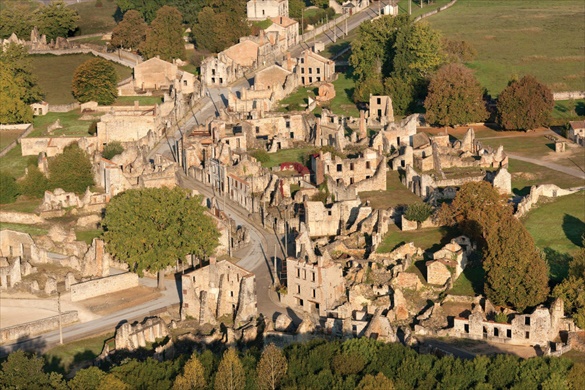
Above: Oradour-sur-Glane today looking southeast along the main thoroughfare, Rue Desourteaux, earlier lined with bars, cafés, and restaurants. In 1944 only about a quarter of its 1,500 residents lived in town. The rest were in outlying hamlets and farms. On a hot Saturday afternoon on June 10, 200 SS soldiers in half-tracks and trucks drove up unannounced from the St. Julien road (bottom), sealed off the town, and rounded up its inhabitants into a central recreational area. The townspeople were then bombed, shot with automatic weapons, or burned to death. The Germans then set the town ablaze. By about 7 p.m. most of them were gone with the exception of 1 German fatality and a guard unit. Photo source: Alan Davidge, “The Execution of Oradour-sur-Glane,” Warfare History Network, Spring 2023.
 |
 |
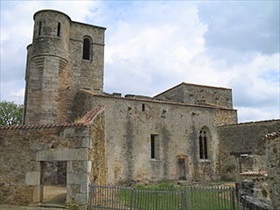
Left: The church of St. Martin in Oradour-sur-Glane in which 245 women villagers or visitors and 205 children were killed or burnt to death in cold blood. Soldiers of the 4th SS Panzer Grenadier Regiment (“Der Fuehrer”), a company of the 2nd SS Panzer Division “Das Reich,” heaped chairs, straw, and bundles doused with fuel on bodies and corpses inside the church after an explosive charge and grenades had failed to do their deadly work. Those who attempted to escape were cut down by automatic weapons fire. Husbands, fathers, sons over 14, and brothers were marched to nearby barns and garages, lined up, and executed. Those who survived execution were set on fire, their bodies unidentifiable. Six males, one a 7‑year-old schoolboy, and one 47‑year-old woman who escaped through a broken sacristy window at the back of the church survived the madmen’s massacre. After the war a new village (population 2,517 in 2022) was built northwest of the site of the massacre. By order of French president Charles de Gaulle the original village (called Village Martyr, “Martyred Village”) has been maintained as an open-air museum and permanent memorial to the cruelty of the Nazi occupation. Photo taken on June 11, 2004, exactly 60 years after Oradour-sur-Glane’s destruction.
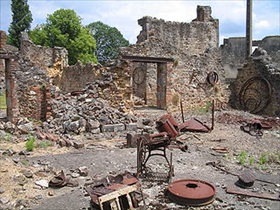
Right: Wrecked and rusting hardware (bicycles, sewing machine, etc.) 6 decades later is left as a lasting reminder of the barbarity of the German reprisal in Oradour-sur-Glane, a hamlet tucked away in the gently rolling hills and green forests of what was then called Limousin, South-Central France. In January 1953 a military tribunal in Bordeaux, France, heard the case against the surviving 65 of the approximately 200 Waffen-SS soldiers who had been involved in the atrocities “Das Reich” Panzer Division committed en route from a staging area north of Toulouse in Southern France to the Normandy front. (The division’s victims while in transit are estimated to number 4,000, many civilians among them.) Only 21 defendants were in court because many of the accused had been killed in action after their arrival in Normandy and some could not be extradited from the new East Germany (German Democratic Republic). On February 11, 1953, with 1 exception, all were found guilty of committing war crimes and were sentenced to hard labor. The convicted were released from prison within 5 years. As late as 2013, German prosecutors were still pondering whether to put on trial 7 elderly members of the “Das Reich” found alive in Germany.
 |
 |
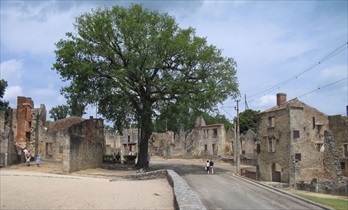
Left: Rue Desourteaux, the main street of Oradour-sur Glane, just outside the village church. On September 4, 2013, German president Joachim Gauck, French president François Hollande, and 2 of the 3 remaining survivors of the 1944 massacre visited the ghost village of Oradour-sur-Glane. A joint news conference broadcast by the 2 leaders followed their tour of the site. Said Gauck: “The Germany that I have the honor of representing is a different Germany from the one that haunts memories.” This was the first time a German president had visited the site of one of the biggest World War II massacres on French soil. For decades relatives of the victims of the Oradour-sur-Glane massacre had opposed any pilgrimage to the site by a German leader.
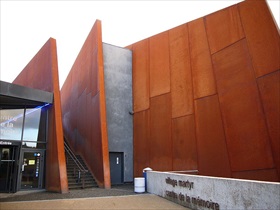
Right: As early as the late 1980s families of the martyrs of Oradour-sur-Glane had proposed a memorial to their fallen kin. Out of 642 just 52 could be positively identified; the remainder were officially classified as “missing,” because their remains were not sufficiently identifiable. A building of innovative design was built to house a permanent exhibition as well as temporary exhibits associated with atrocities committed during the 4‑year German occupation of France. On July 16, 1999, French president Jacques Chirac dedicated the Centre de la mémoire d’Oradour-sur-Glane (Center of Memory). Oradour is well off the beaten track for tourists; that said, since 2002 hundreds of thousands of visitors have visited the museum.
Ghosts of War: Oradour-sur-Glane

World War II was the single most devastating and horrific event in the history of the world, causing the death of some 70 million people, reshaping the political map of the twentieth century and ushering in a new era of world history. Every day The Daily Chronicles brings you a new story from the annals of World War II with a vision to preserve the memory of those who suffered in the greatest military conflict the world has ever seen.