

FRENCH HOSTAGES TO DIE TIT FOR TAT
Paris, Occupied France · September 28, 1941
On this date in 1941, in the wake of the first public assassination of a German officer in France, the German military authorities issued a Code of Hostages to the French people. Pools of Frenchmen, whether detained by French authorities or by the German Wehrmacht (armed forces) or the Gestapo (secret police) for “anti-German” and otherwise illegal activities, were to be held in readiness as hostages against future attacks on German soldiers. Illegal activities included espionage, sabotage, armed attacks, and distributing anti-German tracts. Fifty to 100 Frenchmen would be shot for every German killed. Members of the French Resistance responded with wall posters: “For every patriot shot, 10 Germans will be killed.”
It was open season on both sides for the rest of the war. In one of the most gruesome reprisals—this on June 9, 1944, in the French industrial town of Tulle in Central France—German Waffen-SS company “Das Reich” and members of the Sicherheitsdienst (the intelligence agency of the Nazi Party’s Schutzstaffel, or SS) first tortured, then murdered 99 randomly selected men aged between 17 and 42, hanging the victims’ bodies from trees, balconies, and lamp posts all over town. Additionally, another 321 captives were sent to labor camps in the Third Reich, where 101 lost their lives. In total, the actions of the Germans claimed the lives of 213 Tulle civilians. The next day, June 10, the same Waffen-SS unit massacred 642 inhabitants, including women and children, in the village of Oradour-sur-Glane, 15 miles/24 km north of Tulle.
Marshal Philippe Pétain, the octogenarian head of the collaborationist Vichy government, appealed to his countrymen for restraint, saying that by terms of the Franco-German armistice of June 22, 1940, Frenchmen had agreed to lay down their weapons. He closed his eyes to the unequal tit-for-tat ratio of French dead to German dead and to the fact that truly innocent Frenchmen were being detained and killed, declaring himself more committed than ever to collaboration with psychopathic killers and oppressors. According to French sources, between May 1940 and September 1944 a total of 6,000 Frenchmen were massacred (massacrés) by the Germans and their “allies” (most likely the Milice, a Vichy French paramilitary force), 25,000 were shot (fusillés), and 27,000 résistants died during deportation, not to mention the tens of thousands of déportés who died following their incarceration in German concentration camps.
German Atrocities in France and the French Resistance
 |
 |
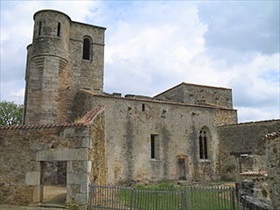
Left: The church in Oradour-sur-Glane in which, on June 10, 1944, 245 women villagers or visitors and 205 children were burned to death or shot as they attempted to escape. Their husbands, sons, and brothers were marched to nearby barns, lined up, and shot. One woman and 6 men survived the massacre. After the war a new village was built on a nearby site. On the orders of French president Charles de Gaulle the original village has been maintained as a museum and permanent memorial to the cruelty of the Nazi occupation. Photo taken June 11, 2004.
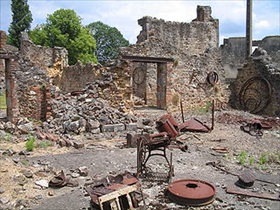
Right: Wrecked hardware (bicycles, sewing machine, etc.) seven decades later, left as a reminder of the unspeakable barbarity of the German reprisal in Oradour-sur-Glane. An initial judicial investigation by German authorities into the Tulle and Oradour-sur-Glane reprisals, urged on by Field Marshal Erwin Rommel and Pétain’s Vichy French government, was opened, then suspended, in part because many of the perpetrators had been killed in action during the Allied invasion of Normandy (Operation Overlord). Finally in January 1953 a military tribunal in Bordeaux, France, heard the case against the surviving 65 of the approximately 200 Waffen-SS soldiers who had been involved in the massacres. Only 21 defendants were in court because many of the accused could not be extradited from the new East Germany (German Democratic Republic). On February 1, 1953, with a single exception all were convicted of war crimes.
 |
 |
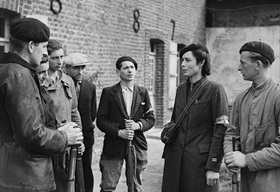
Left: During the Battle of Normandy, the Maquis (rural guerrilla bands in Brittany and Southern France) and other groups played an important role in delaying German mobilization. The FFI (Forces Françaises de l’Interieur, French irregulars) blew up railroad tracks and repeatedly attacked German Army equipment and garrison trains on their way to the Channel coast. This photo shows members of the Maquis in La Tresorerie near Boulogne-sur-Mer, Northern France, September 14, 1944.
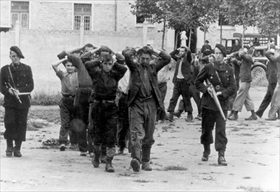
Right: Resistance members captured by the Milice, a Vichy French paramilitary force, July 1944. Milice’s membership may have reached 25,000–35,000 (including part-time members and non-combatants) by 1944. Milicien operated in both the “free zone” (Pétain’s Vichy France) and in the German zone (zone occupée), including Paris. Many milicien were imprisoned for treason, executed following courts-martial, or killed by résistants and civilians who revenged themselves in the épuration sauvage (pursuit of Nazi collaborators) that took place after the war’s end.
Short History of the French Resistance

World War II was the single most devastating and horrific event in the history of the world, causing the death of some 70 million people, reshaping the political map of the twentieth century and ushering in a new era of world history. Every day The Daily Chronicles brings you a new story from the annals of World War II with a vision to preserve the memory of those who suffered in the greatest military conflict the world has ever seen.