

CHURCHILL PROCLAIMS BATTLE OF ATLANTIC
London, England · March 6, 1941
By January 1941 the Allies had lost 1,300 merchant vessels, almost half of them to German U‑boats. Following the enslavement of 120 million people in seven Western and Eastern European countries by Nazi Germany the previous year, the British were reduced to fighting Adolf Hitler’s military juggernaut alone. In alarm they watched the sharp reduction of their food supplies and war material from the U.S. and Canada as the German navy sent merchantman after merchantman to the bottom of the ocean. As an island nation, the British were highly dependent on imported goods, requiring more than a million tons of imported material per week just to survive and fight. Using the example of the 1940 Battle of Britain, in which the Royal Air Force held Hermann Goering’s Luftwaffe at bay from July to October 1940, British Prime Minister Winston Churchill proclaimed the Battle of the Atlantic on this date in 1941. (The battle would turn out to be the longest continuous military campaign of the European war.) The next four months, Churchill predicted, would be used to defeat the Kriegsmarine’s attempt to sever the naval connection between North America and Britain. Four days later, President Franklin D. Roosevelt threw Britain a lifeline in the form of the Lend-Lease Act. Though the U.S. would not be pulled into war for nine more months, the hallmark legislation overturned three successive Neutrality Acts from the 1930s aimed at keeping the U.S. out of the European conflict. Lend-Lease gave the Roosevelt administration legal authority to send military and economic aid to countries whose defense was deemed vital to the U.S. The initial authorization totaled $7 billion. By the end of the war U.S. expenditures would top $50 billion. The first Lend-Lease food shipments left the U.S. on April 16, 1941, and helped avert an acute food shortage in Britain. Between April and December 1941, the U.S. delivered one million tons of food to Britain. The assistance the U.S. gave its Allies in the early part of the war greatly helped revive the U.S. economy from the effects of the Great Depression and placed it on a firm footing to enable it to join the fight against the Axis powers. When unleashed, the almost limitless power of the U.S. agricultural and industrial economy provided one of the principal weapons in the Allied victory.
[fblike]
[amazon_carousel widget_type=”ASINList” width=”600″ height=”200″ title=”Recommended Reading” market_place=”US” shuffle_products=”False” show_border=”False” asin=”1849081735,0752461877,0812979397,1439183244,046502873X,0812982045,030759596X,0195174011,1416591109,1848844786″ /]
Battle of the Atlantic: The Nazi Effort to Starve Britain into Surrender and the Allies’ Response
 |
 |
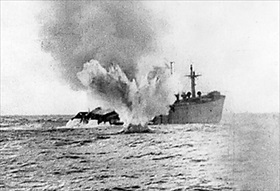
Left: A U-boat shells a merchant ship that remained afloat after being torpedoed. The Battle of the Atlantic was chiefly a tonnage war—the Allies eventually winning the struggle to supply Great Britain with food, armaments, and other necessities, while the Axis attempted to interdict merchant shipping that enabled the island nation to keep fighting. Lasting from 1939 to Germany’s capitulation in May 1945, the battle involved thousands of ships in more than 100 convoy battles and upwards of 1,000 single-ship encounters, all taking place in a watery theater covering millions of square miles.
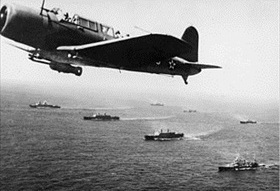
Right: A Vought SB2U Vindicator scout bomber from the USS Ranger flies antisubmarine patrol over a convoy of merchantmen en route to Cape Town, South Africa, November 27, 1941. The convoy was one of many escorted by the U.S. Navy on “Neutrality Patrol” before the country officially entered the war against the Axis on December 8 (Japan) and 11 (Germany and Italy), 1941.
 |
 |
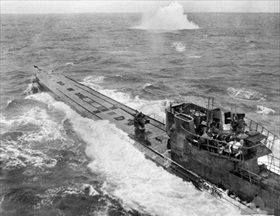
Left: German submarine U-848 under attack in the South Atlantic, November 5, 1943. Churchill wrote in his memoirs, “The only thing that ever really frightened me during the war was the U‑boat peril.” There was a period during the winter of 1942–1943 when the Kriegsmarine came close to cutting the North Atlantic lifeline. In the first 20 days of March 1943, the Germans sank 97 Allied merchant ships—twice the rate of replacement. By the end of 1943, however, the Allies had begun to overcome the threat to their convoys crossing the Atlantic.
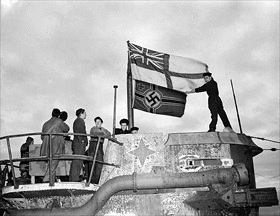
Right: Canadian seamen raise St. George’s Ensign above a German submarine in St. John’s harbor, Newfoundland, in June 1945. Both the Allies and the Germans paid dearly in battling for control of the Atlantic sea lanes. Between 1939 and 1945, 3,500 Allied merchant ships (totaling 14.5 million gross tons) and 175 Allied warships were sunk and some 72,200 Allied sailors and merchant seamen lost their lives. The Germans lost 783 U‑boats and roughly three-quarters of their 40,000‑man U‑boat fleet.
Nazi U-Boats Go After Trans-Atlantic Shipping While Allies Search for Countermeasures in the Battle for the Atlantic

World War II was the single most devastating and horrific event in the history of the world, causing the death of some 70 million people, reshaping the political map of the twentieth century and ushering in a new era of world history. Every day The Daily Chronicles brings you a new story from the annals of World War II with a vision to preserve the memory of those who suffered in the greatest military conflict the world has ever seen.