

BRITISH RUSH TROOPS TO AID GREECE
Cairo, Egypt · March 7, 1941
On this date in 1941 in Greece, a British expeditionary force from Egypt arrived just two days before the army of Italian dictator Benito Mussolini started its last unsuccessful campaign against Greek forces. The previous October the Italian army had crossed Greece’s northwestern frontier from neighboring Albania, launching the Greco-Italian War. The Italian invasion came as a surprise to Adolf Hitler. “Don’t worry, in two weeks it will be all over,” the Duce assured his Axis partner. Hitler characterized Mussolini’s invasion of Greece as “pure madness.” Mussolini told his son-in-law and foreign minister, Galeazzo Ciano, “Hitler rapped me on my knuckles with a ruler like a schoolboy.” The onset of winter and the Greek army combined to stop Mussolini’s misadventure. Indeed, the Greeks succeeded in pushing their Italian enemy back, deep into Albania, and in so doing won one of the Allies’ first victories against an Axis army. The next spring, beginning on April 6, 1941, the German army and Luftwaffe descended on Greece with a vengeance, as well as Greece’s northern neighbor, Yugoslavia, and the Allied garrison on Crete in the Mediterranean. Hitler’s intervention on the side of Italy in April 1941 saved the Duce from a debacle similar to the one in which he found himself in Libya before Gen. Erwin Rommel’s Deutsches Afrikakorps arrived there by air and sea the previous month. The Allied commitment to Greece in March 1941, too little and too late, ended in defeat and mass evacuation by the end of April—or captivity for those who were part of a rearguard under constant attack from dive-bombers and pursuing Germans. Some 12,000 Australian and British troops were killed or captured in the abortive campaign to save Greece from falling into Axis hands, while 50,000 escaped by sea. Despite Allied help, the Greeks were defeated in barely a month and German troops entered Athens on April 27, the king and the Greek government fleeing to exile in Egypt. The German diversion of resources in the Balkans delayed Hitler’s launch of the invasion of the Soviet Union (Operation Barbarossa) by a critical month. This proved disastrous when the Germans, like the Italians the previous winter in Greece, failed to finish off their adversary before the onset of wicked winter weather.
[fblike]
[amazon_carousel widget_type=”ASINList” width=”600″ height=”200″ title=”Recommended Reading” market_place=”US” shuffle_products=”False” show_border=”False” asin=”1781591814,1932455191,1781592489,0300089236,0982373430,1929631421,098165259X,0143126423,1844157709,1889247014″ /]
The Battle of Greece, April 6–30, 1941
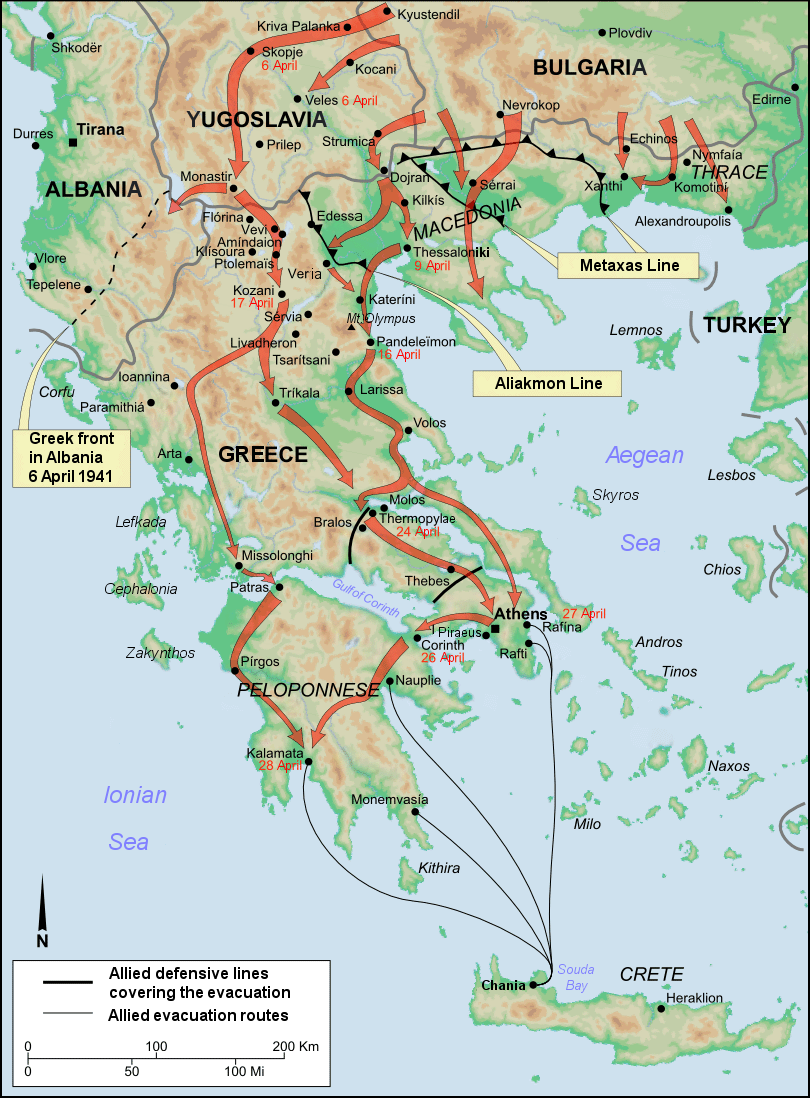 |
Above: Map shows Axis partner Bulgaria serving as the jumping off point for the German Wehrmacht’s invasion of Greece in April 1941.
 |
 |
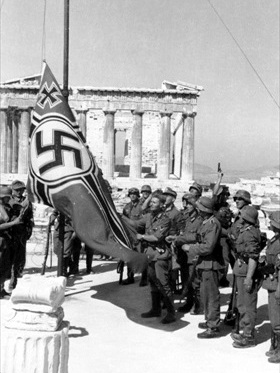
Left: German soldiers raise the German war ensign over the Acropolis of Athens, April 1941. Greek resistance fighters prevented the Axis (Germany, Italy, and Bulgaria) from enjoying a peaceful occupation of the mainland. By 1944, one in four Greeks was a member of the largest armed resistance group, the National Liberation Front (EAM). The German Wehrmacht withdrew from mainland Greece in October 1944 in the face of the Soviet Army’s advance into and conquest of Bulgaria to the north. Isolated garrisons remained on Crete and some of the other Aegean islands until the end of the war in May 1945.
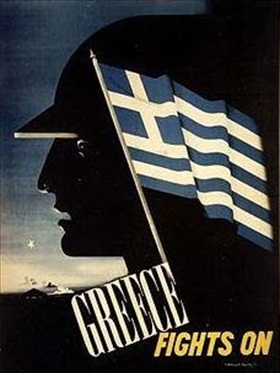
Right: American poster supporting Greece, 1942. Greek officers and soldiers who escaped falling into German hands served in Greek units attached to the British Eighth Army, seeing service in North Africa and Italy. The Greek Navy took part in the Allied invasions of Sicily and Anzio in Italy and Normandy, France.
Italian and German Campaigns in Greece and Yugoslavia, 1940–1941

World War II was the single most devastating and horrific event in the history of the world, causing the death of some 70 million people, reshaping the political map of the twentieth century and ushering in a new era of world history. Every day The Daily Chronicles brings you a new story from the annals of World War II with a vision to preserve the memory of those who suffered in the greatest military conflict the world has ever seen.