

ARMY PLOT TO KILL HITLER NEARLY SUCCEEDS
Wolf’s Lair, Rastenburg, East Prussia, Germany • July 20, 1944
Adolf Hitler had been the target of 4 assassination attempts before he became Germany’s head of state in January 1933 and perhaps 2 dozen more afterwards. On July 11, 1944, 36‑year-old Lt. Col. Claus von Stauffenberg arrived at the Berghof on the Obersalzberg, Hitler’s Bavarian retreat near Berchtesgaden, carrying a bomb in his briefcase. Stauffenberg, a staff officer to the headquarters of the Ersatzheer (Replacement Army), was part of a resistance group in the highest levels of the Wehrmacht (German armed forces) that had been planning Hitler’s assassination since at least 1938. Because the second-most powerful man in the Third Reich, Reichsfuehrer-SS Heinrich Himmler, chief of the Gestapo (secret police) and, from 1943, Minister of the Interior, was absent that day, the plan was aborted. The plotters worried about a “civil war” breaking out between the powerful police services under Himmler and the Wehrmacht if both men could not be killed at the same time.
Four days later Stauffenberg reappeared in Rastenburg at the “Wolf’s Lair” (Wolfsschanze), Hitler’s East Prussian headquarters (now in Kętrzyn, Poland). Again the plan to kill Hitler was nixed because Himmler was not present. Finally, on this date, July 20, 1944, a hot and humid summer day, an exasperated Stauffenberg crossed the Rubicon and planted a 2‑pound/0.9 kilogram bomb in a briefcase under a marble-topped map table in a wood-frame conference room at the Wolf’s Lair. The powerful explosion had the unintended consequence of killing thousands of people. By a quirk of furniture design, the “legs” at each end of the long table were one continuous piece of wood running widthwise from table edge to table edge; thus, the bomb blast was deflected away from its intended target standing to the other side of the single support. The explosion killed 4 individuals, injured 8, and destroyed the conference room. But Hitler, his uniform in tatters, miraculously survived, sustaining an injury to his arm, eardrums, and leg. Hitler shipped his ruined uniform to his long-standing girlfriend and future wife, Eva Braun, as a memento.
The detonation was the start of Operation Valkyrie (Walkuere), the codename for the military coup that began taking shape in Berlin upon Stauffenberg’s return flight to the capital. There the conspirators briefly believed that their watertight plans to kill Hitler had succeeded, and that a new government of their making could successfully conclude an armistice with the Allies, thereby averting, as it turned out, a cataclysmal ending to the Fatherland. At 1 a.m. the next morning, Hitler addressed the nation by radio, telling his listeners that his survival was a providential sign that he must surely continue in his role as Germany’s Fuehrer (leader).
Among the Western Allies the July bomb plot encouraged a delusional end-of-war euphoria. Many imagined Hitler’s Thousand Year Reich to be teetering on the brink of death. In London war planners set December 31, 1944, as the likely date by which hostilities would end. And in Washington, D.C., the War Production Board began cancelling military contracts despite the fight against the Japanese in the Pacific heating up. States in active or passive coalition with Nazi Germany such as Finland, Slovakia, Romania, and Bulgaria were begging for peace. Romania defected to the Allied side on August 23, 1944, several weeks after Anglo-American armies had pushed out of their Normandy, France, salient. In Nazi-occupied Poland, residents of Warsaw staged a 2‑month uprising in August and September 1944 against their oppressors. In bomb-battered Berlin, Nazism’s bleeding heart, brazen antiwar protesters erected a banner in a railroad station that read, “We want peace at any price,” an act of desperation comparable to the decomposing rot that spread internally in 1918 Germany, which forced Kaiser Wilhelm II’s government to agree to an armistice in November. Hitler, too, had plans for an armistice, but they miscarried in the frigid, snow-decked forests of the Ardennes in December 1944.
Some Conspirators in the Plots to Kill Adolf Hitler
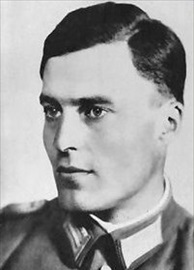 |
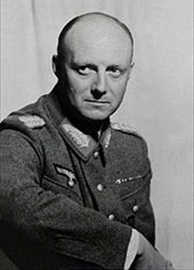 |
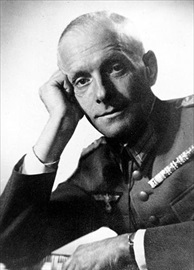 |
Left: Lt. Col. Claus Schenk Graf von Stauffenberg (November 15, 1907–July 21, 1944) was a 36-year-old German Army officer and aristocrat who, along with Gen. Maj. Henning von Tresckow and Gen. Maj. Hans Oster, was a leading member of the failed July 20, 1944, plot to assassinate Hitler and remove the Nazi Party from power. For his involvement Stauffenberg was shot in the courtyard of the General Army Office (Bendlerblock) shortly after the failed attempt known as Operation Valkyrie. Hitler personally made sure of Stauffenberg’s death by having his body exhumed to view it for himself.
Middle: Four-star general Henning von Tresckow (January 10, 1901–July 21, 1944) helped organize resistance within the Wehrmacht against Hitler. He attempted to assassinate Hitler in March 1943, and he drafted the Valkyrie plan. On learning of the failure of the July 20 plot, he committed suicide on the Eastern Front.
Right: Gen. Hans Oster (August 9, 1887–April 9, 1945) was deputy head of the Abwehr (German military intelligence) under Adm. Wilhelm Canaris and a leading figure in the German resistance movement from 1938 to 1943. Oster’s Abwehr group supplied British-made bombs to Tresckow’s group in their various bids to kill Hitler in 1943. Oster was executed on the same day Canaris was executed at Flossenbuerg prison in Bavaria.
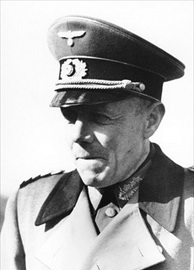 |
 |
 |
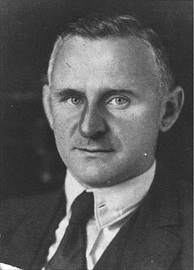
Left: Col. Gen. Ludwig Beck (June 29, 1880–July 20, 1944) was Chief of the German General Staff during the early years of the Nazi regime. In 1943 Beck planned 2 abortive attempts to kill Hitler using a bomb. In 1944 he was one of the driving forces of the July 20 plot with Stauffenberg and Carl Goerdeler. Beck was tapped to head the provisional German government that would assume power after Hitler had been killed.
Middle: Carl Friedrich Goerdeler (July 31, 1884–February 2, 1945) was a conservative politician, the ex-mayor of Leipzig. He was an executive, economist, civil servant, and opponent of the Nazi regime. Had the July 20 plot succeeded, Goerdeler would have been named chancellor in the new government.
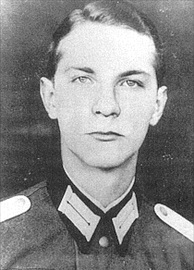
Right: With his father’s blessing, 22-year-old Ewald-Heinrich von Kleist-Schmenzin (July 10, 1922–March 8, 2013) unsuccessfully attempted a suicidal assassination against Hitler in January 1944 at the Wolf’s Lair. After the failure of July 20 plot, he managed to cover up his resistance activities. Many of his fellow plotters, including his father, were brought before Roland Freisler’s kangaroo People’s Court in Berlin and sentenced to death.
Lead-Up to Operation Valkyrie: The Plot to Kill Hitler, July 20, 1944

World War II was the single most devastating and horrific event in the history of the world, causing the death of some 70 million people, reshaping the political map of the twentieth century and ushering in a new era of world history. Every day The Daily Chronicles brings you a new story from the annals of World War II with a vision to preserve the memory of those who suffered in the greatest military conflict the world has ever seen.