

ANGLO-CANADIAN VICTORY ENDS 6-WEEK BATTLE FOR CAEN
Caen, Normandy, France • July 21, 1945
The capture of the historic Norman town of Caen, a city of 62,000, was a key objective of Operation Overlord (June 6, 1944 to August 30, 1944), the start of the Western Allies’ liberation of German-occupied Europe. Overlord’s plans called for the British Second Army and the Canadian First Army, supported by British and French commandos, to land at Sword Beach, the easternmost of 5 Normandy beach landing sectors, and on the same date (June 6, D‑Day) or at most D+1 strike south 9 miles/14½ kilometers and capture Caen (see map). The city was an important communications hub for water (river and canal), road, and air traffic to all compass points. In contrast to the landscape of recessed roads, tall and densely packed hedgerows that limited visibility, and small woodlands and pastures all of which characterized the hinterlands of other invasion beaches, Caen’s hinterland was open, suitably flat for constructing airstrips and deploying armored formations, and conducive to swift offensive operations to the south (Falaise plain) or toward the River Seine and Paris. Because June’s buildup of Allied troops and matériel on liberated French soil had grown to greatly outnumber the defenders in tanks and mobile units, a rapid mobile drive was to the Allies’ advantage.
Factors mostly beyond British and Canadian control on D‑Day and for days thereafter conspired to make the Allies’ planned capture of Caen on June 6 seem overly ambitious. The foul weather on D‑Day brought exceptionally high tides to Sword Beach, severely reducing the landing sector and causing a huge congestion of men, munitions, and equipment on the beach and at beach inland exits. Pre-invasion British reconnaissance had seriously underestimated German strength in the Sword sector. A lucky German kill of the single onshore forward observer on the afternoon of June 6 left 2 British warships unable to direct their 15 in./381 mm Mk I naval cannons to support the invaders needing backup when they encountered a pesky German strongpoint. A British squadron was enlisted to blast holes in the enemy’s defenses instead. Absence tanks and armored personnel carriers, which the British and Canadians didn’t have that day, meant that their understrength but determined infantry battalions were still 3 miles/4.8 kilometers short of reaching their D‑Day objective when they were stopped by another strongpoint. And even if the men could have reached Caen on the slated first or second day, 3 elite German panzer units of men and tanks were there to greet them.
The Allies concentrated on linking their 5 beachheads and strengthening their lodgments during June. In offensives that were integral parts of Operation Overlord, British and Canadian forces resumed their attacks in the vicinity of German-occupied Caen, in Caen’s suburbs, and finally in the city itself. Preceded by an air raid the night before, which destroyed much of Caen’s historic Old City, Operation Charnwood (July 7–9, 1944) began with air, infantry, and armored units attacking German positions north of the city, clearing villages in their path, and reaching Caen’s outskirts. The operation ended with the Anglo-Canadians seizing Carpiquet airfield and the city north of the River Orne, which bisected Caen. The Allies maintained the initiative and began Operation Jupiter the next day (July 10–11, 1944). Between July 18 and 20, 1944, the British kicked off Operation Goodwood, an air and ground offensive synchronized with Operation Atlantic, a Canadian offensive to capture Caen’s suburbs south of the Orne. The dual offensives finally secured Caen. The possession of the city and its surroundings on this date, July 21, 1944, gave the British, Canadian, and American armies a staging area for a push to capture Falaise. The Battle of the Falaise Pocket (August 12–21, 1944), in which most of German Army Group B (Erwin Rommel’s old command) was destroyed west of the Seine River, was the decisive engagement of Operation Overlord and opened the way to liberating Paris, the French capital, later in the month.
Capturing Caen Was a Long, Arduous, Tragic Experience for All, June 6 to July 21, 1944
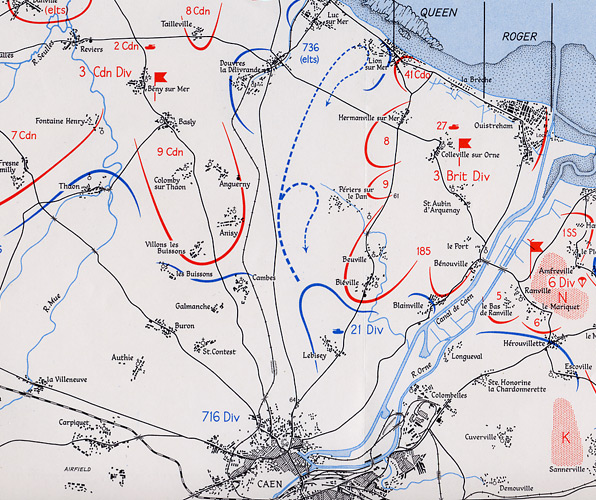
Above: Caen was a city of strategic importance to the German occupiers. Situated on east-west Route N13 (not identified as such on map; today A13), Caen was the gateway to Paris, since mid-1940 the capital city of France governed by the German military and German-approved French collaborators. Red lines for British and Canadian forces and blue lines for German forces indicate the fronts of opposing armed forces in the early days following D‑Day. Queen and Roger (top right corner) refer to Sword Beach sectors.
 |
 |
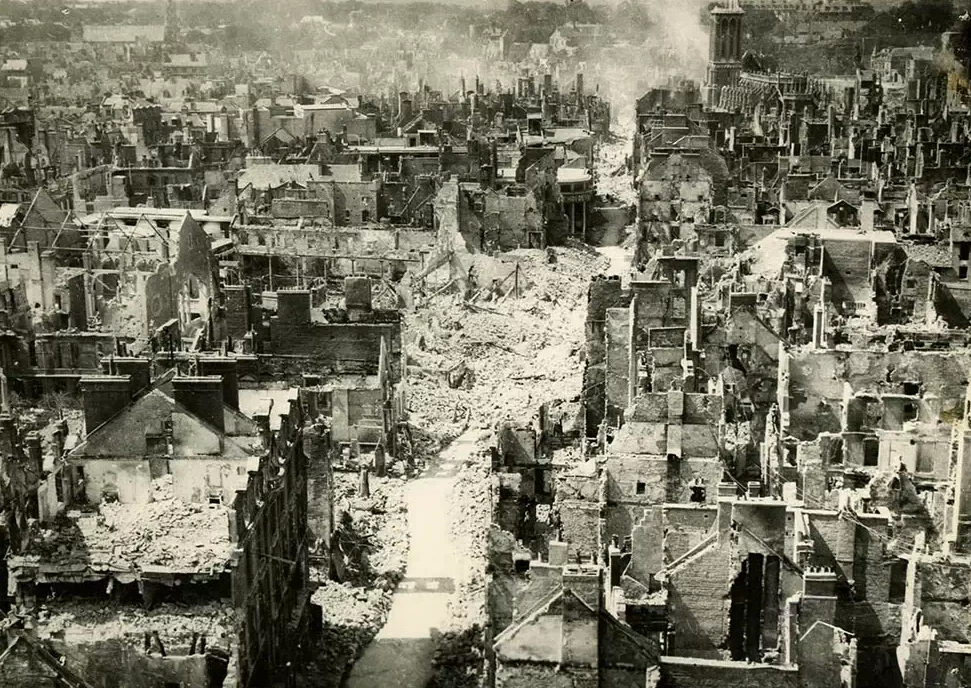
Left: Lunar landscape of Caen after repeated Allied bombing and artillery shelling. Seventy-three percent of the city sustained destruction. Only 1,000 out of 15,000 buildings in the city remained intact. Great Britain’s Royal Air Force and the U.S. Eighth Air Force opened D‑Day with a midnight bombing of Normandy’s coastal batteries and the historic city of Caen, which lay a few miles/kilometers south of the British assault area. Even before D‑Day, the Norman city of 62,000 French citizens and a 300‑man German garrison had been the target of the Western Allies’ wrath. After daylight on D‑Day, with thick cloud cover, the RAF and USAAF returned to bomb Caen’s railroad station. A bomb run the afternoon of June 6 by Eighth Air Force heavy bombers turned the ancient city of Caen—much of which was still wooden structures—into an inferno. In retaliation for the bombing, the German garrison took 80 French Resistance prisoners out of their cells and shot them dead.
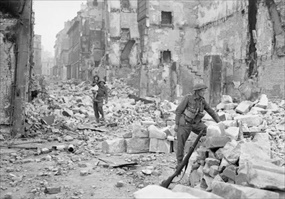
Right: In the aftermath of the intense bombing of Caen late on the night of July 7 through 9, 1944, a British soldier (center rear) carries a small girl through the devastation of the northern half of Caen, July 10, 1944. British Gen. Bernard Law Montgomery, the officer commanding all ground forces during Operation Overlord, foresaw the capture of Caen by nightfall of June 6 as part of D‑Day’s opening shock and surprise. At his final great dress rehearsal for Overlord on May 15, Monty went out on a tree limb to prophesize the possibility of reaching Falaise, 31 miles/50 kilometers inland on D‑Day. Inexcusably, Montgomery days later suppressed the latest British intelligence of a heavy SS armored presence around Caen lest that information dampen the morale of British soldiers or require revised plans for capturing the city. The British Second Army thus walked into a buzz saw as their columns struck out on foot for Caen without adequate antitank weapons. To Gen. Dwight D. Eisenhower, Supreme Commander of the Allied Expeditionary Force, it was incomprehensible that it took the British and Canadians 6 weeks to finish off the enemy in Caen.
 |
 |
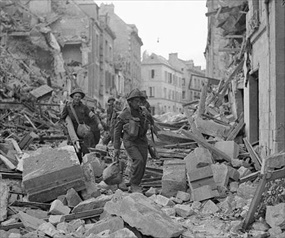
Left: During Operation Charnwood (July 7–9, 1944) Anglo-Canadian troops pick their way through the remains of the northern portion of Caen, July 9, 1944. German defenders used the rubble of homes as fortified fighting positions to block the subsequent attack by Allied soldiers. As Operation Charnwood progressed, fighting became intense, and units engaged in bitter house-to-house battles in the suburbs of Caen. Most infantry battalions sustained losses of 25 percent. The bombings from July 7–9 were regarded as a significant success due in no small part to the amount of physical damage it caused and the psychological effect it had on both Allied and German fighting men. The Allied bombardment did not destroy any significant enemy forces or strongpoints. The only reported impediment caused by the rubble was against the Allied forces forward advancement, especially tanks. The Deputy Mayor of Caen, on meeting the first British officer to enter the city on July 9, “informed the good major that there were virtually no buildings at all left standing in the city.”
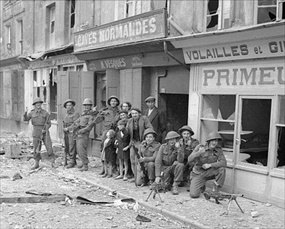
Right: In the aftermath of Charnwood’s heavy bomber air raids, some of the first Allied troops to enter the city pose with local inhabitants outside their wrecked shops. Civilians often welcomed the soldiers with empty glasses and bottles filled with wine among other gifts.
 |
 |
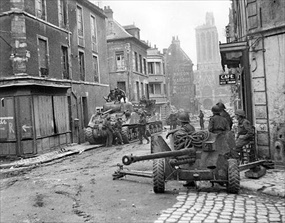
Left: A 6-pounder antitank gun of the 1st Battalion, King’s Own Scottish Borderers, part of the 9th Brigade of the 3rd British Infantry Division, along with two Sherman tanks near the Church of Saint‑Pierre, July 10, 1944. A single tower of the heavily damaged church is visible in the background.
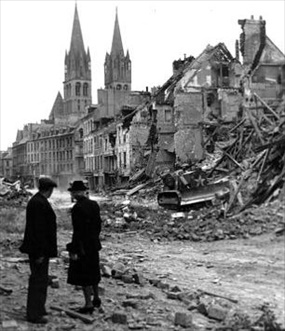
Right: A pair of residents watch a Canadian army bulldozer (right center) clear away some of the never-ending ruins of destroyed residences, rue de Bayeux, Caen. In the background, the twin towers of the Abbaye aux Hommes remain intact, July 10, 1944. While it may be impossible to know the exact number of Caen’s residents who perished, the most accurate assessment is 1,741 died, mostly on June 6–7 during the air raids in support of the Normandy landings. Other sources suggest about 3,000 may have died. Many more thousands were wounded over the weeks-long struggle to secure the city, and one of Europe’s most historic cities was left in ruins. Before the war Caen boasted a civilian populace of 62,000; after the war only 18,000 to 20,000 remained in the martyred city. As late as 1954 over 8,000 residents of Caen still sheltered in sub-par temporary housing. The bitter campaign to drive out the invaders and liberate the city for the Allies’ operational advantage came at a high cost for the Western Allies (30,000 Anglo-Canadian fatalities alone) and the tens of thousands of French civilians who were maimed or died there.
Battle to Liberate Caen, June to July 1944 (Skip first 40 seconds)

World War II was the single most devastating and horrific event in the history of the world, causing the death of some 70 million people, reshaping the political map of the twentieth century and ushering in a new era of world history. Every day The Daily Chronicles brings you a new story from the annals of World War II with a vision to preserve the memory of those who suffered in the greatest military conflict the world has ever seen.