

PEACE THREATENED, EUROPE MOBILIZES ITS ARMED FORCES
Berlin, Germany; Warsaw, Poland; and London, England • August 27, 1939
On this date in 1939, just a day after Adolf Hitler aborted his plan to invade his eastern neighbor, Poland, German mobilization continued. Between August 25 and 31, a further 21 infantry divisions and 2 motorized divisions were in place along the German-Polish frontier. No reserve units were mobilized lest that alert the Poles. Armaments for other units were strengthened. A total of 1.5 million men were within miles/kilometers of the border or in barracks pending orders to move. From August 26 German airports were closed and German airspace became a restricted zone. Diplomats from foreign countries needed permission to travel outside the Nazi capital.
Across the frontier, what amounted to a general Polish mobilization was ordered on August 23 for all army units in the Polish Corridor and much of Western Poland. On the 27th the remaining Polish reserve units were mobilized. In Great Britain, Prime Minister Neville Chamberlain (in office 1937–1940) refused to sanction general mobilization owing to the fear that it could be used as a pretext by other states, as it was in 1914, to mobilize in retaliation. However, on August 22–23 he authorized the first stage of calling up “key parties” to man staff rooms, command posts, and antiaircraft units. On August 24 all antiaircraft and coastal defense positions were ordered to be fully mobilized, involving more than 120,000 men.
Chamberlain also took steps to create a multiparty “War Cabinet,” which included his future successor and strong anti-appeaser, Winston Churchill (in office 1940–1945), whom Chamberlain restored to his executive cabinet as First Lord of the Admiralty. In an address to the British Parliament on August 24 and in a letter to Hitler on August 27, which conveyed pretty much the same thing, Chamberlain reiterated his pledge in the face of “the imminent peril of war” that British commitments to defend Poland’s independence would be honored unreservedly lest anyone in Berlin think otherwise.
As in Britain, Germany, and Poland, so in France. On August 24 French Premier Édouard Daladier (in office 1938–1940) authorized steps to bring his nation to a state of preliminary mobilization. French Army chief Gen. Maurice Gamelin reassured Daladier, “We have a respectable parity in equipment.” European political and military leaders appeared ready and able to protect themselves against Hitler’s next aggressive threat.
Milestones on the Path to War: German-Soviet Nonaggression Pact (1939) and Munich Agreement (1938)
 |
 |
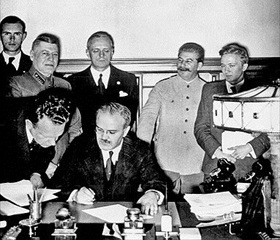
Left: Soviet Foreign Minister Vyacheslav Molotov signs the German-Soviet Nonaggression Pact watched from behind by German Foreign Minister Joachim von Ribbentrop and, to his left, Molotov’s boss, Joseph Stalin. Hitler had hoped that the August 24, 1939, pact (ratified by the Kremlin on August 31) would provoke the Polish-British-French axis to collapse, allowing Germany to launch a swift, successful, and localized war against Poland to which Poland’s friends in the West could not quickly or effectively respond. The dramatic news of the pact had much less effect on British and French leaders (and the public) than Hitler had expected. He had anticipated their governments to fall, but Western intelligence services had already predicted the outcome of Ribbentrop’s hasty visit to Moscow. Also, public opinion in the West had shifted from a dread of war to a fatalistic acceptance of war.
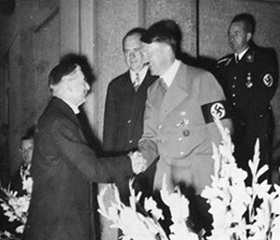
Right: British prime minister Chamberlain climbs a flower-bedecked staircase to Hitler’s study in Munich’s Fuehrer Building (part of Nazi Party headquarters) on the fateful afternoon of September 29, 1938. Next to enter Hitler’s study was French premier Daladier. Already seated inside was Italian dictator Benito Mussolini, the 4 statesmen assembling to put their signatures on the Munich Agreement. Unlike the 1938 crisis, which ended when the 4‑power conference blackmailed Czechoslovakia into handing Germany its Sudetenland (which accounted for one-third of Czechoslovakia’s population but which was primarily ethnic German), the Polish crisis of 1939 turned out to be unsolvable: Chamberlain demanded as a precondition that Hitler abandon war against Poland as an option in settling Polish-German disputes, and Hitler was absolutely determined to conquer Poland despite Western guarantees to maintain Poland’s independence
Snapshots of the Last Peaceful Days in Poland, Baltic Coast, Summer 1939

World War II was the single most devastating and horrific event in the history of the world, causing the death of some 70 million people, reshaping the political map of the twentieth century and ushering in a new era of world history. Every day The Daily Chronicles brings you a new story from the annals of World War II with a vision to preserve the memory of those who suffered in the greatest military conflict the world has ever seen.