

TRUMAN ADVOCATES PUNITIVE PEACE PLAN
Washington, D.C. · May 10, 1945
On this date in 1945 President Harry S. Truman signed the Joint Chiefs of Staff Directive 1067. The person behind the directive was Henry Morgenthau, Jr., President Franklin D. Roosevelt’s former Treasury Secretary who had long advocated that postwar German occupation include measures to eliminate Germany’s ability to wage war for a third time—the first two times being the First and Second World Wars. JCS 1067 applied only to the U.S. zone of occupation, not the British, Soviet, and later French zones. Truman did, however, succeed in incorporating much of JCS 1067 (and its inspiration, the 1944 Morgenthau Plan) into the Potsdam Agreement, a “communiqué” that the victorious powers hashed out during their meeting in a Berlin suburb between July 17 and August 2, 1945. Under the Potsdam provisions, U.S. occupation efforts focused mainly on denazification, German disarmament and demilitarization, the prosecution of German war criminals, and the reduction or destruction of all civilian heavy industry that might have a military potential. Locomotive, merchant ship, and aircraft production, for example, was prohibited and banks were restricted in their lending. The German economy was to be restructured toward light industry and agriculture. Following the Agreement’s implementation, German living standards declined and malnutrition and death rates rose above prewar levels. Beginning in mid-1946 many observers came to see the Morgenthau Plan and JCS 1067 as inflicting undue hardship on Germans and limiting the ability of their country to recover from the devastating effects of the past dozen years. Truman’s Secretary of State, retired Gen. George C. Marshall, citing national (i.e., U.S.) security concerns, was able to convince the president to rescinded the punitive occupation directive JCS 1067 in 1947, months after the Morgenthau Plan had been abandoned as official U.S. policy. In April 1948 a new Economic Recovery Program was in place, informally named after Marshall. The $13 billion, four-year Marshall Plan helped European economies (apart from Soviet satellites’) quickly recover and modernize along American lines. The aid plan also stimulated the political reconstruction of Western Europe. In 1953 Marshall was awarded the Nobel Peace Prize for his postwar work.
[fblike]
[amazon_carousel widget_type=”ASINList” width=”600″ height=”200″ title=”Recommended Reading” market_place=”US” shuffle_products=”False” show_border=”False” asin=”0805777857,0743244540,0465003389,0815410425,0521378400,125003356X,0814408575,1892941902,0743282647,0470097558″ /]
Marshall Plan: Restoring the Infrastructure and Economies of Post‑WWII Europe
 |
 |
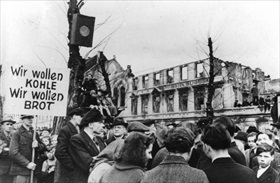
Left: Between 1946 and 1948 food production in Germany was still two-thirds the prewar level. Not until the end of 1949, after the Marshall Plan had kicked in, did industrial production reach prewar levels. During the winter of 1947, thousands of West Germans took to the streets to protest the disastrous housing, food, and displaced persons situation in their country. In this street demonstration, the handheld placard reads: “We want COAL. We want BREAD.”
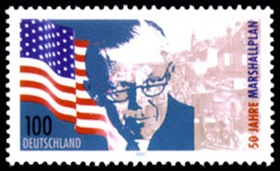
Right: 1997 West German stamp commemorating the 50th anniversary of the Marshall Plan. Marshall delegated the design of the Marshal Plan to his subordinates, using his prestige as the organizer of victory in World War II to garner the requisite support in the U.S. Congress for its passage.
 |
 |
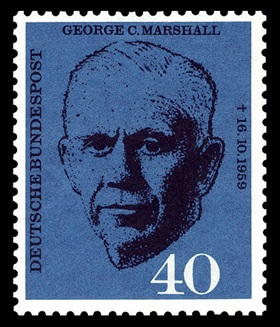
Left: 1960 West German stamp honoring George Marshall (1880–1959). As U.S. Secretary of State (1947–1949), Marshall laid the groundwork for the European Recovery Program (1947–1951), the Marshall Plan’s formal name; the Berlin Airlift (June 1948–May 1949); the creation of the North Atlantic Treaty Organization (NATO) (1949); and the establishment of the German Federal Republic (West Germany) (1949).
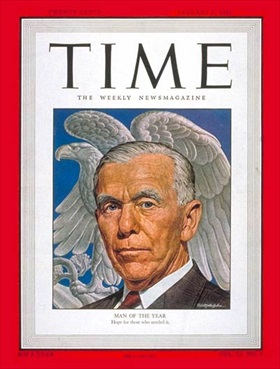
Right: Marshall was the first professional soldier to win the Nobel Peace Prize (1953) and was twice named Man of the Year by Time magazine (1943 and 1947).
George C. Marshall, American Soldier and Statesman (Part 1 of 2)

World War II was the single most devastating and horrific event in the history of the world, causing the death of some 70 million people, reshaping the political map of the twentieth century and ushering in a new era of world history. Every day The Daily Chronicles brings you a new story from the annals of World War II with a vision to preserve the memory of those who suffered in the greatest military conflict the world has ever seen.