

SOVIETS, JAPANESE CLASH AT KHALKHYN GOL
Tokyo, Japan · May 11, 1939
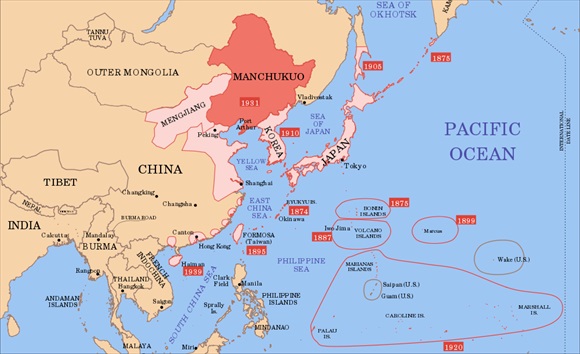
Europe, the United States, and Japan, profiting from the technological, economic, social, and military advantages conferred on their countries by the Industrial Revolution, began placing weaker nations elsewhere in the world under their “protection.” The United States did that in 1898, when the Philippines became an American territory. Japan declared Korea, lying across the Sea of Japan, a protectorate in 1905 and five years later annexed the country (see map below). Japanese militarism and aggressive trade policies on the Chinese mainland in the early twentieth century led Japan to garrison “advisors” there in the 1920s. Japanese troops based at Mukden (today’s Shenyang) in northern China staged a bomb attack (allegedly by Chinese dissidents) on a Japanese-owned railroad. The “Mukden Incident” of September 18, 1931, was the ruse for seizing the province of Manchuria, which bordered Korea on the east and, on the west, Outer Mongolia, a de facto puppet state of the Soviet Union. The Japanese creation of Manchukuo became the launch pad for more Japanese land grabs in the 1930s. On this date in 1939 a fierce undeclared war on the Mongolian plains broke out between Japanese forces from Manchukuo and Red Army forces stationed in Outer Mongolia. Although the Battle of Khalkhyn Gol (May 11 to September 16, 1939) is little-known in the West, it had profound implications on the conduct of World War II in Asia and Europe. Khalkhyn Gol may be said to be the first decisive battle of the Second World War: it determined that Japan and Germany, the two principle Axis powers bound together in a full-blooded military alliance (the Tripartite Treaty signed in Berlin on September 22, 1940), would never geographically link up their areas of control through the Soviet Union. Japan’s defeat at the Battle of Khalkhyn Gol convinced the Imperial General Staff, which held a stranglehold over successive Japanese civilian governments, that seizing Soviet resources was not tenable. Instead, the rich resources of Southeast Asia, especially the petroleum and mineral-rich Dutch East Indies (today’s Indonesia), looked more and more appealing, leading directly to the attack on the Philippines, the Dutch East Indies, British Malaya, and the American possession of Hawaii on December 7 and 8, 1941.
[fblike]
[amazon_carousel widget_type=”ASINList” width=”600″ height=”200″ title=”Recommended Reading” market_place=”US” shuffle_products=”False” show_border=”False” asin=”0700616632,159114339X,1906959234,0691102228,1105650146,0801495296,0679753036,0804718350,0582493498,0859791521″ /]
The Battle of Khalkhyn Gol: Japan versus the Soviet Union, 1939
 |
 |
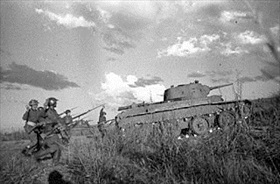
Left: The four-month conflict was named after the river Khalkhyn Gol, which flows through the battlefield. In Japan the conflict is known as the “Nomonhan Incident,” named after a nearby village on the border between Mongolia and Manchukuo (Manchuria).
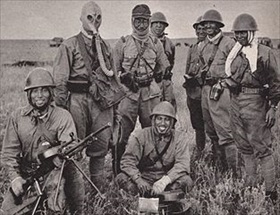
Right: Japanese soldiers pose with captured Soviet equipment during the Battle of Khalkhyn Gol. After the occupation of Korea (1905) and Manchuria (1931), Japan’s military leaders in China focused expansionist aims on Soviet territories, and conflicts occurred frequently on the Manchurian border, in fact as early as mid-1929. The army’s aggressive plans sometimes caught the civilian government in Tokyo by surprise, as the 1931 “Mukden Incident” (also known as the “Manchurian Incident”) showed.
 |
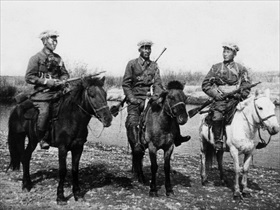 |
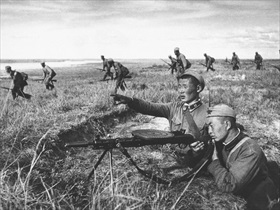
Left: Mongolian People’s Army soldiers fight against Japanese soldiers, Khalkhyn Gol, 1939. The Mongolian People’s Republic was proclaimed in November 1924 after Soviet troops expelled White Russian and Chinese forces from Outer Mongolia.
Right: Mongolian cavalry during the Battle of Khalkhyn Gol, 1939. After Soviet and Mongolian armed forces had defeated Japanese forces in the summer of 1939, the warring parties entered into a truce and set up a commission to define the Mongolian-Manchurian border later in the year.
 |
 |
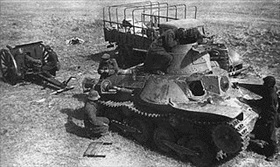
Left: A Japanese light tank (Type 95 Ha-Go) captured by Soviet troops after the Battle of Khalkhyn Gol. Six years later, on August 9, 1945, Soviet forces invaded Manchukuo. The rapid defeat of Japan’s Kwantung Army, as its army on the Chinese mainland was called, was a significant factor in Japan’s surrender. Japanese leaders imagined the Red Army as poised to invade the Home Islands with boots on the ground, while the Americans were viewed as perfectly content to incinerate the Home Islands using their fleet of heavy bombers.
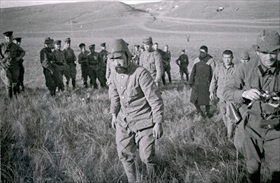
Right: Captured Japanese soldiers, Khalkhyn Gol, August 1939. Khalkhyn Gol resulted in total defeat for the Japanese Sixth Army, a garrison force based in Manchukuo under the overall command of the Kwantung (Japanese) Army.
Contemporary Accounts of the Soviet-Japanese Conflict in Manchuria During World War II

World War II was the single most devastating and horrific event in the history of the world, causing the death of some 70 million people, reshaping the political map of the twentieth century and ushering in a new era of world history. Every day The Daily Chronicles brings you a new story from the annals of World War II with a vision to preserve the memory of those who suffered in the greatest military conflict the world has ever seen.