

WAR CRIMES TRIAL BEGINS FOR HITLER’S HENCHMEN
Nuremberg, Germany · November 21, 1945
On this date in 1945 in Germany, the International Military Tribunal (Nuremberg Trials) of Nazi leaders got down to business in the city where Adolf Hitler had staged his 1930s showy party rallies. The legal basis for the trials was established by the London Charter, issued on August 8, 1945, which restricted the trials to “punishment of the major war criminals of the European Axis countries.” The charter defined three categories of crimes: war crimes, crimes against peace, and crimes against humanity. The international tribunal at Nuremberg (November 20, 1945, to October 1, 1946) defined crimes against humanity as “murder, extermination, enslavement, deportation . . . or persecutions on political, racial, or religious grounds.” Some 200 German political, military, and economic leaders were tried by the IMT, and 1,600 other defendants were tried under the traditional channels of military justice. With the exception of Heinrich Himmler and Joseph Goebbels, both suicides, 21 of Hitler’s most prominent henchmen were indicted and 12 sentenced to death by the panel of judges. Among them was Reich Marshal and Luftwaffe chief Hermann Goering, who cheated the hangman’s noose by suicide; Field Marshal Wilhelm Keitel and Col. Gen. Alfred Jodl, signers of Germany’s Instrument of Surrender in May 1945; Joachim von Ribbentrop, Hitler’s foreign minister; Wilhelm Frick, Minister of the Interior and co-author of the Nuremberg race laws; Hans Frank, governor-general of occupied Poland; and Adolf Eichmann, who oversaw the extermination of 400,000 Hungarian Jews in 1944. Eichmann, sentenced to death in absentia, later was caught, tried, and hanged in Israel in 1961. Grand Admiral Karl Doenitz, Hitler’s successor after his suicide, was incarcerated for 10 years. Albert Speer, Hitler’s favorite architect and from 1942 onwards Minister of Armaments and War Production, was sentenced to 20 years. The unstable Rudolf Hess, Hitler’s Deputy Fuehrer until May 12, 1941, after his farcical “peace mission” to England failed, was the last of the Nuremberg prisoners to die, by suicide in 1987. The Nuremberg Trials served as the model for the International Military Tribunal for the Far East (April 29, 1946, to November 12, 1948), which tried Japanese officials for crimes against peace and against humanity.
[fblike]
[amazon_carousel widget_type=”ASINList” width=”600″ height=”200″ title=”Recommended Reading” market_place=”US” shuffle_products=”False” show_border=”False” asin=”014016622X,1400030439,0700616985,1616080213,0826211399,0230006418,1403979650,0881840327,1848588402,1620877880″ /]
Postwar Trials of German War Criminals at Nuremberg
 |
 |
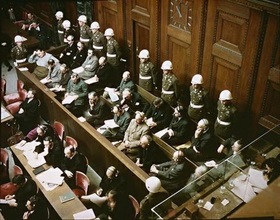
Left: When the International Military Tribunal (IMT) trial of major war criminals opened in courtroom 600 of the Nuremberg Palace of Justice on November 20, 1945, 21 defendants appeared before judges representing the Allied powers. Not all of the 24 indicted defendants were in Allied custody or able to stand trial. German industrialist Gustav Krupp von Bohlen und Halbach, included in the original indictment, was excluded due to his advanced age and failing health. Nazi Party Secretary and Hitler’s right-hand man Martin Bormann was tried and convicted in absentia. And Robert Ley, head of the German Labor Front, committed suicide in prison on the eve of the trial.
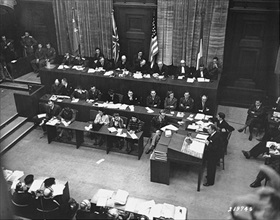
Right: This photo shows Chief American prosecutor and U.S. Supreme Court Justice Robert Jackson (behind large desk) as he delivered the prosecution’s opening statement at the International Military Tribunal at Nuremberg on November 21, 1945. Jackson played an important role not only in the trial itself, but also in the creation of the IMT, as he led the American delegation to London that helped devise the London Charter or Nuremberg Charter in the summer of 1945.
 |
 |
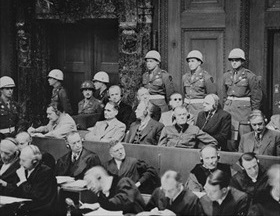
Left: The defendants listen as the prosecution begins introducing documents at the International Military Tribunal trial of war criminals, November 22, 1945.
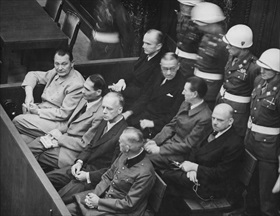
Right: The defendants left-to-right, front row: Reich Marshal Hermann Goering, former Deputy Fuehrer Rudolf Hess, Foreign Minister Joachim von Ribbentrop, and Chief of Staff of the Armed Forces High Command Wilhelm Keitel; back row: Grand Admiral Karl Doenitz, retired Grand Admiral Erich Raeder, Nazi Youth Leader Baldur von Schirach, and Slave Labor Deployment Chief Fritz Sauckel.
 |
 |
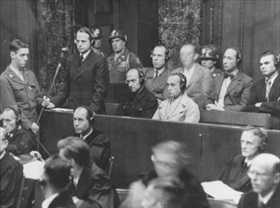
Left: Under the aegis of the IMT, the U.S., acting alone, conducted 12 further trials of lower-level German functionaries at Nuremberg. These trials are often referred to collectively as the Subsequent Nuremberg Proceedings (or sometimes the “American Nuremberg Trials”), and they provide a far broader picture of Nazi atrocities than their more famous predecessor. Between December 1946 and April 1949, U.S. prosecutors tried 177 persons and won convictions of 97 defendants. Leading physicians (Nuremberg Medical Trial), members of Einsatzgruppen (mobile killing units), members of the German justice administration and German Foreign Office, members of the German High Command (High Command Trial), and leading German industrialists were among the groups that stood in the dock. This photograph shows Otto Ohlendorf, commander of Einsatzgruppe D, which gathered its victims in southern Ukraine and the Crimea, during Trial 9 of the Subsequent Nuremberg Proceedings at his arraignment during the Einsatzgruppen Trial (September 29, 1947, to April 10, 1948) in Nuremberg. Ohlendorf was sentenced to death and hanged in Bavaria’s Landsberg Prison on June 8, 1951.
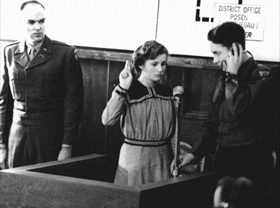
Right: In the RuSHA Trial (short for Rasse- und Siedlungshauptamt), which took place in Nuremberg between October 20, 1947, and March 10, 1948, the 14 defendants were all officials of various SS organizations responsible for the implementation of the Nazi “pure race” program. Fifteen-year-old Maria Dolezalova is shown here being sworn in on October 30, 1947, as a prosecution witness at the RuSHA Trial. Dolezalova was among the children kidnapped by German forces after they had massacred all males over 16 in Lidice and Lezaky, Czechoslovakia, on June 9, 1942.
Nuremberg: Tyranny on Trial. A History Channel Documentary

World War II was the single most devastating and horrific event in the history of the world, causing the death of some 70 million people, reshaping the political map of the twentieth century and ushering in a new era of world history. Every day The Daily Chronicles brings you a new story from the annals of World War II with a vision to preserve the memory of those who suffered in the greatest military conflict the world has ever seen.