

V-2 ROCKET KILLS/INJURES HUNDREDS
London, England • November 25, 1944
On this date in 1944 a German ballistic missile slammed into a crowded Woolworths store in London, England, killing 160 civilians and seriously injuring 108 more. The 42‑ft./12.8‑meter-tall, 12‑ton V‑2 (Vergeltungswaffe 2, “Retribution [or Vengeance] Weapon 2”) rocket with its 1‑ton payload of high explosives was truly a weapon of mass destruction. After these deadly results, British intelligence leaked falsified information implying that V‑2 rockets were overshooting their London target by 10 to 20 miles/16 to 32 km. Erroneous recalibration by the Germans meant that for the remainder of the war most V‑2s exploded harmlessly in Kent, “Hell Fire Corner” southeast of London and the front line during the earlier Battle of Britain.
Still, V-2 strikes mainly on London, Norwich, and Ipswich were often devastating, typically burrowing 25 ft./7.62 meters below ground and throwing around 3,000 tons of material into the air. In London alone, an estimated 2,754 civilians were killed by V‑2 attacks, with another 6,523 injured. The single-worst loss of life caused by a V‑2 rocket occurred in Antwerp, Belgium, when one landed on a movie theater killing 567 people.
Despite the tide of war turning against them and the area from which they could launch their supersonic rockets shrinking, the Germans were able to fire over 3,000 V‑2s with ever more deadly accuracy. The majority—1,610 of them—hit the Allies’ strategic deep-water port city of Antwerp, followed closely by the 1,358 that landed on Greater London. Additional V‑2s hit Liege, Hasselt, Tournai, Mons, Lille, and Diest in Belgium; Paris, Arras, and Tourcoing in France; Maastricht in the Netherlands; and the German Rhine crossing at Remagen just south of Bonn, whose Ludendorff Bridge had been captured intact by American troops on March 7, 1945. (Because V‑2 rockets were area-effect weapons, most of the rockets landed within several miles/kilometers of the Ludendorff Bridge, destroying several farms and killing civilians and farm animals.) The last 2 V‑2s targeting England exploded on March 27, 1945, one of them killing a civilian in her Kent home, the second one exploding in London, where it killed 134 souls and injured 94. Blessedly, Nazi Germany’s inevitable day of reckoning was a little over 5 weeks away.
Dr. Wernher von Braun and the German V-2 Rocket Program
 |
 |
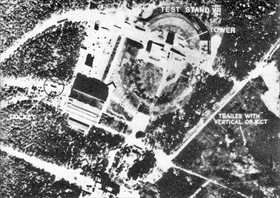
Left: Royal Air Force reconnaissance photograph of V‑2 rockets at Test Stands I and VII on the isolated island of Peenemuende, just off the Baltic coast of Northern Germany, June 12, 1943. The island was home to research laboratories, factory facilities, power plants, testing sites, and concrete launching bunkers—all in an effort to keep the V‑1 flying bomb and the V‑2 missile development programs as secret as possible. V‑2 missile testing began in March 1942, 2 months before a British Spitfire returning from a reconnaissance run over the Baltic snapped the first Allied pictures of the secret site. On the night of August 17/18, 1943, nearly 600 RAF airplanes dropped 1,800 tons of mostly high-explosive bombs on the Peenemuende Army Research Center, killing 2 V‑2 rocket engineers. The raid began Operation Crossbow, the Allies’ strategic bombing campaign against Nazi Germany’s V‑weapons program. In July and August of the following year, hundreds of U.S. B‑17 Flying Fortresses pummeled Peenemuende and the nearby classification (or marshalling) yards, killing scores of people. Among the German rocket engineers affected by the Allied air campaign was Dr. Wernher von Braun.
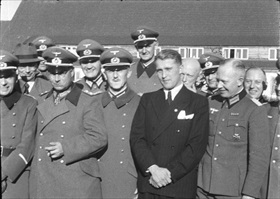
Right: Von Braun (1912–1977), Technical Director at the Army Research Center at Peenemuende, in a photograph taken March 21, 1941. The brilliant pioneer of modern rocketry (and father of the American space program), von Braun and his team of engineers postponed their initial dreams of space travel to create weapons of terror and mass destruction for Adolf Hitler’s Germany. Not only were they ambitious members of Hitler’s Nazi movement (von Braun was issued Nazi Party membership number 5,738,692), but they actively collaborated with the Nazi Party’s infamous SS (short for Schutzstaffel) in exploiting mostly non-German slave labor to build their V‑2 rockets. Reichsfuehrer-SS Heinrich Himmler, the second most powerful man in Nazi Germany, personally awarded an honorary SS rank of Untersturmfuehrer (second lieutenant) to von Braun in May 1940, though the latter claimed he accepted the award reluctantly. Himmler proceeded to promote von Braun 3 more times, the last time in June 1943 to SS-Sturmbannfuehrer (major). In 1944 Hitler awarded von Braun the Knights Cross of the War Merit Cross with Swords (Kriegsverdienstkreuz) for exceptional meritorious service to the Third Reich.
 |
 |
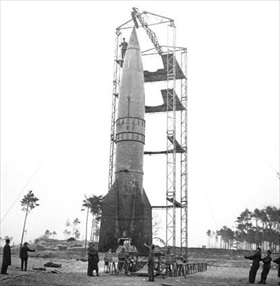
Left: Peenemuende launch pad with 5-story-tall V-2 rocket, March 1942. After a successful liftoff, the cigar-shaped rocket could travel 200 miles/322 km in 5 minutes. The ancestor of modern-day ballistic missiles, the A‑4 (more commonly known by its propaganda name, V‑2) could not win the war for Germany—it was too complicated, too inaccurate, and its warhead too small. It was also too expensive: the combined V‑1 and V‑2 weapons program was more costly (equivalent to 3 billion U.S. wartime dollars) than the Manhattan Project that produced the atomic bombs that were dropped on Japan ($1.9 billion then, or $35.36 billion in 2026). Nonetheless, during the V‑2 offensive (September 1944 to March 1945) the Germans launched over 3,000 of these rockets out of the 6,048 V‑2s built.
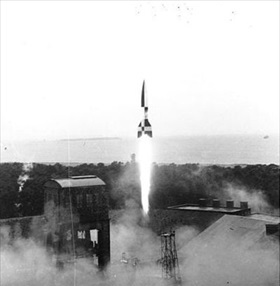
Right: Seconds after a V-2 rocket launch at Peenemuende, March 1942. Due to the 1943 RAF air raid on Peenemuende, V‑2 development and test firing shifted to an SS training base near Blizna in Southeastern Poland, which was less vulnerable to air attacks, while the nearly operational V‑2 production plant for the most part shifted to the gypsum mining tunnels in the Kohnstein quarry located 4 miles/6.4 km northwest of the town of Nordhausen in the southeastern Harz Mountains of Thueringen in Eastern Germany.
 |
 |
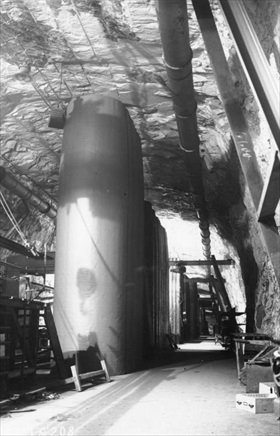
Left: In huge underground factories in the Kohnstein quarry, slave laborers from the Mittelbau-Dora concentration camp on the northern outskirts of Nordhausen constructed 5,200 V‑2 rockets by war’s end. (Mittelbau-Dora was initially a subcamp of Buchenwald concentration camp.) An estimated 20,000 prisoners died at the German camp, 9,000 from exhaustion. The majority, however, died from disease, starvation, or execution, including 200 accused of sabotage. Von Braun admitted paying many visits to the subterranean facilities, scene of unspeakable crimes and horrors. Photo taken after the Allies had captured the area.
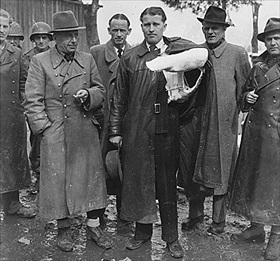
Right: The unprecedented invulnerability and influence on Allied planning made the V‑2 and the advancements it represented the ultimate war trophy, and American, British, and Soviet forces scrambled to seize German rocket technology along with its engineers and scientists. This photo from May 3, 1945, shows von Braun, arm in plaster cast following a near fatal car crash, in the company of several of his engineers a day after their surrender to U.S. soldiers. Acquiring U.S. citizenship in 1955, von Braun eventually became director of the U.S. National Aeronautics and Space Administration’s (NASA) Marshall Space Flight Center near Huntsville, Alabama. Although von Braun spent half his life living and working in Germany (until age 33), two-thirds of his professional career was spent in the United States, where he is credited with inventing the Saturn V rocket used by NASA to support the Apollo lunar program.
V-2 Terror on European Cities, 1944–1945

World War II was the single most devastating and horrific event in the history of the world, causing the death of some 70 million people, reshaping the political map of the twentieth century and ushering in a new era of world history. Every day The Daily Chronicles brings you a new story from the annals of World War II with a vision to preserve the memory of those who suffered in the greatest military conflict the world has ever seen.