

U.S. MORAL EMBARGO ON EXPORTS TO JAPAN
Washington, D.C. · July 2, 1940
America responded to Japan’s invasion of China in 1937 and to the many news reports of indiscriminate bombing of Chinese civilian targets by imposing trade restrictions on exports to Japan. Initially a proclamation by President Franklin D. Roosevelt on June 26, 1940, it morphed into an expression of national moral outrage when the U.S. Congress passed the Export Control Act on this date in 1940. The act gave the president power to halt or curtail the export of materials vital to U.S. defense and, more notably, limit the unlicensed export of certain materials to Japan.
Invoking the act on July 5, 1940, Roosevelt suspended the sale of aircraft parts (aircraft sales were already halted), chemicals, and strategic minerals to Japan—an act that raised the level of tension between the two nations. Toward the end of the month the government halted shipments of high-octane aviation fuel, lubricant, and premium scrap metals such as iron and steel. Lacking natural resources, Japan was sorely pressed to continue its aggression against China (for instance, Japan was almost totally dependent on U.S. oil), much less expand its economic and military orbit around Western colonial holdings in its Southeast Asia backyard. Washington ratcheted up its attempts to restrain Japanese expansionist policies by embargoing machine tools and all iron and steel shipments. That prompted Japan’s ambassador to the U.S. on October 8, 1940, to protest the expanding export ban as “an unfriendly act.” The State Department’s response was to advise American citizens to leave the Far East.
Japan’s frustration over the military stalemate in China and the cascading embargoes—the British and the Dutch followed suit in banning trade between their Southeast Asian colonies and Japan—pushed Tokyo in the opposite direction that Western leaders wanted Japan to take. The only way forward and build momentum, as Japanese leaders saw it, was for their military to seize control of the resources of British Malaya and the Dutch East Indies (present-day Malaysia and Indonesia, respectively). It was a gamble taken in steps, first by moving soldiers and naval personnel into French Indochina (today’s Vietnam)—prompting Western nations to freeze Japanese assets in their countries—then opening up sham negotiations in Washington, D.C., in November and early December 1941 after Army general Hideki Tōjō, Japan’s hardline Minister of War, became prime minister on October 17, 1941. Meanwhile, on December 1, 1941, Emperor Hirohito gave his military permission to attack Western interests on December 7 and 8.
Japan and the U.S. on the Threshold of War
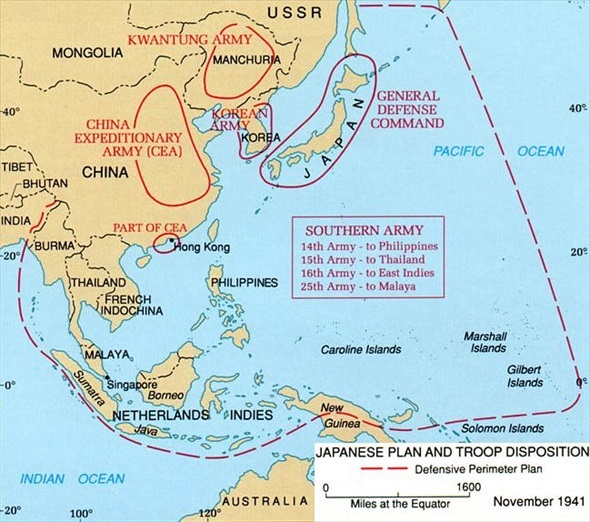 |
Above: Map showing Japanese plans for expanding into Southeast Asia and Japanese troop dispositions for defending their conquests and the Home Islands, November 1941.
 |
 |
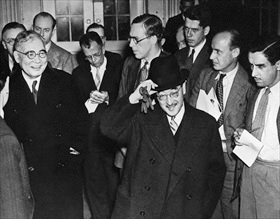
Left: Japanese Ambassador Adm. Kichisaburō Nomura and Special Envoy Saburō Kurusu (tipping hat) after speaking with Secretary of State Cordell Hull and President Roosevelt at the White House, November 27, 1941. Through much of the year, Nomura and Hull discussed ways to resolve differences over Japan’s territorial ambitions in China and French Indochina and the U.S. oil embargo. On November 15, 1941, Nomura was joined by former ambassador to Nazi Germany Kurusu. Kurusu presented FDR and Hull Japanese Prime Minister Hideki Tōjō’s proposal that the U.S. cease providing military support to China and resume trade relations that had been frozen in December 1939.
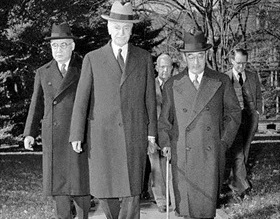
Right: Nomura and Kurusu with Hull (middle), November 17, 1941. The two diplomats would visit Hull again on Sunday afternoon (Washington time), December 7, 1941. The Secretary of State had just learned of the surprise Japanese attack on Pearl Harbor, but his visitors had not yet read Tokyo’s coded message informing them of the attack because their embassy’s technical support staff was off duty that day. Hull, after glancing over Nomura and Kurusu’s note explaining Japan’s rationale for breaking off negotiations with Washington, told the two envoys, “In all my fifty years of public service I have never seen such a document that was more crowded with infamous falsehood and distortion.” As the rattled envoys bowed themselves out of Hull’s office, the Secretary of State was heard to mutter at the closing door, “Scoundrels and piss-ants.”
Several Contemporary Newsreels Document Japanese Military Aggression on Chinese Mainland

World War II was the single most devastating and horrific event in the history of the world, causing the death of some 70 million people, reshaping the political map of the twentieth century and ushering in a new era of world history. Every day The Daily Chronicles brings you a new story from the annals of World War II with a vision to preserve the memory of those who suffered in the greatest military conflict the world has ever seen.