

U.S. AIRBORNE TROOPS LIBERATE FIRST SIGNIFICANT FRENCH TOWN
Carentan, Cotentin Peninsula, France • June 13, 1944
Late Monday, June 5, 1944, the largest amphibious invasion in history was set to launch. The next day, June 6, D-Day, 3 Allied armies began depositing their precious cargo of men and equipment on 5 Normandy beaches and in multiple aerial drop zones behind them. By evening the first-day wave of 156,000 U.S., British, and Canadian infantry and airborne troops, backed by 5,000 ships and landing craft and 11,000 aircraft, had taken possession of Omaha, Utah, Gold, Juno, and Sword beaches. These 5 invasion beaches were the codenames for the 50‑mile/80‑kilometer stretch of Calvados and Cotentin coastline in Northwestern France. Facing the invaders were 80,000 Wehrmacht defenders, German troops with a large helping of Osttroopen “volunteers” (Polish and Russian former POWs in German uniforms).
Among the priorities of Operation Overlord in the week American forces slapped down payments on their Utah and Omaha beach properties were these: (1) merge the 2 U.S. lodgments, (2) destroy enemy forces and lines of communication across the paths from the shoreline to the interior, and (3) prevent the arrival of enemy reinforcements intent on pushing them off their beachheads. Carentan, a crossroads town (4 intersecting highways, a canal and river, and a railroad station) of 4,000 residents some 10 miles/16 kilometers south of Utah Beach and 30 miles/48 kilometers southeast of the strategic ocean port of Cherbourg, was a significant impediment to achieving U.S. objectives. The town was garrisoned by 2 battalions of German paratroopers of the crack 6th Fallschirmjaeger Regiment (3,450 men, average age 17½) along with an assortment of infantry, airborne, and tank battalions belonging to the 91st Infantry Division. Tasked with removing the Carentan obstacle after securing safe exit points from Utah Beach was Maj. Gen. Maxwell Taylor’s 101st Airborne Division (“Screaming Eagles”), which had parachuted into D‑Day’s inky blackness near Carentan.
Legendary Field Marshal Erwin Rommel, since January 15, 1944, in charge of Wehrmacht formations in Northwestern France, was worried. Should Carentan fall to the invaders, Cherbourg harbor and the entire Cotentin Peninsula would be cut off from the rest of German-occupied France. The field marshal correctly assumed the Carentan garrison must be at the top of the list of U.S. targets after the 101st Airborne’s parachute and infantry glider regiments had consolidated their scattered forces around the French town on June 9. Rommel therefore instructed 37‑year-old garrison commander Major Friedrich von der Heydte, who had served with him in North Africa 2 years before, to defend Carentan “to the last man.”
The Battle of Carentan began just after midnight on June 10, 1944. It ended on this date, June 13, when German defenders withdrew late in the afternoon following a mauling by American tanks, aircraft, and infantry on the outskirts of town (Battle of Bloody Gulch). The previous day, June 12, 2 regiments of the 101st Airborne Division had secured the approaches to Carentan, as well as the town itself, after 48 hours of fierce, house-to-house, touch-and-go combat. The remnants of the German garrison, having evacuated the town during the night of June 11/12, counterattacked on June 13, resupplied and augmented by a division of SS Panzergrenadiers. They were beaten off by strafing P‑47 Thunderbolt dive-bombers, antitank guns, a third parachute infantry regiment of the 101st Airborne, and the timely arrival of tanks from the Normandy beaches. Together they inflicted a staggering loss of 500 soldiers on the Wehrmacht. It cannot be overstated that the U.S. victory at Carentan contributed to the success of Operation Overlord. The victory closed the gap between the Utah and Omaha beachheads, the last gap in the 5 D‑Day beaches, and it greatly reduced the danger of the enemy pushing the Western Allies from their hard-won French foothold.
Deadly Paratrooper Brawl at Carentan, June 10–13, 1944
 |
 |
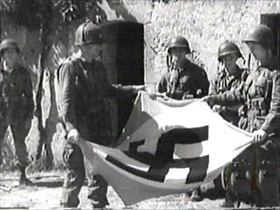
Left: Two officers of the 101st Airborne Division proudly display a captured German flag on June 12, 1944, the day the shattered enemy withdrew from Carentan. Although the town itself was liberated, the enemy still held the outskirts and most of the Cotentin Peninsula. Cherbourg, for instance, the chief port city at the tip of the peninsula, did not fall to the Allies until 20 days after D‑Day. Its capture was tempered by the discovery that the deep-water harbor on the English Channel, so critical to sustain and reinforce Allied forces in Normandy, had been systematically wrecked by German engineers starting the day after D‑Day, June 7. The main harbor basins were not made serviceable until September 21, causing a logjam of war matériel and vehicles, mixed with a shortage of fuel, that forced the Allied advance eastward across France to sputter out near the German frontier. The efficient demolition of Cherbourg harbor bought the Third Reich 3 extra months before Germany’s apocalyptic collapse in April and May 1945.
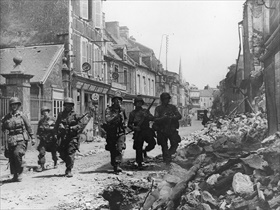
Right: Men from the 101st Airborne Division move through Carentan after the Germans were expelled from the town and its approaches on June 14, 1944, in nearly a week of nonstop fighting. Capture of Carentan’s key highways and rail line not only linked up American forces at Utah and Omaha beaches, but because of Carentan’s position at the base of the Cotentin Peninsula it also led the way for U.S. advances on the strategic harbor of Cherbourg. Mopping-up operations on nearby Cap de la Hague were completed by July 1, which was also the last day the Germans could conceivably have reversed their sagging fortunes in Normandy.
 |
 |
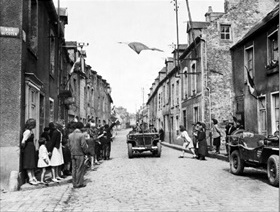
Left: Both the Allies and the Germans realized the importance of Carentan: for Americans, Carentan was a link between their landing beaches at Utah and Omaha, possession of which would firm up the Allies’ defensive line in Normandy. Also, Carentan provided a springboard for further attacks deeper into German-occupied France. For Germans, holding Carentan would, in view of the recent Normandy landings, be the first step toward driving a wedge between the 2 U.S. invasion beaches, a step that would severely disrupt and possibly even push back the advancing Allied invaders. In this photo, taken 2 days after bitter fighting for possession of Carentan, the French Tricolor floats high above the main street. Carentan was the first significant French town to be liberated by the Americans. Grateful residents wave their hands in welcome and appreciation as soldiers of the U.S. VII Corps, which landed at Utah Beach, drive past.
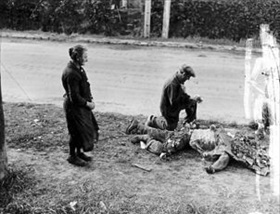
Right: Two residents lay flowers on the corpses of American paratroopers. By one estimate, the Battle of Carentan cost Americans at least 400 dead and hundreds more wounded and missing. The number of German dead, wounded, and missing is not precisely known. According to various contradictory sources German dead at Carentan ranged from 500 to 800. During the last day of combat, June 13, 1944, dubbed the Battle of Bloody Gulch, U.S. casualties were 32 killed and 73 wounded, while German casualties were 43 killed and over twice that wounded. During the 85‑day Battle of Normandy (June 6 to August 30, 1944), the Allies suffered 226,386 casualties and the Germans between 288,695 and 530,000. French civilian deaths were 25,000 to 39,000 when the pre-invasion bombing and the invasion itself are combined. During one 38‑day-stretch the 101st Airborne Division suffered 868 killed (about half occurring at Carentan), 2,303 wounded, and 665 missing in action.
Excellent Documentary on the 101st Airborne Division’s Attack on Carentan, June 10–13, 1944. Age restricted. Sign in on YouTube

World War II was the single most devastating and horrific event in the history of the world, causing the death of some 70 million people, reshaping the political map of the twentieth century and ushering in a new era of world history. Every day The Daily Chronicles brings you a new story from the annals of World War II with a vision to preserve the memory of those who suffered in the greatest military conflict the world has ever seen.