

U.S. A-BOMB VAPORIZES HIROSHIMA, JAPAN
509th Composite Group HQ, Tinian, Mariana Islands · August 6, 1945
For several months the U.S. had dropped more than 63 million leaflets across Japan, warning civilians of devastating aerial bombings. Many Japanese cities suffered terrible damage from napalm bombs that set their wood-frame buildings on fire. On August 1, 1945, some 80 percent of Hachioji, a rail choke point near Tokyo, was burned out by napalm. Sixty-five percent of Nagaoka was wasted the same day. Nearly 100 percent of Toyama was incinerated.
On this date, August 6, 1945, things were different. Hiroshima, a city of 280,000 civilians and 43,000 soldiers on the Japanese mainland of Honshū, was incinerated by a 5-ton uranium-filled bomb codenamed “Little Boy,” the first of 2 atomic bombs ever dropped on an enemy nation. A blinding flash lasting perhaps a tenth of a second created an explosion that blew out windows 6½ miles from the epicenter and sent a massive column of debris and smoke miles high.
Allied forces were poised for invasion hundreds of miles/kilometers from the Japanese Home Islands when the first atomic bomb exploded. Remembrance of the horrific casualties inflicted by a fanatical enemy on Americans assaulting Japan’s offshore islands of Iwo Jima and Okinawa (February 19 to June 22, 1945)—nearly 70,000 dead and wounded—forebode worse numbers ahead, as high as 1 million Allied servicemen and millions more Japanese. President Harry S. Truman and American commanders fretted that a war-weary public might have neither the patience nor the stomach for a Japanese-style Armageddon on Japan’s home turf. After the Hiroshima bombing, the White House issued a statement that promised Japan “a rain of ruin from the air, the like of which has never been seen on earth” if the country’s military leadership did not end the war in 48 hours on U.S. terms. To a group of Christian leaders Truman explained his motives for deploying the atomic bomb: “When you have to deal with a beast you have to treat him as a beast.”
Japanese leaders had expected, indeed planned for a brutal, no-holds-barred land invasion beginning in October. But nothing in their past experience or in their wildest imaginations had prepared them for this level of aerial immolation. The deadly new weapon system was the equivalent of 220 fully loaded B‑29s dropping their loads in an instant. Within minutes 40,000 Hiroshima men, women, and children died mostly in the firestorms set off by the enormous blast, while a further 90,000–166,000 victims would die of burns and radiation poisoning within days or weeks. Survivors of the blast, Hibakusha (lit. “explosion-affected people”), often succumbed months or years later to leukemia or other cancers or passed malignant genetic diseases onto their children.
Hiroshima Atomic Bomb: Delivering a Foretaste of National Apocalypse
 |
 |
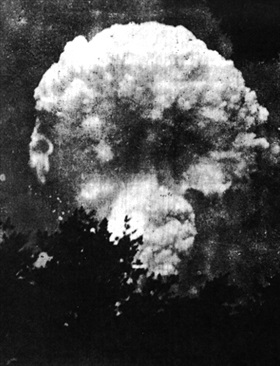
Left: Ground-level photograph of the Hiroshima radioactive mushroom cloud taken from approximately 4.3 miles/6.9 km northeast of ground zero, the commercial center and residential area of the city. “Little Boy,” as the uranium‑235 bomb was nicknamed, detonated 1,900 ft./579 m above the Shima Hospital and 550 yards/503 m from the bombardier’s aiming point, the Aioi Bridge. Three days later another mushroom cloud appeared over the city of Nagasaki, the product of “Fat Man,” as the plutonium‑239 bomb was called. Less than a minute after falling earthward, the bombs transformed both cities into rubble. (They also transformed the world, though very differently.) The following day Japan capitulated.
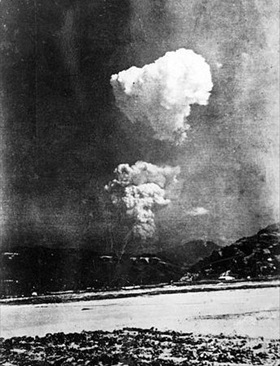
Right: Lost image found in Honkawa Elementary School in 2013 of the Hiroshima radioactive mushroom cloud, believed to have been taken 20–30 minutes after detonation from about 6.2 miles/10 kilometers east of ground zero. Some 400 Honkawa students and more than 10 teachers were victims of the bomb blast.
 |
 |
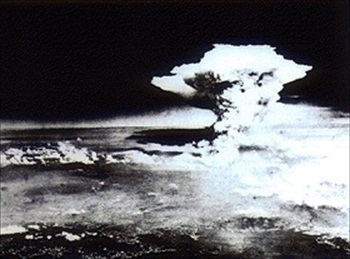
Left: The best-known photographs of the bomb’s aftermath were taken from the air by one of three B‑29s that left Tinian in the Mariana Islands in the predawn hours of August 6, 1945, for Hiroshima. This aerial photograph is less well known, taken about 1 hour after the atomic bomb detonated over Hiroshima. “Little Boy” was carried by the Enola Gay, a modified B‑29 Superfortress (configured to carry an atomic bomb) piloted by 30‑year‑old Col. Paul Tibbets, Jr. Tibbets had developed his flying skills as a pilot for the U.S. Eighth and Twelfth Air Forces over Europe and North Africa. In March 1943 Tibbets returned to the States to test-fly the new Superfortress, earning him the nickname “Mr. B‑29.”
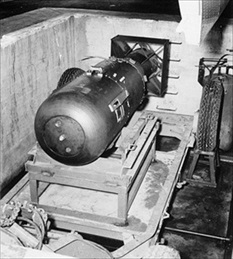
Right: At 120 inches/300 cm in length, 28 inches/71 cm in diameter, and weighing approximately 9,700 lb./4,400 kg, “Little Boy” lies on trailer cradle before being loaded into Enola Gay’s bomb bay. The plane’s forward bomb bay door is visible in the upper right-hand corner of the photo. Of the 131 lb./59 kg of uranium‑235 in the bomb, less than 2 lb./0.9 kg underwent nuclear fission. The force of the explosion was roughly equivalent to 15,000 tons/15 kilotons of TNT.
 |
 |
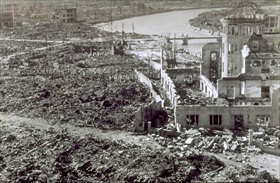
Left: The Hiroshima Chamber of Industry and Commerce Building was the only building remotely close to standing near the epicenter of the atomic bomb blast of August 6, 1945. Known today as the Genbaku (“Atom Bomb” in Japanese) Dome, it was left unrepaired as a reminder of the event. On December 7, 1996, the iconic Genbaku Dome was added to the UNESCO World Heritage List. It sits in a lush park, the Hiroshima Peace Memorial Park, surrounded by a city of 1 million people. For many visitors the memorial park and museum are hallowed ground, like a cemetery, because the ashes and bones of the bombing victims are literally underfoot in a thin white layer a few feet (about a meter) beneath the earth’s surface. A Children’s Peace Monument in the park was unveiled on Children’s Day, May 5, 1958, to commemorate the thousands of innocent young victims, but in particular of Sadako Sasak who at age 12 died of radiation-induced leukemia 10 years after “Little Boy” was dropped on Hiroshima.
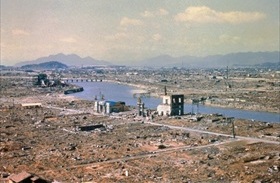
Right: Eight months after America’s ultimate weapon was dropped, Hiroshima still stands in ruins, the visible evidence of the world’s first use of nuclear weapons in war. Of the 68 cities bombed in the summer of 1945, Hiroshima was fourth in terms of square miles/km destroyed, 17th in the percentage of the city destroyed, but second in the number of civilian deaths.
Well-Done Documentary on the Atomic Bombing of Hiroshima and Nagasaki, August 6 and 9, 1945

World War II was the single most devastating and horrific event in the history of the world, causing the death of some 70 million people, reshaping the political map of the twentieth century and ushering in a new era of world history. Every day The Daily Chronicles brings you a new story from the annals of World War II with a vision to preserve the memory of those who suffered in the greatest military conflict the world has ever seen.