

TIZARD MISSION’S WAR-WINNING GIFT: CAVITY MAGNETRON
Washington, D.C. • September 8, 1940
On this date in 1940 the 7-member British Technical and Scientific Mission to the United States, or Tizard Mission as it was informally known, assembled in the nation’s capital. Sir Henry Tizard, brilliant visionary scientist and head delegate, had been in Washington, D.C., since August 22, meeting with notables, including President Franklin D. Roosevelt. Tizard’s immediate task: formulate ground rules for British and American scientists and their military advisors to exchange each nation’s treasured war-related research and development (R&D) secrets with the other. The British delegates brought with them what 1 American historian called “the most valuable cargo ever brought to our shores,” a single cavity magnetron that emitted 10‑centimeter wavelength signals, or radar waves. (Radar is the acronym for Radio Acquired Detection and Ranging.)
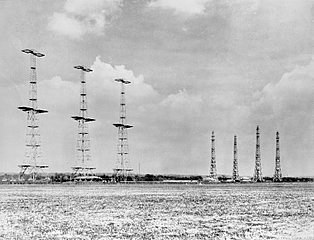
During the 1920s and ’30s British radar R&D had led Britain to deploy a chain of transmitter and receiver towers along its southern and eastern coastlines designed to detect incoming enemy aircraft as far out as 80 miles/150 km or more using radio wavelengths of between 10 and 13 meters, the famous Chain Home Network. Radio waves from the transmitter tower reflected off the incoming radar target (i.e., enemy aircraft) and returned to the receiver tower, providing crucial information about the target’s rough location and speed.
With the outbreak of World War II in Europe in September 1939, Tizard, chair of the national research committee that had orchestrated the development of British radar in the 1930s, came to the conclusion that his country, pressed by the immediate demands of war-related production, could not successfully engage its European adversaries without the industrial, scientific, and funding resources of the United States, then a neutral nation. His audacious suggestion that Britain hand over its most sacred technical and scientific secrets to the U.S. in exchange for American productive and research capacity was widely mocked until France and the Benelux countries, Britain’s continental allies, fell victim to Germany’s military juggernaut in May and June 1940. Prime Minister Winston Churchill conferred with his White House counterpart, President Roosevelt, and the two agreed that a joint delegation should explore the possibility of exchanging closely guarded secrets in Washington, D.C.
American and British scientists and their military advisors began discussions on September 12, 1940. As the days passed both sides became ever more comfortable sharing information about ways to advance radar technology. (Other topics apart from radar were discussed but are off topic here.) American radar experts lamented that they were at loose ends trying to find a high-power vacuum tube that was able to generate enough power (wattage) to make for a feasible centimeter-band radar system. On cue 2 Tizard delegates opened a wooden box they carried with them and pulled out an object small enough to fit in the palm of a hand—a super-secret resonant cavity magnetron, or simply cavity magnetron.
The British-made cavity magnetron was a high-power vacuum tube that controlled electric current flow. It served as an electronic oscillator, spitting out high-power pulses of microwave radio energy on a short wavelength of about 10 centimeters. The shorter the wavelength, the better the radar was at finding smaller objects. But the shorter wavelength needed more power to emit a coherent beam capable of traveling miles/kilometers to a target and back. The cavity magnetron was not only the key to making micrometer radar work, it carried the potential to bolster British—and by extension Allied—military capabilities across the board and give their armed forces the upper hand in what truly was a technological war.
The high-power pulses of radio energy generated from a device the size of a small book and transmitted from an antenna only centimeters in length reduced the size of practical radar sets by orders of magnitude. New micrometer radars appeared on aircraft and even the smallest escort ships, and from that point on the Allies of World War II held a lead in radar that their foes never closed.
Cavity Magnetron: One of the Keys to Allied Victory in World War II
 |
 |
Left: Chain Home (CH) Network’s long-wave radar installation at RAF Poling, Bawdsey Manor, Sussex, 1945. (In May 1936 Bawdsey Manor was the site of the first operational radar station in Great Britain.) On the left are 3 (originally 4) inline 360‑ft./100‑m steel transmitter towers that sent out pulses of radio energy. On the right are 4 240‑ft./73‑m wooden receiver towers that picked up the faint echo of enemy aircraft more than a 100 miles/160 km away. The CH Network was the world’s first comprehensive early warning radar system, which the British called radio direction finding (RDF), operating round-the-clock, rain or shine. Never had radar been used to blanket such a large area for air defense. Twenty-one CH stations covering most of the eastern and southern coasts of Great Britain, along with a complete ground network of thousands of miles/kilometers of private telephone lines, were ready by the time the European conflict erupted in 1939. Chain Home proved decisive during the Battle of Britain in 1940.
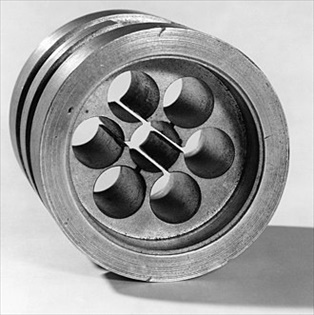
Right: This anode block was developed for the original 6‑cavity magnetron. Two physicists at the University of Birmingham in England looked into the problem of why current vacuum tubes provided insufficient power to be useful as a radar transmitter. By late February 1940 they had invented the much more powerful (resonant) cavity magnetron, which was fitted in an experimental radar by May 1940. Their first cavity magnetron prototype produced about 400 watts at 10‑centimeter wavelength, an extraordinary achievement. Within weeks engineers at Britain’s General Electric Company’s research laboratory had improved this to well over a kilowatt, and within months 25 kW, over 100 kW by 1941, and pushing towards a megawatt by 1943. By the end of the war in 1945, practically every Allied micrometer-band radar was based on a magnetron.
 |
 |
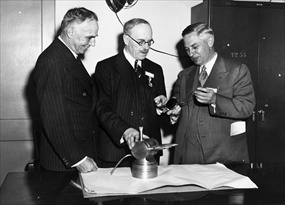
Left: (l-r) Sir Henry Thomas Tizard, Alfred L. Loomis, and Lee Alvin-DuBridge examine a cavity magnetron on a table. Loomis was chairman of the 2-month-old U.S. National Defense Research Committee. On September 29, 1940, he was present when Edward George Bowen, the young Welsh radar expert on Tizard’s mission, carefully revealed to his American counterparts the diminutive cavity magnetron, one of the first 12 production copies of Britain’s mysterious radar transmitter. Standing to Loomis’s right is Alvin-DuBridge, who became the director of Massachusetts Institute of Technology’s Radiation Laboratory (“Rad Lab”), the cover name to disguise its true identity as a radar R&D facility.
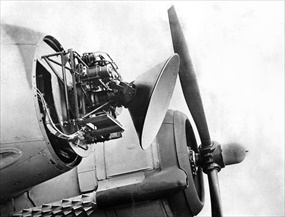
Right: The reasons the diminutive cavity magnetron was so vital to Britain’s survival during the early years of the European conflict were its compactness and power. Placed inside the nose of an RAF fighter-interceptor, for instance, a 10‑centimeter pulse in miniaturized airborne-interception (AI) radar systems would be sharp, losing little concentration as it made its way to a fast-approaching enemy aircraft and bounced back. Longer radio waves in the multimeter range like that of the Chain Home Network could only detect large fields of enemy aircraft, but a micrometer beam possessed the resolution to pick out small objects like a single aircraft or several aircraft—even a U‑boat periscope or sea mines—for successful interception.
Battle Stations: Radar in World War II Documentary

World War II was the single most devastating and horrific event in the history of the world, causing the death of some 70 million people, reshaping the political map of the twentieth century and ushering in a new era of world history. Every day The Daily Chronicles brings you a new story from the annals of World War II with a vision to preserve the memory of those who suffered in the greatest military conflict the world has ever seen.