

STRIKE INTO NAZI HEARTLAND SLOWED AT AACHEN
Near Aachen on Franco-German Border • October 2, 1944
After a rapid overland drive through France following their Normandy breakout (July 25–31, 1945), the Western Allies approached the Siegfried Line, or West Wall, the extensive defensive network on Nazi Germany’s western border. The Battle of Aachen from September 12 to October 21, 1944, became one of the U.S. Army’s largest and toughest urban battles of World War II. The ancient and picturesque capital of Charlemagne’s Holy Roman Empire had been incorporated into the Siegfried Line; the Allies hoped to capture their first city on German soil quickly and advance into the Ruhr basin, Germany’s right-bank industrial heartland in today’s North Rhine-Westphalia.
On this gray and dismal morning, October 2, 1944, Maj. Gen. Leland S. Hobbs’s 30th Infantry Division left its line of departure for Aachen, 10 miles/16 kilometers to the west. Their advance was immediately met with fierce German resistance, requiring extensive use of flamethrowers to snuff out die-hard German defenders as well as explosives to clear reinforced concrete pillboxes. Progress was slow and costly despite the U.S. Ninth Air Force bombing and strafing enemy positions wave after wave augmented by divisional heavy artillery at point-blank range.
The task of capturing the city itself, mostly devoid of its civilian population, fell to the 26th Infantry Regiment. Endowed with enormous symbolic importance dating to the ninth century, Aachen fostered fanatical resistance among its defenders. Cautiously American infantrymen advanced into the city, supported by M4 Sherman tanks or M10 tank destroyers and other armored vehicles, towed 155 mm/6.1 in. “Long Tom” howitzers, Browning M1919 machine guns, bazookas, flamethrowers, and other deadly hardware.
Aachen’s urban environment required a slow, deliberate sledgehammer approach. Tank-infantry teams—i.e., an M4 Sherman supported by a platoon of infantrymen fitted out with satchel charges—would blast open a building, infantry would step through the gaping hole(s), climbing up and down stairs to attics and cellars and floors in between, and use grenades or flamethrowers to eliminate anyone not surrendering. This went on from building to building, block after shattered block. For overcoming hardened urban defenses like bunkers, the approach was known as “knock ’em all down.” A 90‑pound round fired by a “Long Tom” against a bunker wall resulted in defenders inside suffering massive headaches and bleeding from eyes, nose, and ears before they waved the white flag or were killed if they took flight. Smaller bunkers were taken out by grenades tossed through rifle slits in their walls.
The “meat grinder” aspect of the Battle of Aachen is perhaps best illustrated in a comparison of numbers: 100,000 attacking Allied soldiers vs. 18,000 enemy defenders, of which 500 were police officers, 5,000 home militia (Volkssturm), and much of the remainder Col. Wilck’s 246th Volksgrenadier Infantry Division. Many men in the 246th had less than 10 days infantry training. Both adversaries took heavy casualties: 7,000 of which 2,000 were KIAs on the American side, an estimated 5,100 dead and wounded on the German side just in Aachen itself. The high numbers of German casualties and enemy taken prisoner (5,600, of which nearly 3,500 were captured within the city) relative to their number at start of combat is poignant and attests to the brutal nature of urban warfare when the odds in manpower, equipment, and aircraft were overwhelmingly stacked in favor of the Allies.
Unfortunately, the 5½‑week battle for Aachen threw a monkey wrench into the Allies’ timetable to capture the Ruhr industrial complex and thus cripple the enemy’s war-making capability. And before that could happen there was the pesky matter of wresting control of a series of Roer River dams behind the Huertgen Forest, a short distance southwest of Aachen, that stood in the Allies’ way to a Rhine River crossing and the Ruhr beyond. The 6‑month Battle of the Huertgen Forest would turn out to be the longest single battle the U.S. Army ever fought.
Battle of Aachen: Urbanized Meat Grinder for U.S. and German Armies
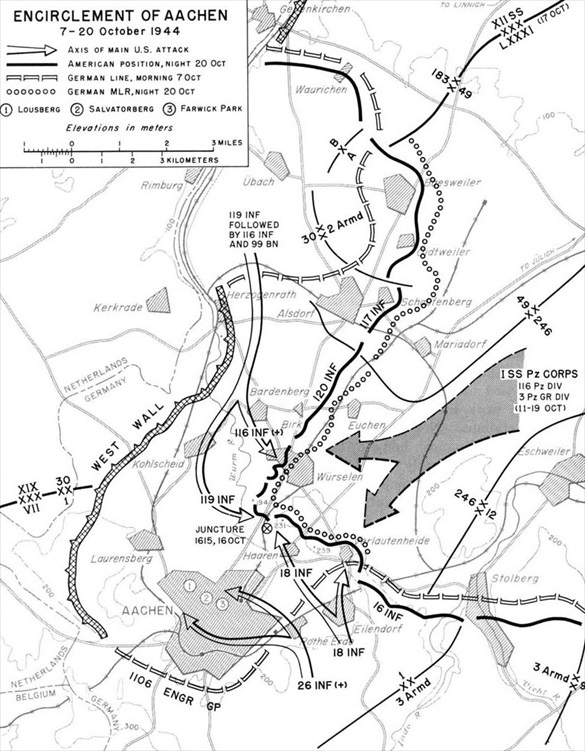
Above: Map of U.S. encirclement of Aachen, the first important city on German soil to fall to the advancing Western Allies, who launched attacks from multiple directions (see arrows). Aachen was one of the largest urban battles fought by U.S. forces in World War II. Though the battle for the city (October 2–21, 1944) ended in Aachen’s capitulation, the Germans’ tenacious defense significantly disrupted Allied plans to advance into Germany.
 |
 |
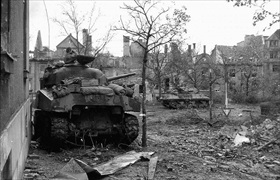
Left: The commander of an M4 Sherman tank looks through binoculars from his turret hatch on the day before the city of Aachen fell. The tanks mounted an extra .50 caliber machine gun in front of the turret, useful in street fighting for suppressing fire from upper-story windows. In the distance is an M10 tank destroyer, a lightly armored vehicle sporting a 3 in./76.2 mm gun and a fully rotating, open-topped turret specifically designed to take out enemy tanks. In 1 2‑day period (October 9–10) the 30th Infantry Division claimed 20 German tanks: 12 destroyed by 105 mm howitzers, 5 by supporting tanks and tank destroyers, and 3 by bazookas.
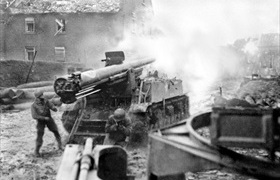
Right: American urban tank-infantry teams fire a powerful M12 155 mm/6.1 in. Motor Carriage “Door Knocker” gun for heavy direct fire against fortified German positions on Aachen’s streets in October 1944. These weapons were used to clear out German bunkers when tank fire proved ineffective. With bitter experience as a teacher, GIs assumed every building, cellar, air-raid shelter, and sewer was occupied by hostile forces. Light artillery and mortar fire thus swept enemy streets ahead of advancing infantrymen, who made proactive use of demolition charges, flamethrowers handled by 2‑man teams, bazookas, and grenades. The Battle for Aachen was remembered by 1 soldier as a fight “from attic to attic and sewer to sewer.”
 |
 |
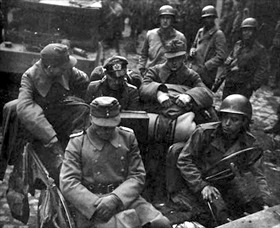
Left: Col. Gerhard Wilck (sitting in front passenger seat, head bowed) and his headquarters group after their surrender. On the afternoon of October 19, 1944, Wilck, who commanded the 246th Volksgrenadier Infantry Division, which had taken responsibility for this sector of the Siegfried Line, issued a written order of the day: “The defenders of Aachen will prepare for their last battle. Constricted to the smallest possible space, we shall fight to the last man, the last shell, the last bullet, in accordance with the Fuehrer’s orders. . . . I expect each and every defender of the venerable Imperial City of Aachen to do his duty to the end, in fulfillment of our Oath to the Flag. . . . Long live the Fuehrer and our beloved Fatherland!” Fanatical exhortations like this one did little to forestall the city’s tragic end. On October 19 and 20 resistance swiftly collapsed inside and outside Aachen. Their bags already packed and ready to go, Col. Wilck and his staff surrendered to the Americans on October 21, 1944, the colonel ceremonially handing over his sidearm to his captors.
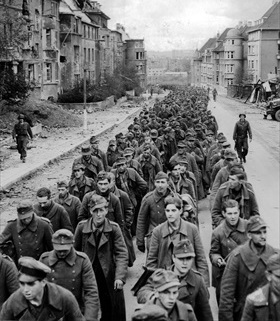
Right: The endless procession of German prisoners captured in the fall of Aachen march through ruined streets into captivity. Civilians who witnessed their homes reduced to rubble by advancing Americans and well-entrenched German defenders heaped abuse on their exhausted countrymen as they passed by, causing American soldiers to occasionally separate the 2 groups. Eighty-five percent of Aachen was destroyed when captured. “The city is as dead as a Roman ruin,” wrote a U.S. observer, “but unlike a ruin it has none of the grace of gradual decay. . . . Burst sewers, broken gas mains and dead animals have raised an almost overpowering smell in many parts of the city. The streets are paved with shattered glass; telephone, electric light and trolley cables are dangling and netted together everywhere, and in many places wrecked cars, trucks, armored vehicles and guns litter the streets.”
Contemporary Newsreel Account of Battle for Aachen, October 1944

World War II was the single most devastating and horrific event in the history of the world, causing the death of some 70 million people, reshaping the political map of the twentieth century and ushering in a new era of world history. Every day The Daily Chronicles brings you a new story from the annals of World War II with a vision to preserve the memory of those who suffered in the greatest military conflict the world has ever seen.