

SOVIETS K.O. JAPANESE AT KHALKHYN GOL
Moscow, Soviet Union · August 20, 1939
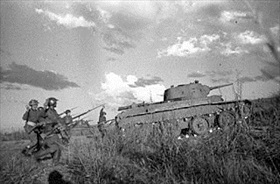
The Soviet Union and Japan, two expansionist powers that occupied portions of the Asian mainland north of China, butted heads in the Mongolian borderlands as early as 1929. (They had also fought a war in 1904–1905, the Russo-Japanese war, over influence in China, Mongolia, and Manchuria, the latter country rich in coal, iron, and grains and with warm water ports in the northeastern-most part of China.) On this date in 1939, days before the German invasion of Poland, the two nations began a massive ten-day tank battle near the Mongolian Khalkha River (also known as Khalkhyn Gol)—the largest tank battle the world had yet seen and arguably the first decisive battle of the Second World War. Soviet forces were commanded by a then unknown Georgy Zhukov, who, now newly promoted to general, would become in a few short years a military legend for spearheading the Soviet assault on Nazi Germany and formally accepting Germany’s unconditional surrender in the spring of 1945. (Ironically, Zhukov was one of two Soviet generals who coordinated the Soviet armies at the Battle of Kursk, the largest tank battle in history, in July 1943.) The defeat of Japanese forces in the Battle of Khalkhyn Gol (known in Japan as the “Nomonhan Incident”) had the most profound implications on the conduct of World War II. Since 1937 Japan had been engaged in a protracted, knockdown drag-out fight in China, which lay to the south of Japan’s puppet state of Manchukuo (Manchuria). The stunning Soviet victory, followed by a ceasefire on September 15, 1939, and then an agreement between the two belligerents to respect the borders of Mongolia and Manchukuo, persuaded expansionist circles in Tokyo (particularly the Imperial Japanese Navy) to look to Southeast Asia, where they saw the United States, Britain, and France—all of which had resource-rich but ill-defended possessions there—as weaker opponents than the Soviets on the Asian mainland. The strategic change in course for Japan, which the Battle of Khalkhyn Gol prompted, eventually led to a change in Japan’s expansionist fortunes, beginning with the attack on the Philippines, the Dutch East Indies (Indonesia), British Malaya (Malaysia), and the American possession of Hawaii on December 7 and 8, 1941. The strategic change in course also foreshadowed Japan’s downfall.
[fblike]
[amazon_carousel widget_type=”ASINList” width=”600″ height=”200″ title=”Recommended Reading” market_place=”US” shuffle_products=”False” show_border=”False” asin=”1105650146,1137270357,0312164548,0801451809,159114339X,1906959234,0801495296,0679753036,0804718350,0859791521″ /]
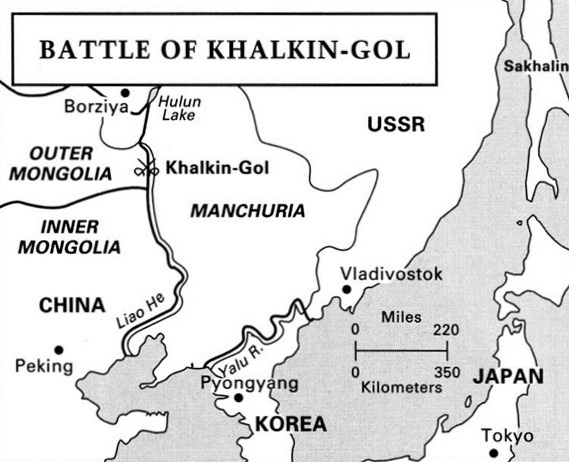
Battles of Khalkhyn Gol: The Soviet Union versus Japan, May to September 1939
 |
 |
Left: The four-month conflict was named after the River of Khalkh (Khalkhyn Gol), which flows through the battlefield. In Japan the conflict is known as the “Nomonhan Incident,” named after a nearby village on the border between Mongolia (sometimes informally called Outer Mongolia) and Japanese-occupied Manchuria (Manchukuo).
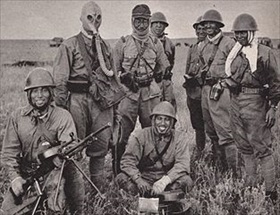
Right: Japanese soldiers pose with captured Soviet equipment during one of the Battles of Khalkhyn Gol. After the occupation of Korea (1905) and Manchuria (1931), Japan’s military leaders in China, essentially army leaders, focused expansionist aims on Soviet Mongolia and Siberia, and conflicts occurred frequently on the Manchurian border from mid-1929 onward. The army’s aggressive plans on the Asian mainland sometimes caught the civilian government in Tokyo by surprise, as the 1931 “Mukden Incident” (also known as the “Manchurian Incident”) in northern China showed.
 |
 |
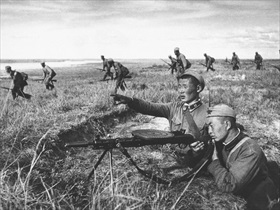
Left: Mongolian People’s Army soldiers fight against Japanese soldiers, Khalkhyn Gol, 1939. The Mongolian People’s Republic was proclaimed in November 1924 after Soviet troops expelled White Russian and Chinese forces from Mongolia. Mongolia then became a de facto puppet state of the Soviet Union.
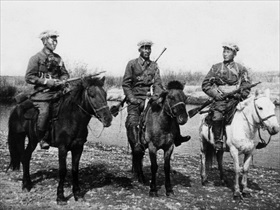
Right: Mongolian cavalry during the Battle of Khalkhyn Gol, 1939. After Soviet and Mongolian armed forces had defeated Japanese forces in the summer of 1939, the warring parties entered into a truce, set up a commission to define the Mongolian-Manchurian border later in the year, and entered into a neutrality pact.
 |
 |
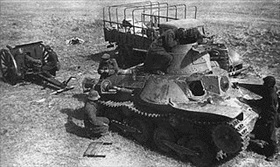
Left: A Japanese light tank (Type 95 Ha-Go) captured by Soviet troops after the Battle of Khalkhyn Gol. Six years later, on August 9, 1945, Soviet forces invaded Manchuria (Manchukuo). The rapid defeat of Japan’s Kwantung Army, as its army on the Chinese mainland was called, was a significant factor in Japan’s surrender. Japanese leaders imagined the Red Army in Manchuria as poised to invade the Home Islands with boots on the ground, while the Americans were viewed as perfectly content to continue incinerating Japan from above.
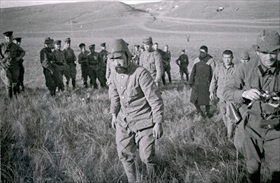
Right: Captured Japanese soldiers, Khalkhyn Gol, August 1939. Khalkhyn Gol resulted in total defeat for the Japanese Sixth Army, a garrison force based in Manchukuo under the overall command of the Kwantung (Japanese) Army.
Contemporary Accounts of the Soviet-Japanese Conflict in Manchuria During World War II

World War II was the single most devastating and horrific event in the history of the world, causing the death of some 70 million people, reshaping the political map of the twentieth century and ushering in a new era of world history. Every day The Daily Chronicles brings you a new story from the annals of World War II with a vision to preserve the memory of those who suffered in the greatest military conflict the world has ever seen.