

SOVIET UNION DECLARES WAR ON JAPAN
Moscow, Soviet Union • August 8, 1945
On this date the Soviet Union declared war on Japan, the last Axis hold-out after the Soviets and their Western Allies had vanquished Nazi Germany and Fascist Italy. U.S. President Franklin D. Roosevelt and British Prime Minister Winston Churchill had long urged Soviet Premier Joseph Stalin to join the West in tightening the noose around the necks of Tokyo’s warlords. Stalin’s hand on the hemp necktie in exchange for guarantees of Far Eastern booty agreed to at 2 Big-Three Conferences (November 1943 and February 1945) pushed the avaricious Soviet dictator in April 1945 to tell Japan’s leaders that he would not be extending their countries’ mutual neutrality pact, which still had a year to run. While Stalin furiously worked to strengthen his military presence in the Far East by shifting an additional 40 Soviet divisions along with some 500 new Sherman tanks, a gift from the United States, to the Mongolian and Manchurian borders, his diplomats assured the nervous Japanese they had nothing to worry about during the next 12 months.
Stalin’s duplicitous game doomed Japan’s hope that the Soviets would act as a disinterested third party in negotiating an end to hostilities short of unconditional surrender as demanded by the Western powers. Now Japanese war planners looked at their calendars to forecast when the Soviet onslaught would strike Japan’s puppet state on the Chinese mainland, Manchukuo (Manchuria). August or September maybe, or even earlier? Psychologically and militarily Japan was nowhere near prepared for a massive Soviet invasion of its mainland and ancillary possessions.
On August 9, 1945, the Soviets began their Manchurian offensive (Soviet name, Manchurian Strategic Offensive Operation; in the West, Operation August Storm). It was a gigantic pincer movement by 3 fronts, the equivalent of 3 Western army groups. Land and air forces consisted of 1.5 million well-armed, battle-hardened men from Europe’s Eastern Front: 76 or 89 divisions equipped with 3,704 or 4,500 tanks, 1,852 self-propelled guns, 85,819 vehicles, and 3,721 or 4,300 aircraft (sources differ for every listed category). Naval forces consisted of 12 major surface vessels, 78 submarines, numerous amphibious craft, and a river flotilla of gunboats and small craft.
Soviet forces easily swept aside Japan’s depleted Kwantung Army of occupation and its second-rate Manchukuoan allies. In the case of Manchukuoan soldiers, many melted away into the interior or mutinied rather than defend Japanese convoys and Manchurian, Northeast Chinese, and Korean territories. Most of the Kwantung Army’s best armored and elite infantry units, along with heavy military equipment, modern antitank weaponry, and stocks of ammunition, were absent from the mainland, having been transferred to the Pacific Theater over the previous 3 years in a futile attempt to reverse the tide of Allied victories.
By August 21, 1945, the Red Army had secured the ultimate objectives of its campaign, including Changchun (Xinjing or Hsinking during Japan’s occupation), capital of Manchukuo and headquarters of the Kwantung Army. The Japanese High Command had already announced the capitulation of the Kwantung Army 5 days earlier. For all practical purposes, organized resistance ceased after August 21. What remained was collecting prisoners, disarming Japanese and Manchukuo units, and occupying central and southern Manchuria.
With Japan’s September 2, 1945, surrender pending, the Red Army staked claims to half the Korean Peninsula. The Soviets dispatched some 8,000 soldiers across 500 nautical miles/926 kilometers of sea to the Kuril archipelago, where combat operations ended on August 21. Sakhalin Island opposite Soviet Siberia, which Japan and the Soviet Union shared, was secured on August 26. In Manchuria and the island operations, the Soviets claimed to have killed, wounded, or captured 674,000 Japanese troops at a cost to the Red Army of 12,031 dead and 24,424 sick or wounded. Japan claimed 21,389 killed, but the true figure likely exceeds 80,000.
Catching Japan Unawares: Sudden Soviet Strike in August 1945 Ends Manchukuo’s Short Existence
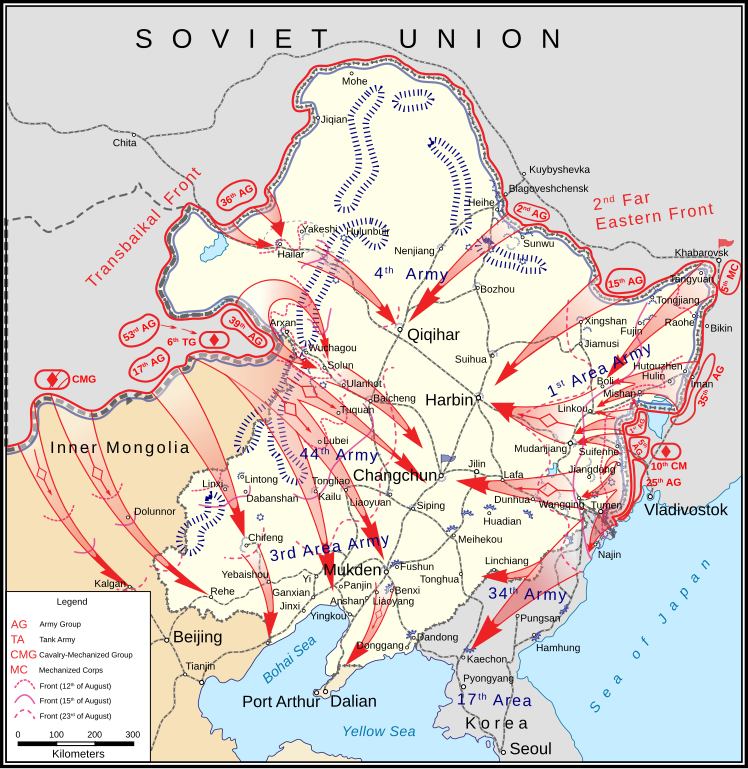
Above: Map showing most of the extent of Operation August Storm (August 9–20, 1945), known by the Soviets as the Manchurian Strategic Offensive Operation or more simply as the Manchurian Operation. The invading forces primarily targeted Japanese-occupied Manchuria (Japanese-puppet state of Manchukuo), an area of 600,000 sq. miles/1.55 billion sq. kilometers in Northeast China. Red Army forces also swept onto the Korean Peninsula, halting at the 38th parallel (today’s boundary between North and South Korea), the Kuril Islands that form an archipelago from Hokkaido, Japan’s northernmost home island, to the Soviet Union’s Kamchatka Peninsula, and the whole of Sakhalin Island opposite Soviet Siberia. (Captured islands not shown on this map.)
 |
 |
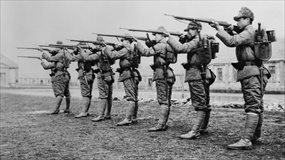
Left: New recruits of the Japanese-trained Manchukuo Imperial Army blaze away at rifle practice before being sent to the Siberian border in July 1945. The army, raised from local Chinese collaborators, numbered between 170,000 and 220,000 men at its peak in 1945 but possessed neither the will nor the means to give much combat support to the Japanese army of occupation—the Kwantung Army. Soldiers of the Manchukuo Imperial Army, volunteers and conscripts, were considered to be mostly unreliable by their Japanese officers and advisers due to poor training and low morale. In the face of cascading Soviet advances in Manchukuo in August 1945 a weeklong series of mutinies broke out in the capital, Changchun. In revenge for the years of brutal treatment a number of Manchukuoan soldiers killed their Japanese officers. A minority of Manchukuoan regulars and auxiliaries remained loyal and continued to fight on alongside the Japanese.
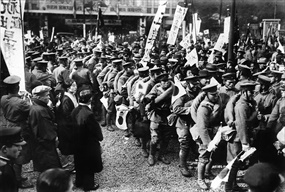
Right: Japanese reinforcements depart for the Manchurian front following the Soviet invasion, which came several months before the Japanese had expected it. The Kwantung Army—estimated by the Soviets to number over a million men had an actual strength of 713,724 second-line troops organized into 24 infantry divisions, 9 infantry brigades, and 2 tank brigades. The so-called Manchukuo Imperial Army numbered 170,000 men. Also aiding the Japanese were 44,000 cavalry troops in Inner Mongolia. Elsewhere in the theater—in Korea, Sakhalin Island, and the Kurils—the Japanese forces numbered 289,000 men. Most of the remaining divisions of the Kwantung Army were newly formed from reservists, conscripts, and troops cannibalized from other units. Training was extremely limited in all units, and equipment and material shortages plagued Japanese and collaborationist forces at every level.
 |
 |
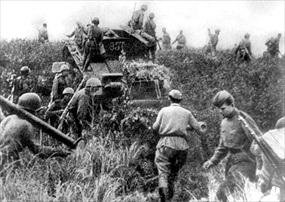
Left: Soviet troopers invade Manchuria on Day 1, August 9, 1945. Soldiers here follow in the wake of an armored vehicle towing an artillery piece up a sharp incline. The Soviet invasion of Japanese-occupied Manchuria was not done as a favor to Stalin’s Western Allies who dearly wanted assistance in ending the Pacific War quickly and expeditiously. Instead, it was Stalin’s modus operandi of extending Soviet military and geopolitical hegemony over new swatches of the Asia-Pacific region and reclaiming what his country had lost in decades past. Stalin did it all in a Blitzkrieg reminiscent of Nazi Germany.
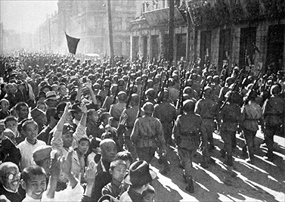
Right: Soldiers of the 2nd Far East Front, 1 of 3 Soviet Fronts (army groups) that invaded Manchukuo, stream into captured Harbin on August 21, 1945. In time roughly 700,000 Soviet troops occupied the former Japanese puppet state out of nearly 2 million who saw service in the Far East. Harbin, like other major population centers in Manchuria, became a center of Soviet looting and mass rape of Japanese women, including underage girls who were also considered to be war spoils. Over a half-million Japanese troops and able-bodied Japanese men in Manchuria were taken prisoner and transported to labor camps in Siberia, the Soviet Far East, and Mongolia, where many would die. Some 30,700 non-Japanese soldiers (chiefly Chinese and Koreans) also became prisoners of war. Those who survived their captivity were repatriated in stages over the next 5 years, though some continued to be held well into the 1950s.
Soviet Colossus Nails Shut Imperial Japan’s Coffin

World War II was the single most devastating and horrific event in the history of the world, causing the death of some 70 million people, reshaping the political map of the twentieth century and ushering in a new era of world history. Every day The Daily Chronicles brings you a new story from the annals of World War II with a vision to preserve the memory of those who suffered in the greatest military conflict the world has ever seen.